
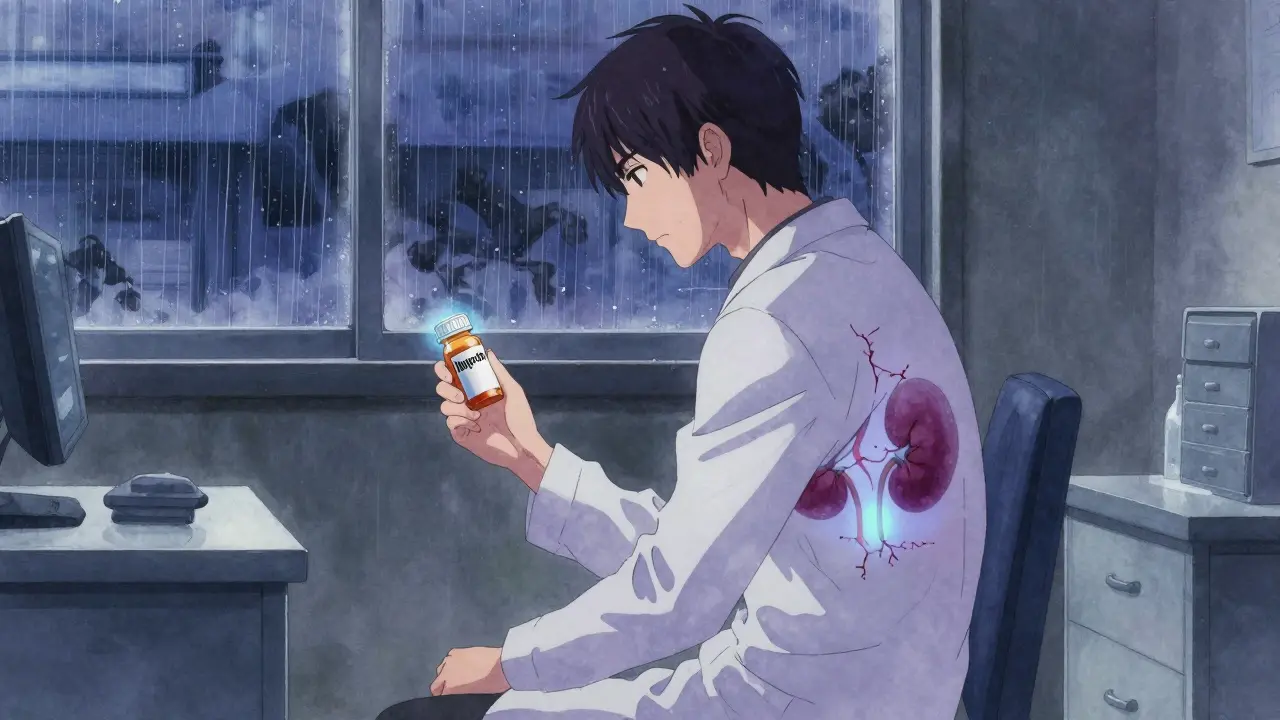
Most people think of painkillers as harmless, everyday tools-pop a couple of ibuprofen for a headache, take acetaminophen for back pain, grab an Excedrin when a migraine hits. But what if those pills, taken daily for years, were quietly damaging your kidneys? This isn’t hypothetical. It’s called analgesic nephropathy, and it’s one of the most preventable causes of chronic kidney disease you’ve never heard of.
What Exactly Is Analgesic Nephropathy?
Analgesic nephropathy is kidney damage caused by long-term, heavy use of pain medications-especially NSAIDs like ibuprofen, naproxen, and aspirin, and sometimes acetaminophen. It’s not about one bad dose. It’s about years of taking 6, 8, even 10 pills a day. The kidneys, which filter your blood and regulate fluid balance, get overwhelmed. The result? Scarring in the inner parts of the kidneys, especially around the papillae-the tiny structures that help concentrate urine. Over time, this leads to chronic tubulointerstitial nephritis, reduced kidney function, and sometimes, end-stage kidney disease.
Back in the 1970s and 80s, this condition exploded in Australia and the U.S. because of combination painkillers packed with phenacetin, a now-banned ingredient. Phenacetin was common in over-the-counter headache remedies, often mixed with aspirin, caffeine, and codeine. Back then, up to 10% of all end-stage kidney disease cases in Australia were linked to these pills. Today, phenacetin is gone-but the problem hasn’t disappeared. NSAIDs and acetaminophen are still the main culprits.
How Do Painkillers Actually Hurt Your Kidneys?
Your kidneys need steady blood flow to work. NSAIDs block enzymes called COX-1 and COX-2, which help keep blood vessels in the kidneys open. When you take these drugs regularly, especially in high doses, your kidneys don’t get enough blood. This triggers a chain reaction: less oxygen, more oxidative stress, and eventually, cell death in the renal papillae. The damage starts silently. You won’t feel it. No pain. No warning.
By the time symptoms show up-swelling in your legs, fatigue, high blood pressure, or blood in your urine-the damage is often advanced. Early signs are subtle: a slightly elevated creatinine level on a routine blood test, or a drop in your GFR (glomerular filtration rate), which measures how well your kidneys filter waste. Many people don’t realize anything’s wrong until their doctor says, “Your kidneys aren’t working like they should.”
Here’s the scary part: a 2020 study in Kidney International Reports found that people who took more than 4,000 mg of acetaminophen daily for five years or more had a 68% higher risk of developing chronic kidney disease compared to non-users. And NSAIDs? Even at standard doses, they can cut kidney blood flow by 25-40%. At overdose levels, that jump to 50-70%.
Who’s Most at Risk?
You might think this only affects older adults or people with existing health problems. But the truth is, it’s hitting middle-aged women hardest. About 72% of diagnosed cases are women between 35 and 55. Why? Many are managing chronic headaches, menstrual pain, or arthritis with daily painkillers. They’re not addicts. They’re moms, teachers, nurses-people trying to keep up with life.
Other high-risk groups include people with:
- High blood pressure
- Diabetes
- Already reduced kidney function
- Heart failure or liver disease
- Those taking multiple painkillers at once (like Excedrin, which combines acetaminophen, aspirin, and caffeine)
And here’s what most people don’t know: combination pills are 3.7 times more dangerous than single-ingredient ones. Caffeine and codeine don’t help the pain-they make the kidney damage worse.

Diagnosis: Silent Damage, Detectable Signs
There’s no single test for analgesic nephropathy. Diagnosis is based on history, symptoms, and imaging. A noncontrast CT scan can show calcifications in the renal papillae-with 87% sensitivity and 97% specificity. But by the time those show up, damage is already significant.
More useful are routine blood and urine tests:
- High serum creatinine
- Low GFR (below 60 mL/min for 3+ months)
- Bland urinary sediment (no red blood cells or casts)
- Non-nephrotic proteinuria (protein in urine, but less than 3.5 grams per day)
- Sterile pyuria (white blood cells in urine without infection)
And now, there’s a new tool: the FDA-approved NephroCheck urine test, launched in January 2023. It detects early signs of renal papillary damage with 92% sensitivity. This isn’t in every doctor’s office yet-but it’s changing the game.
The Real Shock: Most People Don’t Believe It’s Real
On patient forums like HealthUnlocked and Reddit’s r/kidneydisease, the same story keeps popping up:
“I took 8-10 Excedrin Migraine tablets a day for seven years. I thought it was just my headache. My nephrologist said I was lucky my GFR didn’t drop below 30. Many people need dialysis from this.”
That’s from a Reddit user who posted in March 2023. A 2022 Cedars-Sinai survey found that 62% of patients diagnosed with analgesic nephropathy didn’t believe over-the-counter meds could hurt their kidneys. They thought, “It’s just Tylenol.” Or, “I’m not taking a lot.” But “a lot” isn’t what you think. Six pills a day for three years equals more than 6,500 pills. That’s over two kilograms of analgesics-exactly the threshold linked to kidney damage.
What Can You Do Instead? Safer Pain Relief That Actually Works
Stopping NSAIDs cold turkey isn’t easy-especially if you’ve been relying on them for years. But there are better ways to manage pain without risking your kidneys.
1. Start with Non-Drug Options
The American College of Rheumatology recommends trying non-pharmacological approaches for at least 4-6 weeks before reaching for pills:
- Physical therapy for back, knee, or joint pain
- Cognitive behavioral therapy (CBT) for chronic headaches and migraines
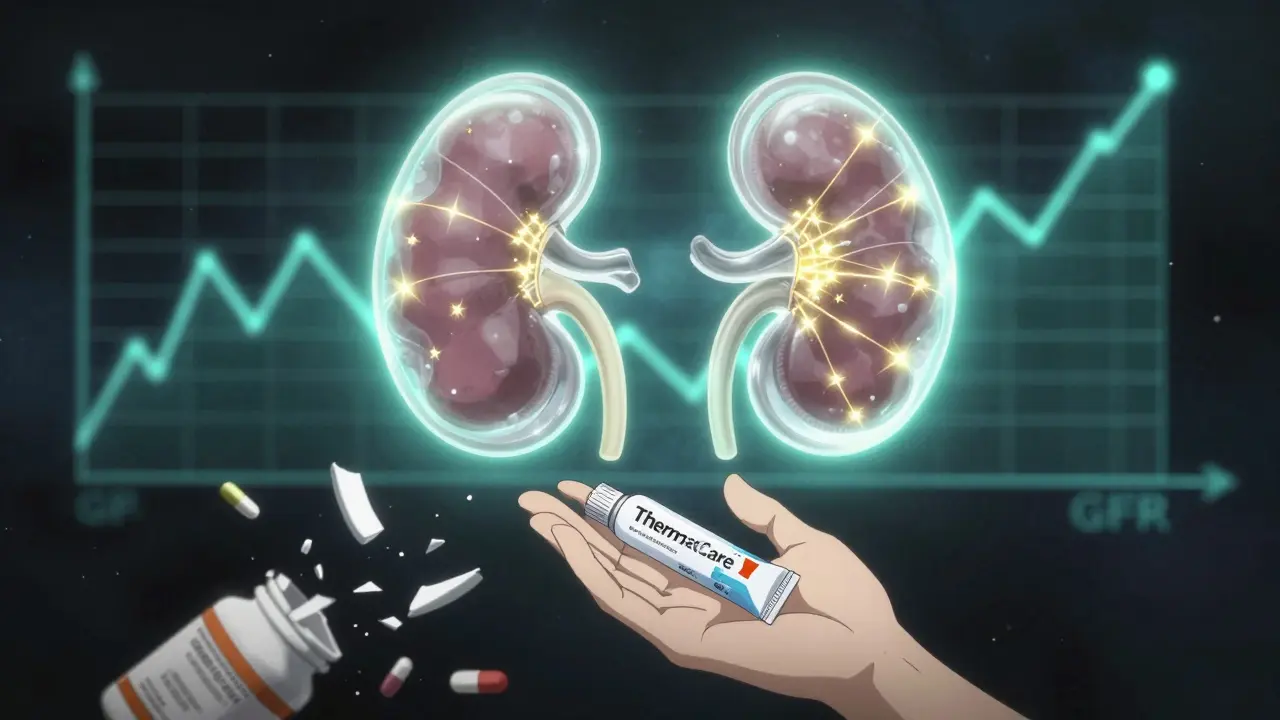
- Heat therapy: ThermaCare HeatWraps reduce osteoarthritis pain by 40-60% with zero kidney risk
- Acupuncture and massage therapy, proven effective in multiple studies for chronic pain
2. If You Need Medication, Choose Wisely
Topical NSAIDs are a game-changer. A 2021 study in Arthritis & Rheumatology showed that gels and patches deliver the same pain relief as oral pills-but with 90% less drug entering your bloodstream. No kidney stress.
For headaches or mild pain, acetaminophen is still the least harmful option-but only if you stay under 3,000 mg a day. That’s six 500 mg tablets. Not eight. Not ten. And never mix it with alcohol.
For migraines, new prescription drugs like CGRP inhibitors (e.g., Aimovig, Emgality) work without touching the kidneys. They cost about $650 a month, but for people with kidney risks, they’re worth it.
3. Know Your Limits
Here’s what the FDA and National Kidney Foundation say:
- Don’t take NSAIDs daily for more than 10 days without seeing a doctor
- Never exceed 3,000 mg of acetaminophen per day
- Don’t take more than 1,200 mg ibuprofen or 750 mg naproxen daily for chronic pain
- Check all your meds-many cold and flu pills contain hidden NSAIDs or acetaminophen
- Get your creatinine checked every 6 months if you’re on chronic pain meds
Can You Reverse the Damage?
Yes-if you catch it early. A 2022 study in the Clinical Journal of the American Society of Nephrology followed 142 patients who stopped taking painkillers right after diagnosis. After five years, 73% had stabilized kidney function. No further decline. No dialysis. Just stopping the meds and letting their bodies heal.
But if you wait until your GFR drops below 30, the damage is usually permanent. That’s why early detection matters more than you think.
The Bigger Picture: Why This Isn’t Just Your Problem
Analgesic nephropathy adds 15,000-20,000 new chronic kidney disease cases to the U.S. system every year. That’s 2-3% of all CKD cases. The cost? $18,500 per patient per year for early treatment. $90,000 if you end up on dialysis.
Manufacturers are responding. Bayer and Johnson & Johnson have reformulated combination products to cut caffeine and lower acetaminophen content. The FDA now requires kidney risk warnings on all NSAID labels. But education is lagging. A 2023 CDC report found 41% of American adults still exceed safe NSAID limits. Among people with chronic pain? That number jumps to 67%.
This isn’t just about individual choices. It’s about how we treat pain in modern society. We’ve normalized pills as the first-and only-solution. But pain doesn’t have to be managed with damage.
What You Should Do Right Now
If you take painkillers regularly, here’s your action plan:
- Count how many pills you take per week. Write it down.
- Check the labels. Are you taking more than one product with acetaminophen or NSAIDs?
- Call your doctor. Ask for a serum creatinine test and GFR calculation.
- If your GFR is below 70, ask about alternatives: topical NSAIDs, physical therapy, heat wraps.
- Set a hard cap: no more than 3 days a week of NSAIDs without talking to your doctor.
- Never take more than 3,000 mg of acetaminophen in a day.
You don’t need to suffer. But you do need to be smart. Your kidneys can’t tell you they’re in trouble. You have to listen to the numbers-and act before it’s too late.
Can over-the-counter painkillers really cause kidney damage?
Yes. Taking NSAIDs like ibuprofen or naproxen daily for three or more years, or more than 4,000 mg of acetaminophen daily for five years, significantly increases the risk of chronic kidney disease. This is called analgesic nephropathy. It’s not rare-it’s preventable.
Is acetaminophen safer than NSAIDs for the kidneys?
Acetaminophen is generally less harmful to kidneys than NSAIDs, but it’s not risk-free. Daily use above 3,000-4,000 mg for several years can still lead to kidney damage. The key is dose and duration. Even "safe" drugs become dangerous when used too long or too often.
What are the early warning signs of kidney damage from painkillers?
There are often no symptoms at first. The first clue is usually an abnormal blood test-elevated creatinine or low GFR. Later signs include swelling in the legs, unexplained fatigue, high blood pressure, or blood in the urine. If you take painkillers daily and feel fine, that doesn’t mean your kidneys are fine.
Can I still use ibuprofen if I have high blood pressure?
It’s strongly discouraged. NSAIDs raise blood pressure and reduce kidney blood flow-two risks that feed each other. If you have high blood pressure, ask your doctor about topical NSAIDs, physical therapy, or acetaminophen (within safe limits). Avoid daily oral NSAIDs entirely.
Are there any new pain relief options that don’t hurt the kidneys?
Yes. Topical NSAID gels and patches reduce systemic exposure by 90%. Heat wraps like ThermaCare work well for arthritis. For migraines, CGRP inhibitors (e.g., Aimovig) are effective and kidney-safe. CBD products show no kidney harm in early studies, but long-term data is still limited. Always talk to your doctor before switching.
How often should I get my kidneys checked if I take painkillers regularly?
If you take NSAIDs or acetaminophen daily for more than a month, get a blood test for creatinine and estimated GFR every 6 months. If you have diabetes, high blood pressure, or existing kidney issues, check every 3 months. Early detection saves kidneys.
Comments (8)
-
Rachel Liew February 1, 2026
i had no idea my daily ibuprofen for cramps could be wrecking my kidneys. i take 2 every day like clockwork. guess i’m switching to heat wraps now. thanks for this.

-
Nicki Aries February 1, 2026
This is terrifying. I’ve been taking 6 Excedrin Migraine tablets a week for 12 years. Six. Per. Week. And I thought I was being careful. The fact that the damage is silent? That’s worse than any pain. I’m calling my doctor Monday. No more excuses. I’m done.

-
Ed Di Cristofaro February 1, 2026
people are dumb. you think your body’s a vending machine? pop a pill, get fixed. wake up. your kidneys aren’t magic. they’re organs. they get tired. you’ve been abusing them for years and now you’re surprised? get off the internet and read a medical journal for once.

-
vivian papadatu February 1, 2026
Thank you for writing this with so much care. 💙 I’m a nurse and I’ve seen too many patients come in with GFRs in the 20s because they "just took Tylenol for headaches." The real tragedy? They never knew it was happening. I’m sharing this with every patient who asks about pain meds. Topical NSAIDs are a game-changer-I’ve had patients go from 8 pills a day to 1 gel twice a day and their kidneys stabilized. It’s not about willpower-it’s about awareness.

-
Melissa Melville February 2, 2026
so let me get this straight… the same people who tell you to "drink more water" for your kidneys are the ones selling you 10-packs of Excedrin at the checkout? capitalism is wild.

-
Deep Rank February 4, 2026
you know what really kills kidneys? not the meds, it’s the laziness. why bother with physical therapy when you can just swallow a pill? i see it all the time. women in their 40s, tired, stressed, just want the pain to go away so they can keep pretending everything’s fine. but it’s not fine. you’re not fine. you’re just numbing yourself with chemicals and calling it coping. and now your kidneys are paying the price. you think this is about pain? it’s about avoidance. you’re avoiding your life. and your kidneys are the collateral damage.

-
Bryan Coleman February 4, 2026
my dad’s on dialysis now. he took ibuprofen daily for 15 years for his back. never had a checkup. doc said it was "just aging." we didn’t know until it was too late. this post saved my life-i stopped my naproxen yesterday. going to get tested next week.

-
Sami Sahil February 5, 2026
bro i used to take 10 paracetamol a day for my migraines. i thought it was normal. now i do yoga, ice packs, and breathing. my kidneys are happy. and guess what? my headaches are way better. you don’t need pills to survive. you need to listen to your body. trust me, i’ve been there. you can do this 💪
