

When your kidneys are damaged, high blood pressure doesn't just make things worse-it speeds up the damage. That’s why controlling blood pressure isn't just about preventing heart attacks or strokes in people with kidney disease. It's about saving your kidneys from failing altogether. And for millions of people with chronic kidney disease (CKD), two types of blood pressure medicines-ACE inhibitors and ARBs-are doing more than lowering numbers. They're slowing down the progression of kidney damage, reducing protein in the urine, and helping people avoid dialysis longer than they otherwise would.
How ACE Inhibitors and ARBs Work in Kidney Disease
These drugs don’t just relax blood vessels like most blood pressure medications. They target the renin-angiotensin-aldosterone system (a hormone pathway that regulates blood pressure and fluid balance). When this system gets overactive in kidney disease, it squeezes the tiny filtering units in the kidneys (glomeruli) too hard, causing protein to leak into the urine and scarring to build up over time.
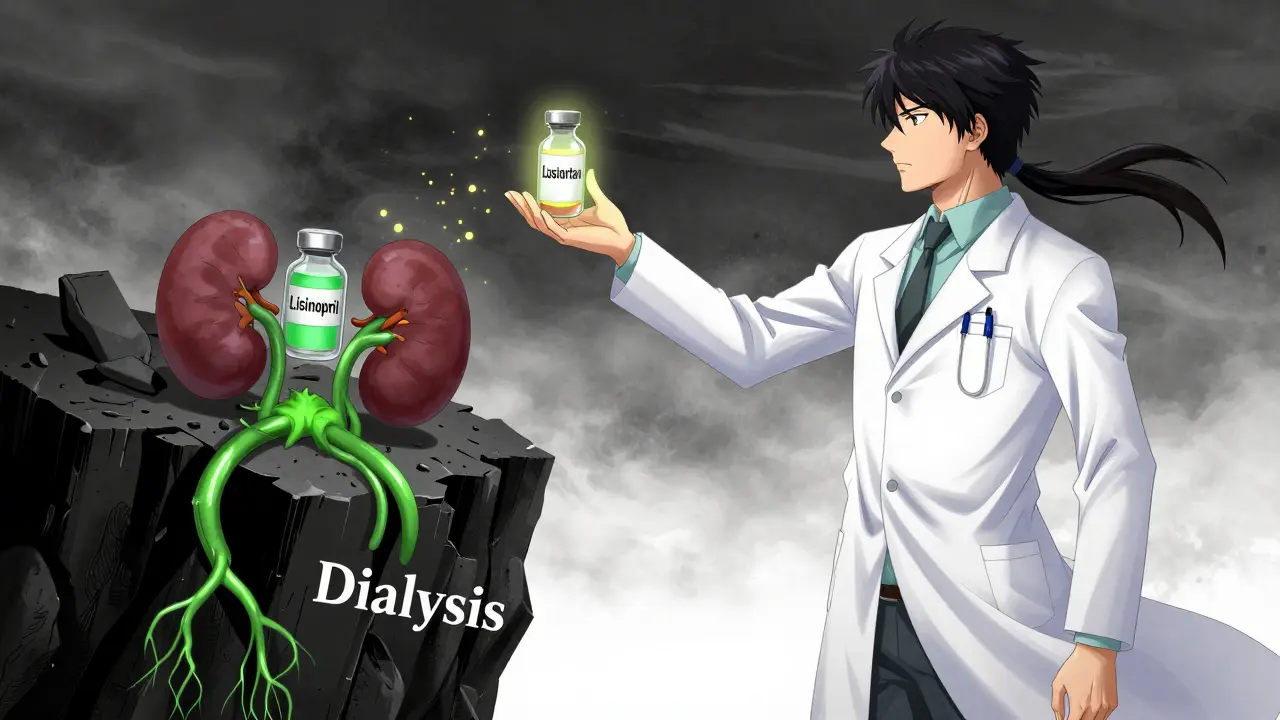
ACE inhibitors, like lisinopril (a commonly prescribed ACE inhibitor) and enalapril (another widely used ACE inhibitor), block the enzyme that turns angiotensin I into angiotensin II. ARBs, such as losartan (the first ARB approved by the FDA) and valsartan (a popular ARB used for both blood pressure and kidney protection), block the receptors that angiotensin II binds to. Either way, the result is the same: less pressure inside the kidney filters, less protein loss, and slower decline in kidney function.
Studies show that when these drugs are used properly, they can reduce proteinuria (protein in urine) by 30-50% and slow kidney disease progression by 20-40%. In people with diabetes or high blood pressure-two leading causes of CKD-the benefit is even clearer. A major analysis found that patients on ACE inhibitors or ARBs had a 25% lower risk of ending up on dialysis compared to those on other blood pressure meds.
Why These Drugs Are First-Line Therapy
Since the early 2000s, guidelines from the American College of Cardiology and the American Heart Association have consistently ranked ACE inhibitors and ARBs as the top choice for high blood pressure in patients with CKD, especially if they have protein in their urine. Why? Because no other class of blood pressure drugs does this combination of things: lowers pressure, reduces protein leakage, and protects the kidney structure.
Even when other drugs like calcium channel blockers or diuretics are added, ACE inhibitors and ARBs remain the foundation. The current standard is to titrate the dose of one of these drugs to the maximum tolerated level before adding anything else. For most patients, the goal is a systolic blood pressure below 130 mmHg. That’s lower than the general population target-and it’s intentional.
What’s more, these drugs aren’t just for early-stage kidney disease. A 2024 study of 1,237 patients with advanced CKD (eGFR under 20 mL/min) showed that those who started or kept taking ACE inhibitors or ARBs had a 34% lower risk of needing kidney replacement therapy (dialysis or transplant) over 34 months. That’s not a small number. It’s life-changing.
The Real-World Gap: Why So Many People Don’t Get Them
Despite the strong evidence, only about 58% of patients with advanced CKD are getting these medications. In early-stage CKD, that number jumps to 82%. Why the drop-off?
Doctors and patients alike get nervous about two things: rising potassium levels and a sudden drop in kidney function.
It’s true. About 10-15% of patients will see their potassium rise above 5.0 mmol/L after starting one of these drugs. And 5-10% will see their eGFR drop by more than 30% in the first few weeks. But here’s the catch: that initial dip in kidney function doesn’t mean the drug is hurting you. It often means the drug is working-reducing pressure inside the kidney filters so they don’t get damaged. The real danger comes from stopping the drug because of fear.
One study comparing patients who continued ACE inhibitors or ARBs versus those who stopped them in stage IV or V CKD found that those who kept taking the drugs had higher eGFR levels after three years. No extra deaths. No more hospitalizations. Just better kidney function. Yet, many still avoid them.
ACE Inhibitors vs. ARBs: What’s the Difference?
Both classes work similarly and offer nearly identical kidney protection. But they differ in side effects.
ACE inhibitors cause a dry, persistent cough in 5-20% of users. It’s not dangerous, but it’s annoying enough that many people stop taking them. There’s also a rare but serious risk of angioedema-swelling of the face, lips, or throat-in about 1 in 500 to 1 in 1,000 people. That’s why switching to an ARB is often the next step if cough becomes unbearable.
ARBs don’t cause cough. They’re less likely to cause angioedema. But they’re not side-effect free. They can still raise potassium and cause dizziness from low blood pressure. And while they’re slightly more expensive than older ACE inhibitors like lisinopril, generic versions of losartan and valsartan are now very affordable.
For most people, the choice comes down to tolerance. If you’ve had a cough on an ACE inhibitor, switch to an ARB. If you’re fine on one, stick with it. The kidney protection is the same.
Combining ACE Inhibitors and ARBs? Not Recommended
Some people think doubling up on these drugs gives better protection. But the data says otherwise.
The Veterans Affairs Nephropathy Trial showed that combining an ACE inhibitor with an ARB cut proteinuria by an extra 15-20%. Sounds great, right? But it also doubled the risk of acute kidney injury and increased hyperkalemia by 50%. There was no improvement in long-term outcomes-just more hospital visits and more complications.
Current guidelines, including KDIGO 2023, strongly advise against dual therapy. It’s not worth the risk. Stick with one. Maximize the dose. Monitor closely.
Monitoring: What You Need to Check and When
You can’t just start these drugs and forget about them. Monitoring is part of the treatment.
- Before starting: Check serum potassium, eGFR, and urine albumin-to-creatinine ratio.
- Within 1-2 weeks: Recheck potassium and eGFR. If eGFR drops more than 30% from baseline or potassium goes above 5.5 mmol/L, hold the drug and reassess.
- After each dose increase: Same checks. Don’t rush the titration.
- Monthly during the first few months: Keep an eye on trends. After that, every 3-6 months is usually enough if things are stable.
Many patients worry about dietary potassium. Bananas, potatoes, spinach, and salt substitutes can all raise potassium. But you don’t need to eliminate them. Just avoid massive increases. Work with a dietitian if your potassium keeps creeping up. Often, adjusting the dose or switching to a different drug works better than drastic diet changes.

Advanced CKD? Still Worth It
There’s a myth that if your kidneys are failing, these drugs won’t help-or are too risky. That’s outdated.
KDIGO 2023 guidelines say: keep using ACE inhibitors or ARBs in stage 4 and 5 CKD as long as your eGFR is above 15 mL/min and potassium stays below 5.0 mmol/L. That means many people on dialysis are still on these drugs-and benefiting.
One patient I spoke with, a 68-year-old man with stage 4 CKD and diabetes, had been on lisinopril for five years. His proteinuria dropped from 2,400 mg/day to under 800 mg/day. His eGFR stayed stable at 22 mL/min. He didn’t have a single hospital visit related to his kidneys in three years. He’s not on dialysis. He’s not dead. He’s managing.
Doctors who stop these drugs in advanced CKD aren’t protecting patients-they’re denying them proven benefits. Fear of side effects shouldn’t override evidence.
What’s Next? Newer Drugs on the Horizon
Scientists are already working on better versions. Angiotensin receptor-neprilysin inhibitors (ARNIs), like sacubitril/valsartan, are being studied for kidney protection. A 2024 extension of the PARADIGM-HF trial showed that in heart failure patients with CKD, sacubitril/valsartan slowed kidney function decline by 22% compared to enalapril alone.
It’s early, but it suggests the next generation of drugs may offer even better protection with fewer side effects. For now, though, ACE inhibitors and ARBs remain the gold standard.
Final Takeaway
If you have kidney disease and high blood pressure, ACE inhibitors and ARBs aren’t optional. They’re essential. They’re not magic bullets, but they’re among the few drugs that actually change the course of kidney disease. The risks-high potassium, a temporary drop in kidney function-are manageable with proper monitoring. The risk of doing nothing? Faster progression to kidney failure.
Don’t let fear stop you. Talk to your doctor. Get your numbers checked. If you’re not on one of these drugs and you have protein in your urine, ask why. You might be missing out on years of kidney function you didn’t know you could keep.
Can ACE inhibitors and ARBs be used together for better kidney protection?
No. Combining an ACE inhibitor with an ARB increases the risk of serious side effects like hyperkalemia and acute kidney injury without improving long-term outcomes. Current guidelines strongly advise against dual therapy. Stick with one drug at the highest tolerated dose.
Why do my kidneys seem to get worse when I start an ACE inhibitor or ARB?
It’s common to see a temporary drop in eGFR-sometimes 20-30%-in the first few weeks. This usually means the drug is reducing pressure inside the kidney filters, which is protective. If the drop is more than 30% or if potassium rises above 5.5 mmol/L, your doctor may pause the drug. But if it’s mild and stable, continuing is usually safe and beneficial.
I have advanced kidney disease. Should I still take an ACE inhibitor or ARB?
Yes-if your eGFR is above 15 mL/min and your potassium is below 5.0 mmol/L. A 2024 study found that patients with stage 4 or 5 CKD who continued these drugs had a 34% lower risk of needing dialysis. Stopping them doesn’t protect your kidneys-it may speed up their decline.
What’s the difference between ACE inhibitors and ARBs for kidney protection?
They work the same way and offer nearly identical kidney protection. The main difference is side effects. ACE inhibitors can cause a dry cough in 5-20% of people and carry a small risk of angioedema. ARBs don’t cause cough and have lower angioedema risk. If you can’t tolerate an ACE inhibitor, switching to an ARB is the best option.
How long should I take an ACE inhibitor or ARB for kidney disease?
These are long-term medications. Unless you have a serious side effect or your doctor advises otherwise, you should continue them indefinitely. The goal is to slow kidney damage over years, not weeks. Stopping them increases your risk of faster decline and earlier need for dialysis.
Are there foods I need to avoid while taking ACE inhibitors or ARBs?
You don’t need to eliminate potassium-rich foods entirely, but avoid sudden large increases. Foods like bananas, oranges, potatoes, spinach, and salt substitutes can raise potassium levels. If your potassium is stable, moderate intake is fine. If it’s rising, work with a dietitian. Often, adjusting your medication dose helps more than drastic diet changes.
Comments (12)
-
John Smith March 2, 2026These drugs are the only reason I'm still standing after 8 years of CKD. My doc wanted to pull me off lisinopril because my potassium was 5.2. I said no. We adjusted my diet a little and kept going. Now my proteinuria is down 70% and my eGFR hasn't budged. Stop being scared of numbers and start listening to what the science says. These aren't just meds-they're time machines that let you keep your kidneys longer.
Also side note: if you're still on diuretics as your first-line BP med with CKD, you're doing it wrong. Go read the KDIGO guidelines again. Or better yet, go ask your nephrologist why they're not pushing this harder.

-
Sharon Lammas March 3, 2026I used to think kidney disease was just about numbers. Then I watched my mom go from 30% kidney function to 22% without ever needing dialysis. She’s 74. On losartan. No hospital stays. No dialysis. Just quiet, steady control. It’s not glamorous. No one posts about it on TikTok. But it’s real. And it’s enough.
Some days I still cry thinking about how close we came to losing her. I wish more people understood that sometimes the most powerful medicine is the one no one talks about.

-
Donna Zurick March 4, 2026I started an ARB last year after my proteinuria spiked. My doctor was nervous. I was terrified. But we stuck with it. Now I’m down to 400 mg/day protein. My BP is perfect. I feel better than I have in years. Don’t let fear stop you from trying. You don’t need to be a superhero. Just be consistent. One pill. Every day. That’s all it takes.

-
Tobias Mösl March 5, 2026Let me guess. You’re one of those people who thinks Big Pharma is just giving out free magic beans. ACE inhibitors and ARBs? They’re not protecting your kidneys. They’re keeping you dependent on the system. You think your eGFR drop is 'just working'? Nah. That’s your kidneys shutting down because the drug is poisoning the tubules. They don’t tell you this but 80% of patients on these drugs end up with chronic hyperkalemia and end up on dialysis anyway. It’s a slow kill. And they call it 'treatment'.
My uncle took lisinopril for 5 years. He died at 61. His kidneys were 'protected'. Right. And my dog’s poop is organic fertilizer. Same logic.

-
tatiana verdesoto March 7, 2026I just want to say thank you to whoever wrote this. I’ve been diagnosed with stage 3 CKD and I’ve been so overwhelmed. I didn’t know if I should even take these meds. I read all the scary stuff online. But this? This made me feel like I could breathe again. I’m starting losartan next week. And I’m not scared anymore. You gave me hope. And that’s worth more than any lab result.

-
Ethan Zeeb March 7, 2026I’ve been on an ACE inhibitor for 6 years. My potassium went to 5.8 once. I stopped. Went back. Did it again. This time I didn’t panic. I just ate less banana. Less salt substitute. More water. My eGFR dipped 22%-then climbed back up. Now it’s stable. The fear is the worst part. Not the drug. Not the numbers. The fear. You don’t need to be brave. You just need to be stubborn. Keep taking it. Even if you’re scared. Especially if you’re scared.

-
Darren Torpey March 8, 2026This is the kind of post that makes me believe in medicine again. Not the flashy stuff. Not the new drugs. Not the viral TikTok hacks. Just plain, boring, evidence-based science that actually works. I’ve got CKD. I’m 52. I’m on lisinopril. I’m not dead. I’m not on dialysis. I’m still hiking. Still cooking. Still laughing. And I owe it all to a $5-a-month pill that nobody wants to talk about. Don’t underestimate the quiet heroes.

-
Lebogang kekana March 8, 2026In South Africa, we don’t even have access to these drugs in rural clinics. I’ve seen patients with stage 4 CKD die because they couldn’t get losartan. The system fails them before the disease even has a chance. This isn’t just about science. It’s about justice. If you’re in a country where you can get this, don’t waste it. Fight for it. Take it. And if you can, tell someone who can’t.

-
Jessica Chaloux March 9, 2026I started this drug and my potassium went up 😭 I was so scared I stopped it 😭 now I feel guilty 😭 my doc said to try again but I’m scared 😭 I don’t want to die 😭

-
RacRac Rachel March 11, 2026I was skeptical. I thought I’d be on these meds forever. But then I realized: this isn’t about being 'cured'. It’s about preserving what you’ve got. My eGFR was 38. Now it’s 41. My proteinuria dropped from 1,900 to 650. I didn’t get better. I got to stay the same. And that’s a win. These drugs aren’t miracles. They’re guardians. Quiet, steady, and stubbornly effective. I’m grateful for every day they let me keep.

-
Jane Ryan Ryder March 11, 2026Oh great. Another article written by a nephrologist who’s never met a patient who actually had to pay for their meds. You talk about 'affordable generics' like we’re all living in a CVS ad. My copay for valsartan is $120 a month. My insurance says 'prior authorization required' every time. And you want me to 'maximize the dose'? I can’t even afford to fill it once a week. This isn’t medicine. It’s a luxury. And you’re the one who thinks it’s 'obvious'.

-
Callum Duffy March 13, 2026A thoughtful, well-referenced piece. The clinical evidence is unequivocal: ACE inhibitors and ARBs confer significant renoprotection in CKD, particularly in the presence of proteinuria. The observed transient decline in eGFR is not indicative of nephrotoxicity but rather haemodynamic adaptation, a phenomenon well-documented in the literature since the 1990s. It is imperative that clinicians and patients alike understand this distinction. The abandonment of these agents in advanced CKD, often driven by fear rather than evidence, represents a significant therapeutic gap. Monitoring, not cessation, is the appropriate response to mild hyperkalaemia or eGFR fluctuation. Long-term outcomes are demonstrably improved with continued use. The data are clear. The challenge lies in implementation.
