
Getting the right medicine is only half the battle. If you don’t know how to read the label on your inhaler, patch, or injection, you could be putting your health at risk. Unlike pills you swallow, these delivery systems don’t work the same way - and their labels aren’t written the same way either. A 2022 study found that nearly 39% of medication errors with these devices came from simply misunderstanding the label. That’s not a small number. That’s preventable harm.
Why Inhaler Labels Are Different
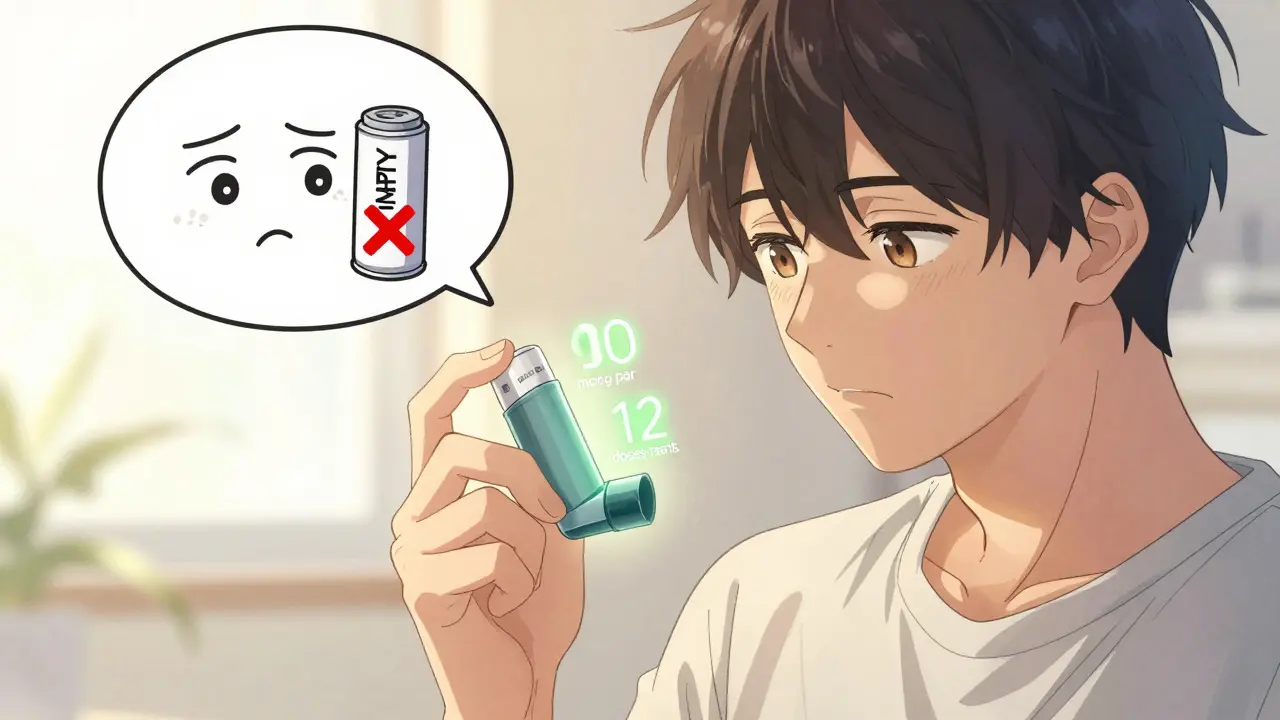
Inhalers look simple: a metal canister, a plastic mouthpiece. But inside, the medicine is pressurized. And the label? It’s packed with details you can’t ignore.First, check the dosage per spray. It might say something like albuterol sulfate 90 mcg per actuation. That means each time you press it, you get 90 micrograms. Not 90 milligrams. Big difference. Mix those up, and you’re either underdosing or overdosing.
Then there’s the total number of sprays. Many people think the inhaler is empty when it stops feeling cold. Wrong. The canister can still have medicine left - it just doesn’t spray as hard. That’s why labels now include a dose counter. If yours doesn’t have one, ask for a new one. The FDA made this required in May 2024 because it prevents emergency room visits. An estimated 18,000 a year.
And don’t skip the priming step. If it’s your first time using it, or if you haven’t used it in weeks, you need to spray it into the air 4 times before using it on your lungs. The label says it. If you don’t, the first few puffs are just air. You won’t get your medicine.
Also, check if you need to shake it. Suspension inhalers? Shake well. Solution inhalers? No shaking needed. This matters. About 62% of metered-dose inhalers are suspension types, according to the American Lung Association. Get it wrong, and you’re not getting the full dose.
Patch Labels: More Than Just Stick and Go
Transdermal patches seem easy. Stick it on. Wait. Done. But the label tells you a lot more.Look for the delivery rate. It might say fentanyl 25 mcg/hour. That’s how much medicine your body gets every hour. Not total. Not per day. Per hour. If you think it’s 25 mcg total, you’re missing the point. That’s why 63% of patients in a Consumer Reports survey didn’t realize change every 72 hours meant exactly 72 hours - not "about three days."
Where you put it matters too. Some patches say apply to clean, dry skin. Others say avoid skin folds or do not apply to irritated skin. Put it on the wrong spot, and absorption changes. Too much medicine gets in. Too little. Either way, it’s risky.
And heat. Heat changes everything. A hot shower, a heating pad, even sitting in the sun too long can boost absorption by up to 50%. That’s why Health Canada and the FDA now require warnings about heat exposure. If your patch says avoid heat, don’t ignore it.
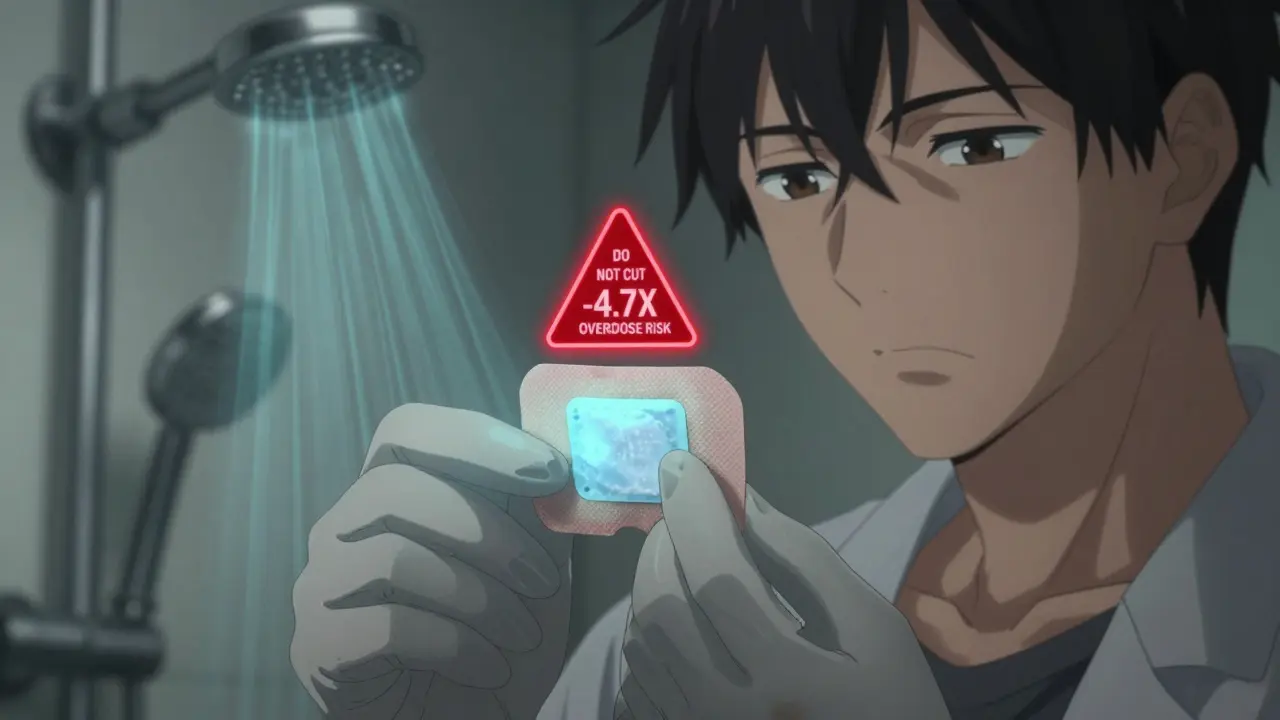
Don’t cut it. Nearly 89% of fentanyl patches have a do not cut warning. Cutting releases all the medicine at once. The FDA says that increases overdose risk by 4.7 times. That’s not a suggestion. That’s a death sentence.
And disposal? You can’t just throw it in the trash. Fentanyl patches still have medicine in them even after you take them off. The FDA issued a safety alert in 2022 after 147 cases of accidental exposure - mostly from kids or pets finding discarded patches. Labels now say fold sticky side together and return to pharmacy. Do it.
Injectables: The Details That Save Lives
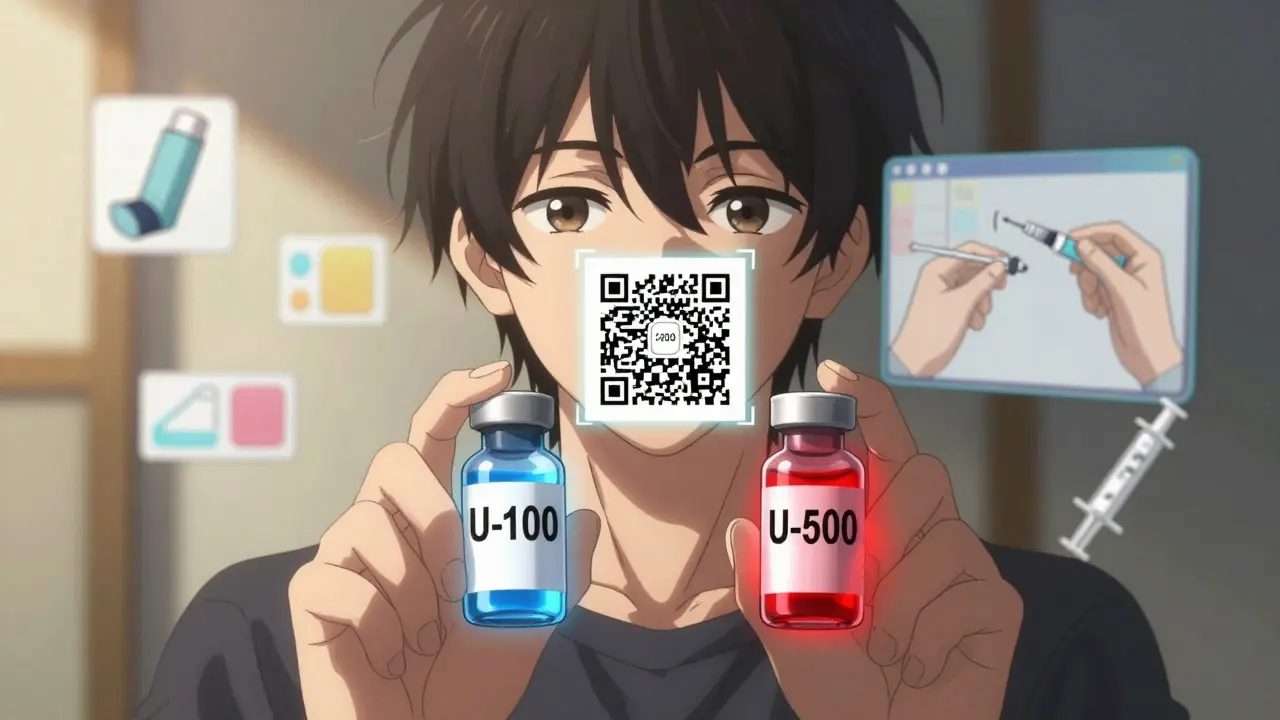
Injections are the most dangerous if misread. One wrong number, one misunderstood unit, and you’re in trouble.Concentration is everything. Insulin labels say U-100. That means 100 units per milliliter. But some insulin is U-500. That’s five times stronger. If you grab the wrong one, you’re giving yourself five times the dose. The American Diabetes Association says 19.3% of insulin errors in 2023 came from this. Always double-check the label. Look for the "U" number. Write it down if you have to.
Some injectables need mixing. If the label says reconstitute with 1 mL diluent, you can’t skip it. That means adding liquid to powder before injecting. If you don’t, the medicine won’t work. And if you add too much or too little? Dose is off. That’s why 68% of injection errors happen during preparation, not during the shot.
Storage matters too. Some injectables need refrigeration. Others don’t. Some can be kept at room temperature for 28 days. Others expire in 7. Check the label. If it says discard after 30 days, don’t use it past that. Even if it looks fine.
Visual cues help. Since 2019, 87% of injectable labels include color coding or unique shapes to help you tell them apart. If two vials look the same, the label should help you choose the right one. If it doesn’t, ask your pharmacist.
What’s on the Label - The Hidden Details
Beyond the big stuff, labels have small print that’s just as important.Auxiliary labels - those little stickers on the bottle - say things like take with food, do not drink alcohol, or shake well. They appear on 92% of specialized delivery system prescriptions. Don’t ignore them.
Visual instructions are now common. Pictograms - simple drawings showing how to use the device - are on 78% of inhaler labels since 2020. Studies show they cut technique errors by over 22%. Patches and injectables are catching up. Some now have QR codes. Scan them with your phone. You’ll get a video showing exactly how to use it. A 2024 study found that using these videos improved understanding by 29%.
And don’t assume all labels are the same. A 2023 study found that 43% of patients who used multiple delivery systems - say, an inhaler and a patch - got confused because the labels looked totally different. One said "apply daily." Another said "change every 72 hours." The wording wasn’t consistent. You have to read each one like it’s brand new.
What to Do When You’re Confused
You’re not alone. A 2023 JAMA Internal Medicine study found that only 38% of patients got a full 15-20 minute explanation from their pharmacist. That’s not enough. You deserve better.If the label doesn’t make sense, call your pharmacy. Ask for a pharmacist. Don’t just say, "Can you explain this?" Say, "I need help understanding how to use my inhaler/patch/injection. I don’t want to make a mistake."
Bring your device. Show them the label. Ask: "Is this the right one?" "How many times a day?" "What happens if I miss a dose?" "What should I do if I accidentally use too much?"
If you’re visually impaired, ask for large-print labels or audio instructions. Some pharmacies offer this. The PatientsLikeMe platform reports that 57% of users with vision issues struggled with similar-looking vials. You shouldn’t have to guess.
And if you’re using more than one device - inhaler, patch, injection - keep a written checklist. Write down: device name, dose, frequency, special instructions. Keep it in your wallet. Review it every week.
The Future Is Here - And It’s Smarter
The system is improving. By 2025, all new inhalers, patches, and injectables will have standardized pictograms. By 2026, pharmacies will start using AI systems that check your label against your prescription - and flag mismatches before you leave.Some companies are testing augmented reality. Point your phone at your inhaler, and a 3D animation shows you how to use it. A 2023 Johns Hopkins study found this cut errors by 37%. That’s not science fiction. It’s coming to your pharmacy soon.
The World Health Organization wants to cut global medication errors from these devices by half by 2030. That starts with clear labels. And you - reading this - are part of that change.
You don’t need to be a doctor. You just need to read. Slowly. Carefully. Twice. And ask when you’re not sure.
What should I do if I can’t read the label on my medication?
Call your pharmacy and ask for help. Most pharmacies offer free consultations with a pharmacist. You can also ask for a large-print version, an audio guide, or a caregiver-friendly handout. Don’t guess - a mistake can be dangerous.
Can I cut a transdermal patch to adjust the dose?
Never cut a patch unless your doctor specifically tells you to. Most patches, especially fentanyl, are designed to release medicine slowly. Cutting it releases the full dose all at once, which can cause an overdose. The FDA warns that cutting increases overdose risk by 4.7 times.
Why does my inhaler feel full even when it’s empty?
The canister’s pressure keeps the spray working even after the medicine runs out. That’s why dose counters were required in 2024. Always check the counter. If yours doesn’t have one, ask for a new inhaler. Relying on how it feels is dangerous.
How do I know if my insulin is U-100 or U-500?
Look for the "U" number on the label. U-100 means 100 units per mL. U-500 means 500 units per mL - five times stronger. They look similar. Always double-check. Mixing them up can cause a life-threatening overdose. Ask your pharmacist to confirm.
Do I need to refrigerate all injectable medications?
No. Some need refrigeration before opening. Others can be stored at room temperature after opening. Always check the label for storage instructions. If it says "discard after 30 days," don’t use it past that date - even if it looks fine.
What should I do with used patches or needles?
For patches: Fold the sticky sides together, then return them to your pharmacy. Never throw them in the trash. For needles: Use a sharps container. If you don’t have one, ask your pharmacy for one. Never recap needles. Improper disposal can harm children, pets, or waste workers.
Comments (8)
-
Scott Easterling March 11, 2026So let me get this straight - the FDA just MADE dose counters mandatory because people are too dumb to know when their inhaler is empty?
And we wonder why healthcare costs are through the roof.
Someone’s got to pay for the 18,000 ER visits caused by people who refuse to READ THE LABEL.
My grandma used to count puffs on her fingers. Now we need a digital display?
Next they’ll install GPS trackers on insulin pens so we don’t ‘misplace’ them.
At this point, we’re just babysitting adults.
And don’t get me started on the QR codes.
My phone’s battery dies before I scan the damn thing.
It’s not innovation - it’s enabling incompetence.

-
Mantooth Lehto March 11, 2026I just read this and started crying 😭 I’ve been using my fentanyl patch wrong for TWO YEARS because I thought "change every 72 hours" meant "whenever I feel like it". My husband found out when I passed out in the shower. Now I have to go to therapy. I’m so ashamed. 💔

-
Melba Miller March 13, 2026This whole thing is a scam.
They don’t want you to understand your meds - they want you dependent.
Why do patches say "do not cut"? Because if you could cut them, you’d save money.
Why do inhalers have dose counters? So they can track how often you refill.
And QR codes? That’s how they link your device use to your insurance data.
I’ve seen the documents.
The FDA doesn’t care about safety - they care about control.
They’re not protecting you.
They’re monetizing your ignorance.

-
Katy Shamitz March 13, 2026I’m so proud of how far we’ve come.
When I first got my inhaler, I thought shaking it was optional.
Now I read every tiny word - even the auxiliary labels.
I fold my patches. I check the U-number. I scan the QR code.
And you know what? I’ve never had an accident.
It’s not hard.
It just takes a little care.
And if you’re too lazy to read the label?
That’s not a system failure.
That’s a personal choice.
You don’t get to blame the FDA for your negligence.
Take responsibility. You’re worth it.

-
Nicholas Gama March 14, 2026The fact that 39% of errors come from misreading labels proves one thing: people shouldn’t be trusted with complex medical devices.
End of story.

-
Samantha Fierro March 15, 2026I just want to say how incredibly important this article is - and how brave it is to lay it all out like this.
So many of us are terrified to ask questions.
We think we’re being burdensome.
We think, "I should know this already."
But you don’t have to be a doctor to understand your own body.
And you don’t have to feel ashamed for needing help.
Call your pharmacist. Bring your device. Ask for the video.
Do it for yourself.
You’ve survived this far - now let’s make sure you survive the next 30 years too.
You’re not alone.
I’m rooting for you.

-
Peter Kovac March 15, 2026The 87% color-coding stat is misleading.
It doesn’t account for how many labels are still visually indistinguishable.
And QR codes? They’re useless if you’re over 65 or on Medicaid.
This isn’t progress - it’s performative compliance.
Real safety requires standardized, tactile, universal design - not flashy tech.
And the FDA’s 2024 mandate? Too little, too late.
They’re still letting manufacturers decide what "clear" means.
That’s not regulation.
That’s negligence dressed in a white coat.

-
APRIL HARRINGTON March 16, 2026OMG I just realized I’ve been using my inhaler wrong for 5 years 😱 I thought shaking it was just for fun 😅 Now I’m going to call my pharmacy RIGHT NOW and get the video 😍 This article changed my life 💕
