
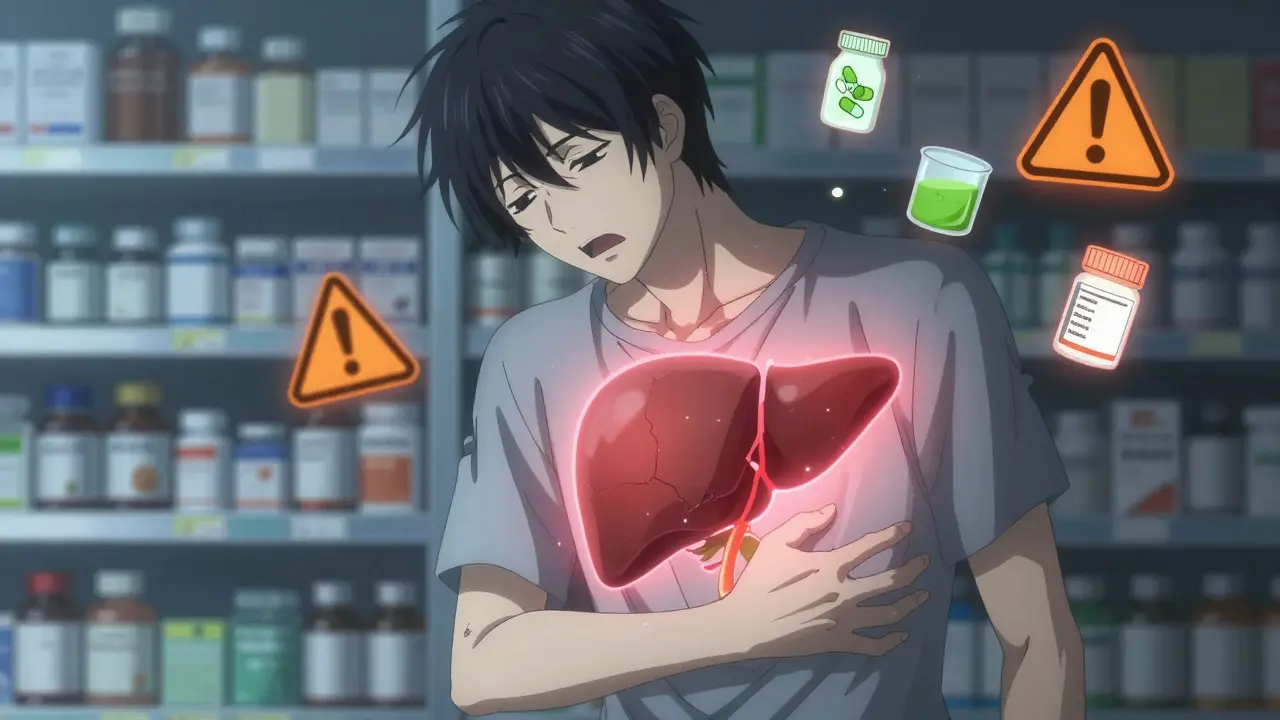
Every year, thousands of people end up in the hospital not because of a virus or bad diet, but because of something they took to feel better. It’s not a rare glitch-it’s called drug-induced liver injury, or DILI. And it’s happening more often than most doctors admit. In Australia, the U.S., and Europe, this kind of liver damage is now one of the top reasons for sudden liver failure. The scary part? You might not know it’s happening until it’s too late.
What Exactly Is Medication-Related Liver Damage?
Your liver is your body’s chemical factory. It breaks down everything you swallow-medicines, supplements, even vitamins. But sometimes, it gets overwhelmed. When a drug or supplement messes with liver cells, it can cause inflammation, cell death, or block bile flow. This isn’t just about overdoses. Even normal doses of common pills can trigger it. Antibiotics like amoxicillin-clavulanate? That’s one of the top culprits. Painkillers like ibuprofen? Yes. Even turmeric and green tea extract? Absolutely.
According to the Drug-Induced Liver Injury Network (DILIN), antibiotics cause about 16% of all cases. Anticonvulsants like valproate? 11%. And herbal supplements? They’re behind 20% of cases in the UK, with green tea extract alone responsible for nearly 4 out of 10 supplement-related injuries. The problem isn’t just the drug-it’s that most people think ‘natural’ means ‘safe.’ It doesn’t.
How Do You Know Something’s Wrong?
The liver doesn’t scream. It whispers. And by the time it screams, you’re already in trouble. Most people don’t feel anything at first. No pain. No fever. Just fatigue. That’s why so many cases get missed. But here’s what to watch for:
- Yellowing of the skin or eyes (jaundice)
- Dark urine, like cola
- Light-colored or greasy stools
- Severe itching without a rash
- Nausea or vomiting that won’t go away
- Pain or pressure under your right ribs
- Unexplained exhaustion that doesn’t improve with rest
These aren’t random symptoms. They’re clues. Jaundice means your liver can’t process bilirubin. Dark urine means bile is backing up into your bloodstream. Itching? That’s bile salts building up under your skin. And right upper quadrant pain? That’s your liver swelling and pressing against your ribs.
One patient from Sydney told me (in a forum I read) she had itching for two weeks while on amoxicillin-clavulanate. Her doctor said it was allergies. By the time she turned yellow, her ALT levels were 15 times higher than normal. That’s not a coincidence. That’s the liver screaming.
When Should You Act? Don’t Wait for Jaundice.
The golden rule: If you’ve started a new medication in the last 8 weeks and you have jaundice plus any two of these-dark urine, belly pain, or nausea-you need to go to the ER now. Don’t wait for your GP appointment. Don’t Google it. Go.
And if it’s acetaminophen (paracetamol)? That’s a race against time. If you took too much-even just a few extra pills-you have less than 8 hours to get N-acetylcysteine (NAC), the antidote. Every hour you wait cuts the treatment’s effectiveness by 10%. By 24 hours, it’s mostly useless. And yes, even 3,000 mg a day is the max for healthy adults. If you have liver disease, it’s 2,000 mg. Many people don’t know this.
Also, alcohol and liver-toxic drugs? That’s a deadly combo. Drinking while on ibuprofen, antibiotics, or statins can multiply your risk by 3 to 5 times. And if you’re on isoniazid for TB? Your doctor should be checking your liver enzymes every 2 to 4 weeks. Ten percent of people on it develop abnormal levels within 3 months. If they don’t monitor you, they’re not following guidelines.
Why Do Doctors Miss It?
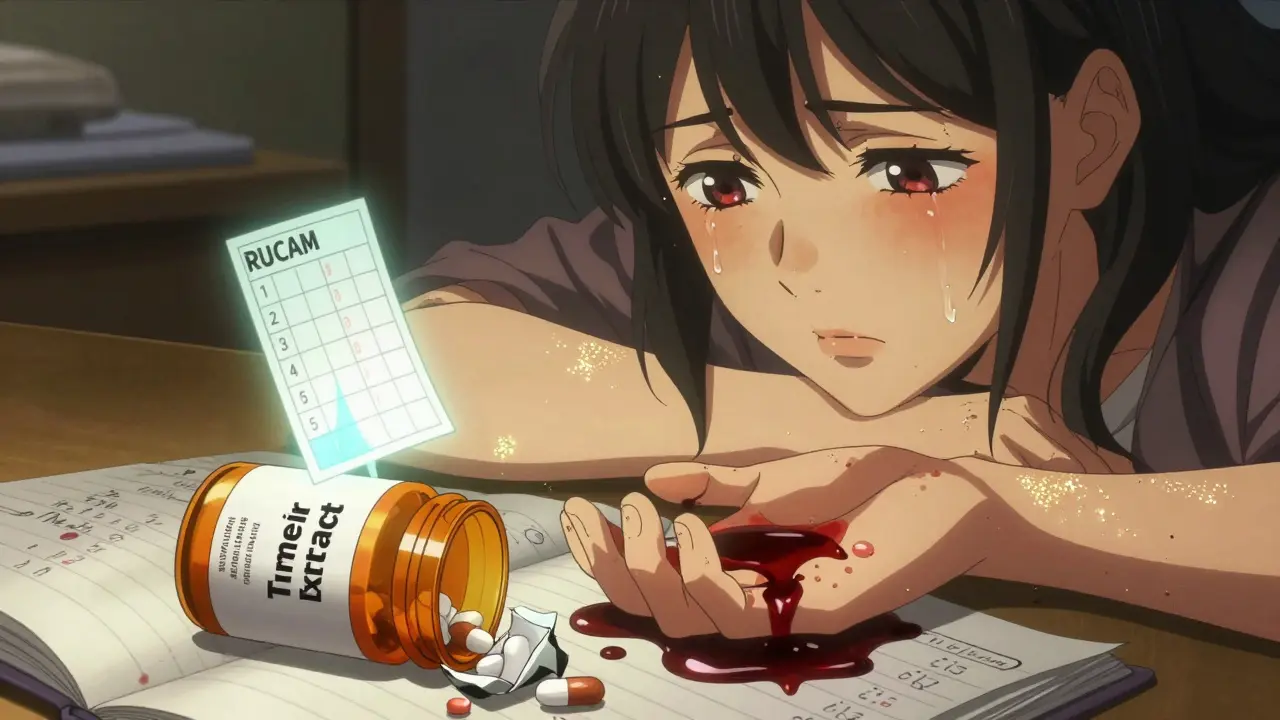
Because DILI looks like everything else. Fatigue? Could be stress. Nausea? Could be a stomach bug. Itching? Could be dry skin. A 2023 survey of 1,247 DILI patients found that 68% were initially misdiagnosed. One Reddit user wrote: “My doctor said my liver enzymes were high because I was ‘detoxing’ from turmeric. He didn’t even ask what I was taking.”
The truth? There’s no single test that confirms DILI. You can’t just do a blood test and say, “Yep, that’s it.” You need to rule out hepatitis, autoimmune disease, alcohol, and gallstones first. That’s why doctors use something called RUCAM-the Roussel Uclaf Causality Assessment Method. It’s a scoring system that looks at timing, dose, other causes, and whether symptoms improve after stopping the drug. It’s not perfect, but it’s the best we have. And it only works if you tell your doctor everything you’re taking.
What’s Really Risky? The Stuff You Think Is Safe
Here’s where most people get tripped up:
- Herbal supplements: Green tea extract, kava, black cohosh, and weight-loss formulas are all linked to liver failure. The European Medicines Agency says supplements caused a 27% spike in DILI cases between 2015 and 2022.
- Over-the-counter painkillers: Ibuprofen, naproxen, and even aspirin can cause damage if used daily for months. It’s rare, but it happens.
- Statins: The FDA says they cause liver injury in 0.5% to 2% of users. The European guidelines say it’s almost never serious. Both are right-it’s a gray zone. But if your ALT jumps 3x above normal after starting a statin, stop it and get checked.
- Antibiotics: Amoxicillin-clavulanate is the #1 offender. It’s common, cheap, and prescribed for everything from sinus infections to ear infections. And it’s silent until it’s not.
And here’s a brutal fact: 76% of people who develop DILI had symptoms within 30 days of starting the drug. But only 32% connected the dots themselves. Most waited for their doctor to notice. That’s the problem. You have to be your own advocate.
What Can You Do to Prevent It?
Prevention isn’t rocket science. It’s simple, but nobody does it.
- Keep a medication log. Write down every pill, capsule, powder, or tea you take-even the “natural” ones. Include the dose and when you started. Show it to your doctor.
- Never mix alcohol with meds. Not even one glass. Not even if you feel fine.
- Know your limits. Acetaminophen max: 3,000 mg/day. If you have liver disease, cut it to 2,000 mg. Check labels. Many cold medicines have it in them.
- Get tested if you’re on high-risk drugs. Isoniazid? Amoxicillin-clavulanate? Valproate? Ask your doctor about baseline liver tests before starting and follow-up tests at 2 and 4 weeks.
- Be skeptical of supplements. If it claims to “detox,” “cleanse,” or “boost liver function,” it’s probably the opposite. The FDA doesn’t regulate supplements like drugs. No safety testing. No long-term studies. Just marketing.
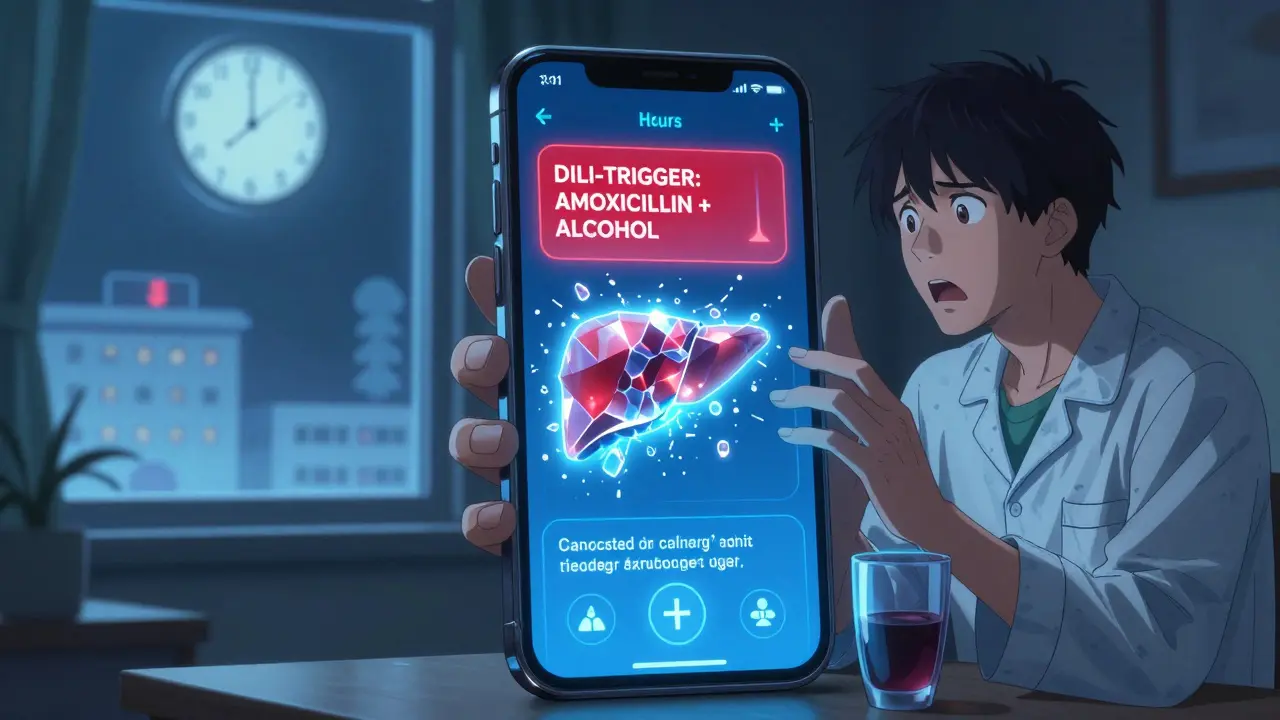
There’s a new tool called DILI-Alert, a smartphone app launched in 2023 that cross-checks your meds against 1,200 known liver-toxic substances. It’s not perfect, but if you’re on 5+ pills or supplements, it’s worth downloading. It’s free. And it could save your liver.
The Future Is Here-But You Need to Act Now
Researchers are getting better at catching DILI early. A blood test for microRNA-122 is showing 92% accuracy in detecting liver damage before ALT levels even rise. AI systems are cutting diagnosis time by 35%. But none of that matters if you ignore the warning signs.
By 2025, experts predict 24,000 new cases of DILI in the U.S. alone-mostly from unregulated supplements. That’s not a future scare. That’s what’s already happening. And it’s happening because people think, “It’s just a pill,” or “I’ve been taking this forever.”
Your liver doesn’t have a voice. But your body does. Listen to it. If something feels off after starting a new medication, don’t brush it off. Don’t wait. Don’t hope it goes away. Go get checked. One blood test could mean the difference between recovery and transplant.
Can over-the-counter painkillers like ibuprofen damage your liver?
Yes, though it’s rare. Ibuprofen and other NSAIDs can cause liver injury, especially if taken daily for months or combined with alcohol. The risk is low-less than 1 in 10,000 users-but it’s real. If you’re taking them long-term, get your liver enzymes checked once a year. If you notice dark urine, fatigue, or jaundice, stop immediately and see a doctor.
Is green tea extract really dangerous for the liver?
Yes, and it’s one of the most common causes of supplement-related liver damage. Studies show green tea extract caused nearly 40% of herbal liver injury cases in the UK. It’s not the tea you drink-it’s the concentrated pills or powders. People take them for weight loss or “antioxidant benefits,” but the liver can’t handle the high doses. Cases have led to acute liver failure and transplants. Avoid supplements with green tea extract unless approved by a hepatologist.
How long does it take for medication to damage the liver?
It varies. Antibiotics like amoxicillin-clavulanate usually cause damage within 1-8 weeks (average 15 days). Anticonvulsants take longer-around 45 days on average. Herbal supplements can take anywhere from a few days to a year. Acetaminophen overdose shows signs in as little as 24 hours. The key is timing: if you started a new drug and symptoms appear within 8 weeks, suspect DILI.
Can you recover from medication-related liver damage?
Most people can-if they stop the drug early. In 70% of cases, liver function returns to normal within weeks to months after stopping the medication. But if you wait until jaundice, vomiting, or confusion sets in, the damage can be permanent. In severe cases, you may need a liver transplant. Early detection is everything.
Should I stop my medication if I think it’s hurting my liver?
Never stop a prescribed medication on your own. Contact your doctor immediately. Some drugs, like anticonvulsants or blood pressure meds, can cause dangerous withdrawal effects. Your doctor may order blood tests to check liver enzymes and decide whether to stop the drug, switch it, or monitor you closely. Never assume it’s just a side effect-get it checked.
Are there any tests to confirm medication-related liver damage?
No single test confirms it. Doctors use a combination: liver enzyme levels (ALT, AST, ALP, bilirubin), a detailed drug history, ruling out other causes (like hepatitis or gallstones), and the RUCAM scoring system. Imaging (ultrasound or MRI) may be used to check for blockages. The diagnosis is made by connecting the dots between when you started the drug and when symptoms appeared.
Comments (9)
-
Prateek Nalwaya February 16, 2026
Man, I never realized how many "natural" supplements are basically silent killers. I was taking green tea extract for "metabolism boost"-turns out my liver was throwing a protest. This post should be mandatory reading before anyone buys a bottle labeled "detox". I’m deleting my supplement cabinet tonight.

-
Jonathan Ruth February 16, 2026
Drug induced liver injury? More like government induced panic. The FDA lets Big Pharma push pills like candy while demonizing herbal stuff. Meanwhile, Tylenol kills 500 people a year and nobody calls it a crisis. Wake up. The system is rigged. You think they want you to know about RUCAM? Nah. They want you scared of turmeric and not asking why your statin prescription came with zero liver monitoring.

-
Oliver Calvert February 17, 2026
Just wanted to add that amoxicillin-clavulanate is indeed the #1 culprit in the UK too. I work in a GP clinic and we’ve had three cases in the last 6 months. All patients were on it for sinusitis. One had itching for 10 days before jaundice. No one connected it. We need better patient handouts. Not just "call if you feel unwell"-specific symptoms, timelines, and drug names. Simple. Effective.

-
Dennis Santarinala February 18, 2026
Hey, I’m not a doctor, but I’ve been on 7 different meds in the last 2 years, and this actually made me pause. I started keeping a log like they said-just a note in my phone. Turns out I was taking ibuprofen daily for back pain AND green tea extract for "energy" AND acetaminophen for headaches. I didn’t realize I was stacking risks. I’ve cut back. I’m getting bloodwork next week. Thanks for the nudge. We all need reminders.

-
James Lloyd February 18, 2026
One thing this post doesn’t emphasize enough: the latency window. People think if they’ve been on a drug for months, it’s safe. Not true. With anticonvulsants like valproate, damage can creep in over 45 days. I had a patient who was fine for 11 weeks-then suddenly ALT spiked 20x. No symptoms. No warning. Just a routine checkup. That’s why baseline and follow-up labs aren’t optional-they’re survival tools. If your doctor won’t order them, ask for a referral to hepatology. Seriously.

-
guy greenfeld February 19, 2026
Think about it. The liver doesn’t scream because it’s been silenced. The pharmaceutical industry doesn’t want you to know that 80% of liver transplants from DILI are preventable. They profit from transplants. They profit from lifelong immunosuppressants. They profit from your ignorance. The FDA doesn’t regulate supplements? Of course not. They’re owned by the same lobbyists who wrote the DSHEA act in 1994. You think this is an accident? No. It’s a business model. And they’re counting on you to keep taking "natural" pills without asking questions.

-
Sam Pearlman February 19, 2026
Wait wait wait. You’re telling me turmeric is dangerous? But my yoga instructor said it’s anti-inflammatory magic. And my cousin took it for arthritis and now she’s running marathons. Are you saying she’s one liver transplant away from being dead? That’s wild. I’m gonna stop my supplements… but first, I’m gonna post a TikTok about it. #LiverAwareness #TurmericIsTheNewVillain

-
Steph Carr February 20, 2026
Wow. I read this whole thing and all I can think is: we live in a world where people trust a $5 supplement more than a $150 blood test. And doctors? They’re too busy to ask what you’re swallowing. I once took a multivitamin with 1000mg of vitamin C and 500mg of green tea extract. My mom said "it’s just vitamins." I thought she was wise. Turns out she was just lucky. I’m getting my liver checked tomorrow. And I’m telling my entire family. This isn’t fearmongering. It’s basic hygiene.

-
Brenda K. Wolfgram Moore February 21, 2026
Just one sentence: if you're on more than three pills or supplements and you're not tracking them, you're playing Russian roulette with your liver.
