
Pterygium isn't just a spot on the eye-it’s a warning sign. If you’ve spent years under the sun without proper eye protection, that pink, fleshy growth creeping from the white of your eye toward your pupil isn’t harmless. It’s your eye’s reaction to decades of UV radiation. In Australia, where the UV index regularly hits 12 or higher, one in five adults over 40 has it. And it’s not just surfers. Farmers, construction workers, lifeguards, even weekend gardeners are at risk. The good news? You can stop it. The better news? If it’s already there, surgery can fix it-with real results.
What Exactly Is a Pterygium?
A pterygium starts as a small, triangular bump on the conjunctiva-the clear membrane covering the white part of your eye. It usually begins near the nose and grows slowly toward the pupil. Think of it like a wing of tissue spreading across your cornea. That’s where the name comes from: pterygion means "little wing" in Greek.
It’s not cancer. It won’t kill you. But it can mess with your vision. When it grows far enough, it distorts the shape of your cornea, causing astigmatism. That means blurry, double, or warped vision-even if your glasses prescription hasn’t changed. You might also feel grit, redness, or constant irritation, like sand is stuck in your eye. Some people can’t wear contact lenses anymore because the growth makes them uncomfortable.
Doctors diagnose it with a simple slit-lamp exam. No blood tests. No scans. Just a bright light and magnification. If you see a raised, pinkish patch with visible blood vessels creeping onto the clear part of your eye, it’s likely a pterygium. And if it’s on both eyes? That’s common-about 60% of cases are bilateral in high-sun areas like Australia or the tropics.
Why the Sun Is the Main Culprit
Ultraviolet light is the #1 cause. Not just the beach. Not just summer. Every day you’re outside without UV-blocking sunglasses adds up. Research shows people who’ve been exposed to more than 15,000 joules of UV radiation per square meter have a 78% higher chance of developing pterygium. That’s roughly 200 days a year in Australia with UV levels above 3.0-the threshold where eye protection becomes necessary.
Why the nasal side? Because the sun’s angle in the southern hemisphere, especially around midday, hits the eye from the side. Your nose casts a shadow on the inner corner of your eye, but the outer part gets full exposure. That’s why 95% of pterygia start on the nasal side.
And it’s not just about latitude. Australia has the highest national prevalence in the world-23% of adults over 40 have it. Why? The ozone layer is thinner here. UV radiation is stronger. And people spend more time outdoors. Men are diagnosed more often than women-about 3 to 2. That’s likely because more men work in outdoor jobs. But anyone who spends time in the sun without protection is at risk.
It’s Not Just Pterygium-What About Pinguecula?
You might hear your doctor mention pinguecula. It’s similar, but different. A pinguecula is a yellowish bump on the conjunctiva, usually near the nose. It never crosses onto the cornea. It’s mostly cosmetic-irritating, maybe, but not vision-threatening. About 70% of outdoor workers in tropical areas get pinguecula. Only 30% develop pterygium.
The key difference? Location. If it’s only on the white of your eye, it’s a pinguecula. If it’s growing onto the clear part covering your pupil, it’s a pterygium. One stays put. The other keeps advancing. And once it crosses that line, your vision is at risk.
When Surgery Becomes Necessary
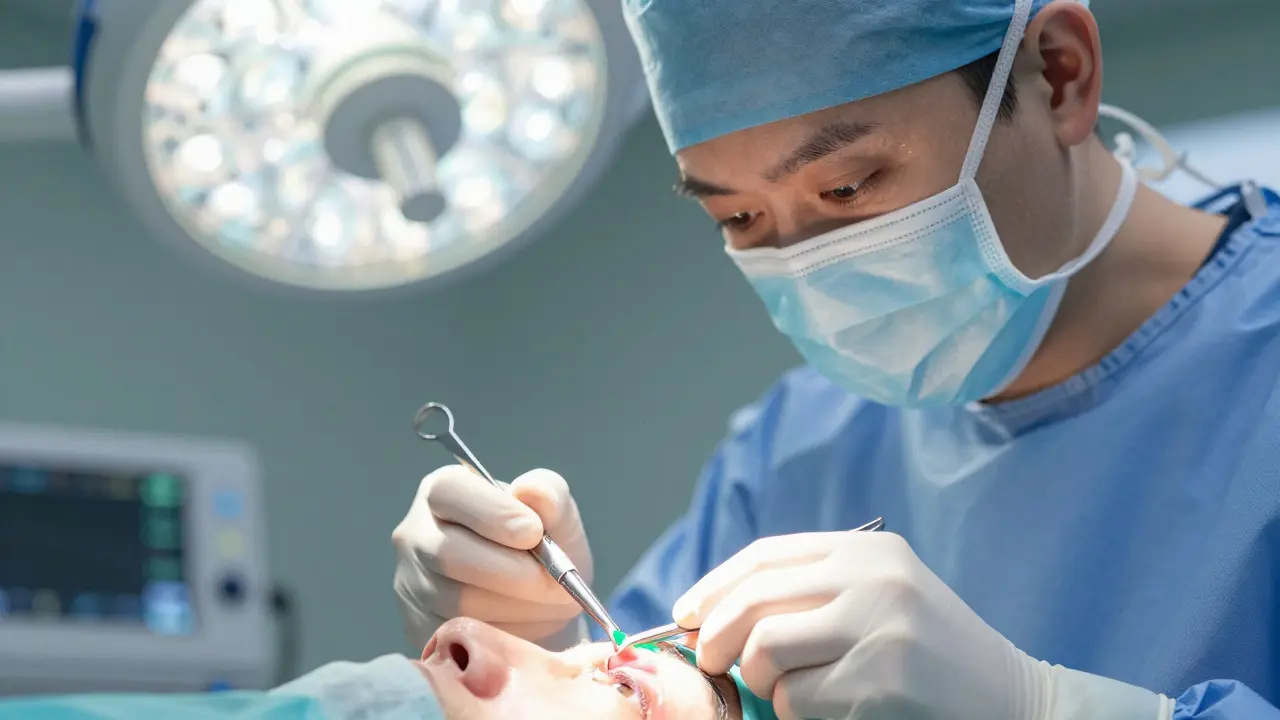
Most pterygia don’t need surgery. If it’s small, doesn’t bother you, and isn’t growing, your doctor will likely recommend lubricating eye drops and UV protection. But if you’re experiencing blurry vision, constant discomfort, or the growth is getting close to your pupil, surgery is the only way to remove it.
There are three main surgical options today:
- Simple excision-just cut it out. Cheap, fast, but risky. Without extra treatment, it comes back in 30-40% of cases.
- Conjunctival autograft-the gold standard. The surgeon removes the pterygium and replaces it with a small piece of your own healthy conjunctiva, taken from under your eyelid. This reduces recurrence to about 8.7%.
- Mitomycin C application-a chemo drug applied during surgery to kill off the cells that cause regrowth. Used with autografts, it cuts recurrence to just 5-10%.
Most Australian ophthalmologists now use autografts with mitomycin C. It’s not the cheapest option, but it’s the most reliable. The surgery takes about 30-40 minutes. You’re awake but numb. No stitches needed in many cases-just a bandage contact lens for a few days.
What Recovery Actually Feels Like
People often say, "It was quick." And it is. But the recovery isn’t glamorous.
For the first week, your eye will be red, swollen, and sensitive to light. You’ll need steroid eye drops for 4-6 weeks to keep inflammation down. Some people say the drops are harder to deal with than the surgery. You have to use them exactly on schedule-miss a dose, and your eye can flare up.
Discomfort lasts 2-3 weeks for most. You can’t swim, wear makeup, or rub your eye. Driving? Maybe not for a few days if your vision is still blurry. But after that? Most people report immediate improvement. Colors look sharper. Vision clears up. The redness fades over months.
But here’s the catch: recurrence is real. About 1 in 3 people who had simple removal see it come back. Even with autografts, 1 in 10 might get a new growth. That’s why follow-up appointments matter. Your doctor will monitor your eye for months-even years.
New Treatments on the Horizon
Science is catching up. In March 2023, the FDA approved OcuGel Plus, a preservative-free lubricant made specifically for post-surgery patients. In trials, it reduced dryness and irritation by 32% compared to regular artificial tears.
Another breakthrough? Amniotic membrane transplantation. European surgeons now use tissue from donated amniotic membranes to cover the surgical site. It’s like a biological bandage that reduces scarring and inflammation. Success rates for preventing regrowth? 92%.
And then there’s topical rapamycin. It’s a drug already used for organ transplants. Now, in Phase II trials, it’s being applied directly to the eye after surgery to stop fibroblasts from rebuilding the pterygium. Early results show a 67% drop in recurrence at 12 months. If approved, this could become standard within the next few years.
By 2027, 78% of eye surgeons expect to use laser-assisted removal. It’s more precise, causes less trauma, and reduces healing time.
How to Stop It Before It Starts
The best surgery is the one you never need.
Wear sunglasses labeled UV400 or that block 99-100% of UVA and UVB rays. Look for ANSI Z80.3-2020 certification. Wraparound styles are best-they block light from the sides.
Wear a wide-brimmed hat. Even on cloudy days. UV rays penetrate clouds.
Don’t wait until you’re 50. Start protecting your eyes in your 20s. One man on Reddit said: "I started wearing sunglasses at 25 after my dad lost vision from pterygium. At 40, my eyes are clean. His weren’t."
Get annual eye exams. Especially if you live near the coast, work outdoors, or have family history. Early detection means you can stop progression with just drops and sun protection.
What Patients Really Say
On review sites, 87% of people who had surgery say they’re glad they did. "I could finally see the road clearly again," one patient wrote. "I stopped squinting. I stopped wearing sunglasses indoors."
But the complaints are real too. "The redness lasted 6 months," said another. "I looked like I’d been in a fight." And 42% say discomfort lasted longer than expected. The steroid drops? "I forgot them twice. My eye swelled up. I panicked."
Those who didn’t get surgery? "I thought it was just dry eyes," one said. "By the time I went in, it was halfway across my pupil. I needed surgery."
There’s no middle ground. Either you protect your eyes now-or you risk losing clear vision later.
Can pterygium go away on its own?
No. Once a pterygium forms, it won’t shrink or disappear without treatment. It may stop growing if you reduce UV exposure, but it won’t vanish. Left untreated, it can keep spreading and eventually affect your vision.
Is pterygium surgery painful?
The surgery itself isn’t painful-you’re numbed with eye drops. Afterward, you’ll feel pressure, grittiness, and mild discomfort for a few days. Most people describe it as a burning or scratchy sensation, like having sand in the eye. Painkillers help, but the biggest issue is usually the steroid drops and swelling, not the pain.
Can I still wear contact lenses after surgery?
Yes, but not right away. Most doctors recommend waiting at least 4-6 weeks after surgery. Once your eye has fully healed and the surface is smooth again, you can usually return to contacts. Some people find they can wear them more comfortably after surgery because the pterygium is gone.
Does insurance cover pterygium surgery?
Yes, if it’s affecting your vision. Most health insurance plans, including Medicare in Australia, cover pterygium surgery when it’s medically necessary-like when it causes astigmatism or blocks your line of sight. Cosmetic removal isn’t covered, but vision-related cases almost always are.
How do I know if my pterygium is growing?
Take photos of your eye every 3-6 months from the same angle. Compare them. If the pink tissue is getting wider, turning whiter, or moving closer to your pupil, it’s growing. Also, if your vision is becoming blurrier, or you can’t wear contacts like you used to, that’s a sign. Schedule an eye exam if you notice any change.
Next Steps: What to Do Today
If you’ve never had an eye exam in the last year, book one. Tell your optometrist you’re concerned about sun damage. Ask for a slit-lamp check.
If you wear sunglasses, check the label. Are they UV400? Are they wraparound? If not, replace them. A cheap pair from the supermarket won’t cut it. You need real protection.
If you already have a pterygium and it’s not bothering you, keep using lubricating drops and wear your hat. Don’t wait for it to get worse. Prevention is cheaper, easier, and safer than surgery.
If it’s already affecting your vision, talk to an ophthalmologist. Ask about autografts with mitomycin C. Don’t settle for simple removal-it’s a gamble with your eyesight.
Your eyes don’t regenerate. Once the cornea is scarred, you can’t undo it. Protect them now-or pay for it later.
Comments (8)
-
Nilesh Khedekar January 15, 2026
Let me tell you something-this isn’t just an eye thing, it’s a lifestyle warning label. I grew up in Rajasthan, where the sun doesn’t ask permission, it just owns you. My uncle lost vision in one eye because he thought "sunglasses are for city folks." He was a farmer. He thought sweat was protection. Spoiler: it wasn’t. Now he wears wraparounds like a NASA astronaut. And he’s 72. Don’t be him.

-
RUTH DE OLIVEIRA ALVES January 17, 2026
It is imperative to underscore the clinical significance of ultraviolet radiation exposure as a primary etiological factor in the development of pterygium. Epidemiological data, particularly from regions with elevated solar insolation such as Australia, demonstrate a statistically significant correlation between prolonged outdoor occupational exposure and increased prevalence. Furthermore, the efficacy of conjunctival autografting with adjunctive mitomycin C has been substantiated in multiple peer-reviewed studies, with recurrence rates consistently below 10%. Prophylactic measures-including UV400-filtering eyewear and broad-brimmed headwear-are not merely advisable-they are medically necessary.

-
Crystel Ann January 18, 2026
I had one removed last year. Honestly? The surgery was the easy part. It was the eye drops I forgot at 2 a.m. that made me cry. I thought I was being responsible until I missed a dose and my eye turned into a tomato. I’m glad I did it-my vision is clear again-but please, don’t wait until it’s halfway to your pupil. Start now. Even if you think you’re fine.

-
Jan Hess January 18, 2026
Man I wish I’d known this when I was 20. I used to work construction in Arizona. No sunglasses. Just a baseball cap. I thought I was tough. Now I’ve got two pingueculas and I wear UV400s like they’re oxygen. Don’t be like me. Your eyes don’t get a do-over. Get the good shades. Wear the hat. Even on cloudy days. Seriously. Just do it.

-
Iona Jane January 19, 2026
They say it’s from the sun but what if it’s the chemicals in the sunglasses? What if the UV400 label is a lie? I read a guy on a forum who said the FDA approved OcuGel Plus because they’re hiding the real cause-fluoride in the water. My cousin’s neighbor’s dog got a pterygium after drinking tap water in Florida. Coincidence? I think not. They don’t want you to know the truth.

-
Jaspreet Kaur Chana January 21, 2026
Bro in India we call this "suraj ka dushman"-the enemy of the sun. My grandfather used to say if you don’t cover your eyes before 30, you’re just borrowing vision from your future self. I’m 34 now and I’ve been wearing wraparounds since I was 22. I don’t care if I look like a spy-I can see the road at night, I can see my daughter’s face without squinting, and I don’t need surgery. And yeah I know about the autograft and mitomycin C stuff, I read the same article. But here’s the thing: the best surgery is the one you never need. So if you’re reading this and you’re outside even for 10 minutes a day-get the damn shades. Your eyes will thank you when you’re 60 and still reading the newspaper without glasses.

-
Haley Graves January 22, 2026
Stop waiting for symptoms. That’s the trap. Pterygium doesn’t scream-it whispers. First it’s redness. Then it’s glare. Then it’s contacts that don’t fit. Then it’s blurry vision. By then, it’s already halfway there. If you’re outside, you’re at risk. Period. Get the UV400 sunglasses. Get the hat. Get the eye exam. Don’t wait for your doctor to say "it’s time." Your eyes are not optional. Protect them like your life depends on it-because it does.

-
Diane Hendriks January 24, 2026
It’s pathetic. America has the best ophthalmologists, the best technology, the best research-and yet people still walk around like their eyes are indestructible. We’ve got laser-assisted removal, amniotic membranes, rapamycin trials-and half the population thinks a $5 pair of Ray-Bans from Target is "good enough." This isn’t just negligence. It’s cultural decay. You don’t get to ignore your biology and then blame the system when your vision goes. Protect your eyes. Or get used to blurry life.
