
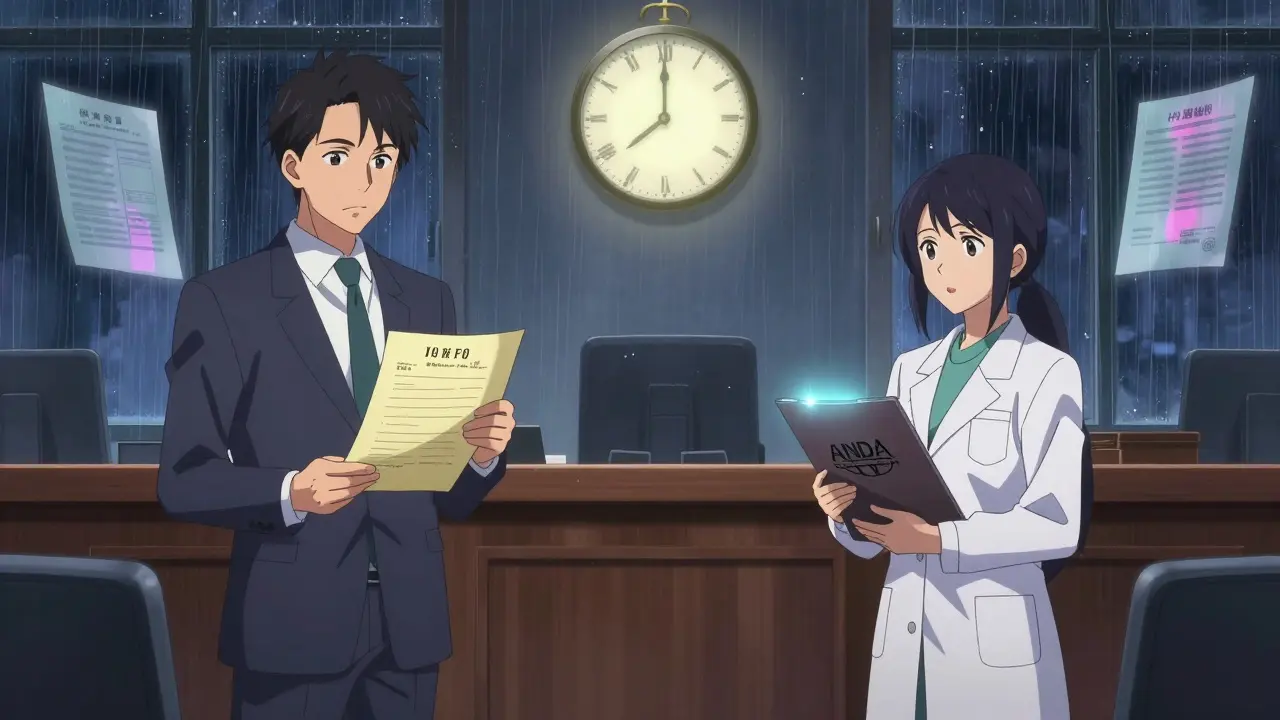
When a brand-name drug hits the market, it usually has a patent that protects it from copycats for 20 years. But in the U.S., that clock doesn’t start ticking the day the patent is filed-it starts ticking the day the drug is approved by the FDA. And even then, generic manufacturers don’t just wait around. They file a legal challenge called a Paragraph IV certification as soon as they can, claiming the patent is invalid or won’t be infringed. That’s when the real game begins.
What the 30-Month Stay Actually Does
The 30-month stay isn’t a patent extension. It’s a legal pause button on FDA approval. If a brand-name company sues a generic maker for patent infringement within 45 days of being notified of a Paragraph IV challenge, the FDA can’t give final approval to the generic drug for up to 30 months. That’s it. No more, no less-unless the court extends it, which sometimes happens if the case drags on.
Here’s the catch: the FDA can still review the generic application during those 30 months. In fact, they often do. If everything checks out-quality, safety, bioequivalence-they issue what’s called a tentative approval. That means the drug is ready to go. It’s just sitting there, waiting for the legal clock to run out. According to FDA data from 2022, 78% of ANDAs (Abbreviated New Drug Applications) received tentative approval while litigation was ongoing.
So the real delay isn’t the FDA sitting on the application. It’s the court system. And sometimes, the brand companies know that. They file lawsuits not because they’re confident they’ll win, but because they know it will cost the generic company millions in legal fees and delay their launch.
Why This System Exists
The 30-month stay was created in 1984 as part of the Hatch-Waxman Act. The goal? Balance. On one side, you want cheap generics to get to market fast. On the other, you want innovator companies to have enough time to recoup their R&D investment. The 30-month window was chosen because it roughly matches the average length of a patent lawsuit at the time.
It worked-at first. Between 1984 and 2010, over 12,000 generic drugs were approved. Consumers saved an estimated $2.2 trillion. But over time, the system got gamed. Brand companies started filing multiple patents on minor changes-new coatings, dosages, delivery methods-to trigger new 30-month stays. This is called patent evergreening. A 2019 Brookings study found that 67% of patents listed for top-selling drugs were filed after the original drug approval.
Then came the 2003 Medicare Modernization Act. It limited companies to one 30-month stay per ANDA filer. That closed the door on stacking multiple stays for the same drug. But it didn’t stop the strategy of filing lawsuits on secondary patents to keep generics out longer.
The Real Bottleneck: Litigation, Not Regulation
Here’s what most people get wrong: the 30-month stay doesn’t always delay generic entry. A 2021 study from USC and the University of Michigan found that the median time between the end of the 30-month stay and actual generic launch was 3.2 years. Why? Because the generic company isn’t ready. They need to ramp up manufacturing, negotiate with distributors, set up pricing. The legal clock runs out, but the business clock hasn’t started.
But here’s the twist: sometimes, the generic company is ready. The FDA has tentative approval. The manufacturing lines are running. And still, they don’t launch. Why? Because they’re waiting for the legal outcome. If they launch before the court rules and lose, they can be hit with massive damages. So they sit tight. That’s not the FDA’s fault. That’s the risk of the system.
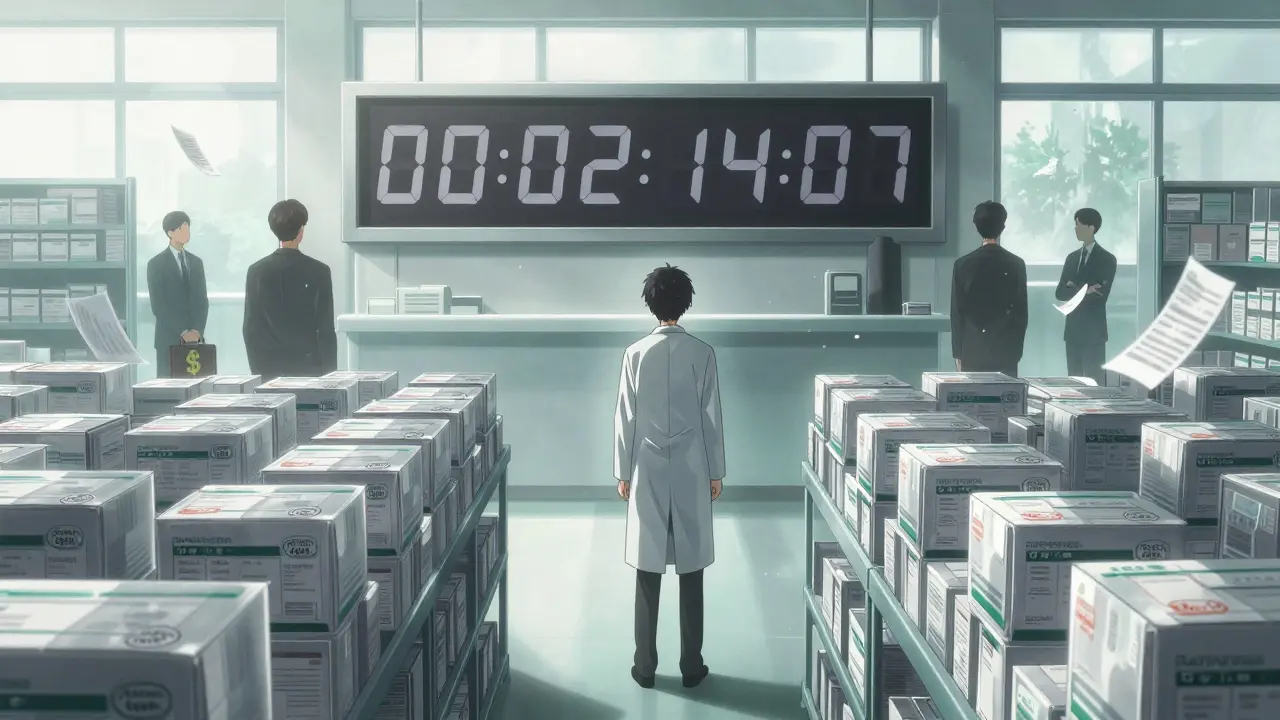
Meanwhile, brand companies benefit from this uncertainty. Even if they lose the lawsuit, they’ve bought themselves years of market exclusivity. The FTC reported in 2017 that 78% of Paragraph IV cases ended in settlements that delayed generic entry beyond patent expiration. These deals-called “pay-for-delay”-often involve the brand company paying the generic maker to hold off on launching. The FTC calls them anti-competitive. The industry calls them business deals.
How Other Countries Handle It
The U.S. is the only country that ties regulatory approval directly to patent litigation. In the EU, generic companies can file for approval as soon as the innovator’s data exclusivity ends-no lawsuits, no stays. In Canada, there’s a 24-month stay, but it’s not triggered by every patent. In Japan, the system is faster, with fewer patent listings.
The result? In the U.S., the average time from patent expiration to generic launch is 18 months longer than in Europe. That’s not because U.S. generics are slower to develop. It’s because the legal system adds layers of delay that don’t exist elsewhere.
The First-Mover Advantage
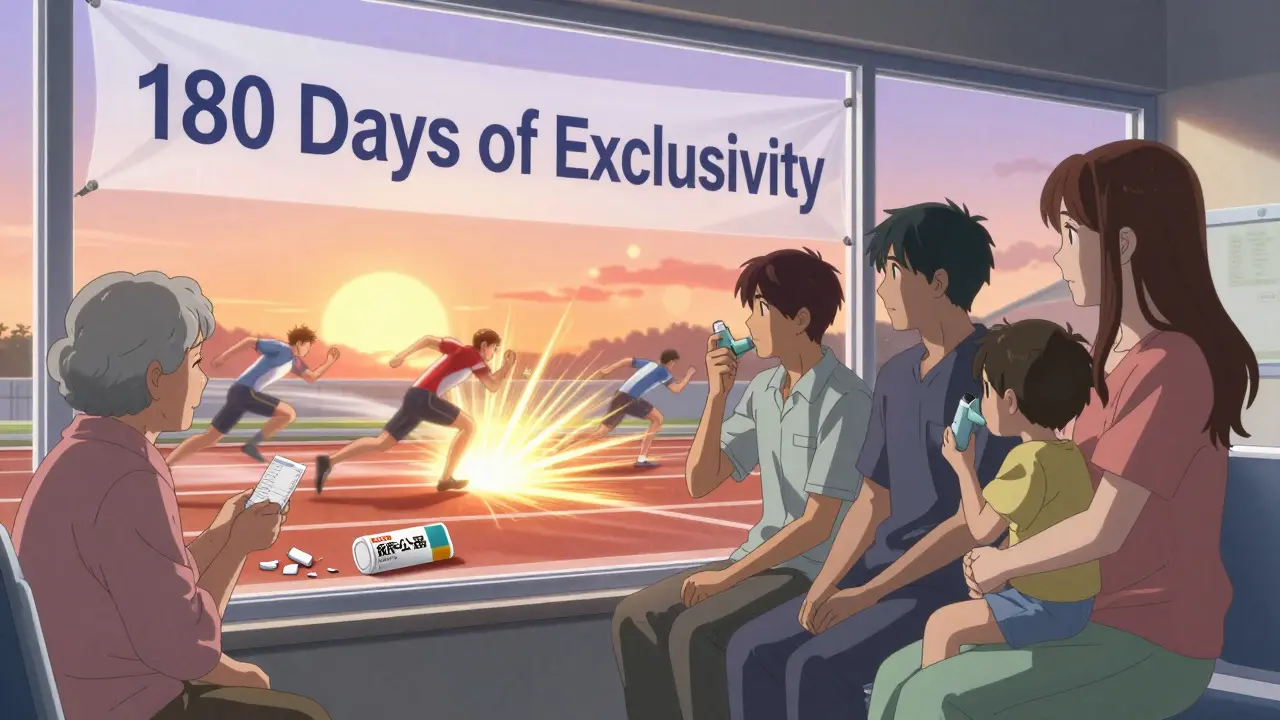
There’s one big incentive for generic companies to be the first to challenge a patent: 180 days of market exclusivity. The first company to file a successful Paragraph IV certification gets to be the only generic on the market for six months. That’s a huge payout. A single blockbuster drug can generate $1 billion in sales in its first year after patent expiry. Six months of exclusivity? That’s hundreds of millions.
That’s why you often see multiple generic companies racing to file on the same drug. In 2022, 72% of drugs facing patent challenges had more than one Paragraph IV filer. And guess what? Those drugs reached the market 8.2 months faster than those with only one challenger. Competition among generics speeds things up. But only if they’re all willing to go to court.
Who Pays the Price?
Every month a generic is delayed, patients pay more. Every year, the 30-month stay and related litigation practices add an estimated $13.9 billion to U.S. drug costs, according to the FTC. That’s not just for the one drug. It’s for every patient taking it, every pharmacy dispensing it, every insurer covering it.
And it’s not just about money. For patients with chronic conditions-diabetes, hypertension, asthma-waiting for a cheaper version can mean skipping doses, choosing between meds and rent, or worse.
Generic manufacturers spend between $3 and $5 million per ANDA just on legal costs, according to a 2022 survey by the Association for Accessible Medicines. That’s on top of the $10-$20 million it costs to develop the drug. No wonder smaller generic companies are getting pushed out. The big players-Teva, Viatris, Sandoz-can afford the legal wars. Smaller ones can’t.
What’s Changing?
The system is under pressure. In 2023, Congress introduced the Affordable Prescriptions for Patients Act, which would cut the 30-month stay from 30 to 18 months and ban stays for secondary patents. The FDA also proposed new rules to clean up the Orange Book-removing patents that don’t actually cover the drug’s active ingredient.
Industry groups like PhRMA warn that cutting the stay will hurt innovation. They say R&D investment will drop by $14 billion a year. But critics point out that the U.S. already spends more on drug R&D than any other country-and the returns are sky-high. The real question is: who benefits? The shareholders? Or the patients?
Meanwhile, the rise of biosimilars-generic versions of biologic drugs-is changing the game. These drugs fall under a different law (BPCIA), with a 12-year exclusivity period and no 30-month stay. They’re slower to develop and more expensive to make, but they’re growing fast. By 2028, they could make up 12% of the biologics market. That’s a new path forward-one that doesn’t rely on patent litigation to delay competition.
What This Means for Patients and Providers
If you’re a doctor prescribing a brand-name drug, ask: Is there a generic available? If not, why? Is it because of a patent, or because no one’s challenged it yet? Sometimes, the answer is simpler than you think: no one’s filed the paperwork. Or the company that did got scared off by the cost of litigation.
If you’re a patient paying out of pocket, ask your pharmacist: Is there a cheaper version coming? You might be surprised. Many drugs with pending Paragraph IV challenges are just months away from being available for a fraction of the price.
The 30-month stay was meant to be a fair compromise. But today, it’s a tool. Used by some to protect innovation. Used by others to protect profits. And used by all to delay the day when a patient can get the medicine they need at a price they can afford.
Comments (14)
-
Sally Dalton January 26, 2026
Wow, this is such an eye-opener. I had no idea generics were just sitting there with tentative approval while lawyers played chess with our medicine prices. My grandma takes blood pressure meds and she skips doses sometimes because she can’t afford the brand name. This isn’t just policy-it’s life or death.

-
Mohammed Rizvi January 27, 2026
Let me get this straight: the system was designed to balance innovation and access, but now it’s just a toll booth for Big Pharma to collect rent on life-saving drugs? Classic. The 30-month stay isn’t a legal tool-it’s a corporate weapon. And the worst part? We’re the ones paying the toll in pain, not profits.

-
Shawn Raja January 29, 2026
Here’s the real tragedy: we’ve turned healthcare into a courtroom drama where the patients are the extras who never get paid. The FDA does their job-approves the drug, checks the science, gives tentative green lights-but the courts? They’re the ones holding the medicine hostage. It’s not broken. It’s rigged.

-
eric fert January 29, 2026
Okay, but let’s be real-this whole system is a farce. You’ve got these giant pharma companies filing patents on things like ‘a blue capsule instead of a red one’ and then suing anyone who dares to make a generic. And we call this innovation? It’s legal extortion. The 30-month stay? More like the 30-month scam. Meanwhile, real scientists are out here developing actual cures while lawyers file motions about coating thickness. The system isn’t broken-it was designed this way to enrich shareholders, not save lives.

-
Ryan W January 30, 2026
Why are we even debating this? The U.S. leads the world in pharmaceutical innovation. Without patent protections, no one would invest billions in R&D. You want cheap drugs? Move to India. They’ve got generics for everything. We don’t need to punish innovation to make people feel better about their prescriptions. This isn’t socialism-it’s smart capitalism.

-
Allie Lehto January 30, 2026
God, I’m so tired of this. People think it’s about money, but it’s about morality. Who are we as a society if we let corporations decide who gets to live? I’ve seen people cry in pharmacy lines because they can’t afford their insulin. This isn’t policy. It’s sin. And the worst part? We all just shrug and say ‘that’s how it is.’ Well, I’m done shrugging.

-
Curtis Younker January 31, 2026
This is why we need to rally behind the Affordable Prescriptions for Patients Act. Change is possible. Look at biosimilars-they’re proving that innovation doesn’t need to come with a lawsuit attached. We can have both: fair rewards for developers AND access for patients. It’s not a zero-sum game. We just need the will to fix it. Let’s push our reps. Let’s make noise. The clock’s ticking-for patients, not just for patents.

-
Geoff Miskinis February 1, 2026
The entire premise is statistically illiterate. The 30-month stay is a rational, time-bound mechanism designed to prevent opportunistic litigation. The FTC’s $13.9B figure is extrapolated from cherry-picked datasets and ignores the counterfactual: without patent protection, R&D investment would collapse. You’re conflating litigation delays with market inefficiencies. The real bottleneck isn’t the stay-it’s the lack of generic manufacturers with the capital to withstand litigation risk. And yes, that’s a market failure, not a regulatory one.

-
Betty Bomber February 3, 2026
Honestly? I just read this and thought about my cousin who’s on chemo. She finally got a generic last year after a 2-year wait. She cried when she saw the price drop. This isn’t abstract. It’s real. And if we keep pretending it’s just ‘business,’ we’re lying to ourselves.

-
Rakesh Kakkad February 3, 2026
It is imperative to note that the Hatch-Waxman Act was a landmark legislative achievement in harmonizing intellectual property rights with public health imperatives. The 30-month stay is not a loophole-it is a statutory safeguard against premature market entry that could jeopardize patient safety. Any legislative reduction of this period would constitute a dangerous precedent undermining the foundation of pharmaceutical innovation.

-
Suresh Kumar Govindan February 4, 2026
The FDA is a puppet. The 30-month stay is a smokescreen. The real agenda? Control the supply chain. The same companies that own the patents also own the distributors, the pharmacies, even the insurance networks. This isn’t about patents-it’s about monopoly. And they’re not just delaying generics-they’re eliminating competition before it even starts.

-
Nicholas Miter February 4, 2026
One thing people miss: the first-mover 180-day exclusivity is actually a good thing. It incentivizes the hard, risky work of filing Paragraph IV challenges. Without it, no one would bother. The problem isn’t the incentive-it’s that the big players buy out the challengers. The fix isn’t to kill the system. It’s to ban pay-for-delay. That’s the real villain.

-
TONY ADAMS February 5, 2026
so like... if the generic is ready but they dont launch cause they scared of getting sued... why dont they just launch anyway? like, whats the worst that happens? they pay a fine? or get sued? idk man i just want my meds cheaper.

-
George Rahn February 5, 2026
Let’s not forget: America invented modern medicine. We don’t need to copy Europe’s broken system just because they can’t afford to innovate. The 30-month stay protects our global leadership. If you want cheap drugs, go to China. They’ll sell you anything-even fake ones. We protect quality. That’s worth something.
