
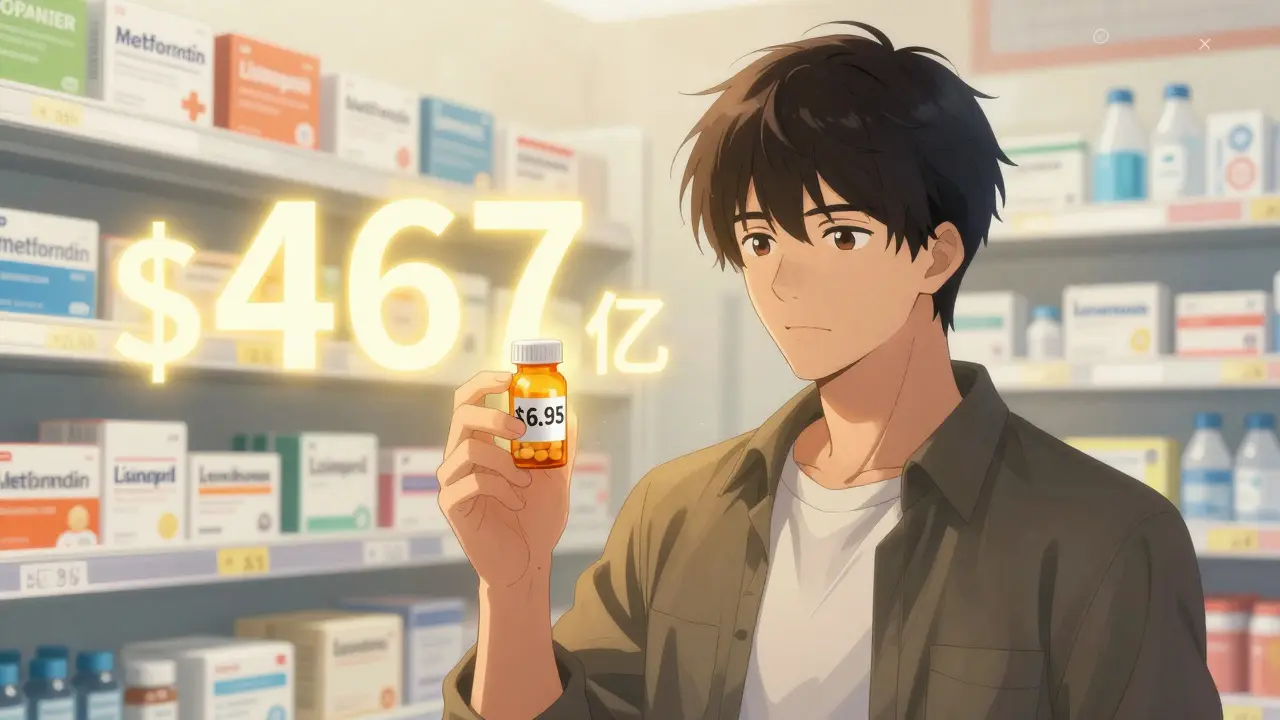
Every year, Americans spend over $700 billion on prescription drugs. But here’s the twist: 90% of all prescriptions filled are for generic drugs, and they cost just 12% of that total. That’s not a typo. Generics are saving the U.S. healthcare system nearly half a trillion dollars a year - and most people have no idea how big that number really is.
How Much Are You Really Saving?
In 2024, the average out-of-pocket cost for a generic prescription was $6.95. For a brand-name drug? $28.69. That’s more than four times as much. If you’re uninsured, the gap gets even wider. Brand-name drugs cost uninsured patients an average of $130.18 per prescription - up 50% since 2019. Meanwhile, generic prices dropped by 6% over the same period. You’re not just saving money. You’re avoiding financial risk.That $6.95 isn’t just a number. It’s what a diabetic pays for insulin instead of $300. It’s what someone with high blood pressure pays for lisinopril instead of $120. It’s what a parent buys for their child’s antibiotics instead of paying $80 out of pocket. Generics aren’t cheaper because they’re less effective. They’re cheaper because the patent expired, competition kicked in, and prices collapsed.
The Big Picture: $467 Billion Saved in One Year
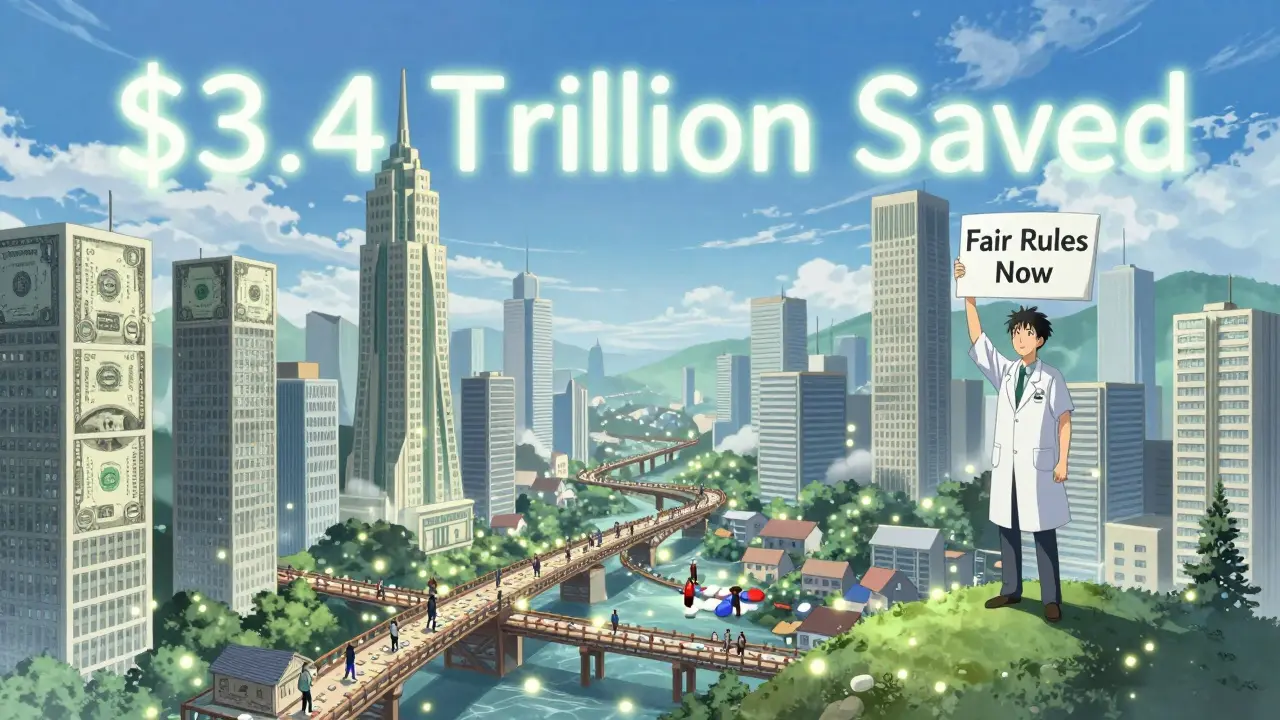
The total savings from generic and biosimilar drugs in 2024? $467 billion. That’s more than the entire annual budget of the U.S. Department of Education. It’s more than what the U.S. spends on public schools in a year. And it’s not a one-time spike - it’s been happening for a decade. Since 2015, generics and biosimilars have saved the system over $3.4 trillion.That’s not hypothetical. That’s real money taken out of patients’ pockets, insurance premiums, and government programs. Medicare alone saved $142 billion in 2024 because of generics - about $2,643 per beneficiary. That’s enough to cover dozens of co-pays, deductibles, or even a full year of a chronic condition medication.
Biosimilars: The New Wave of Savings
Biosimilars are the next chapter. These are generic versions of complex biologic drugs - things like Humira, Enbrel, or Herceptin - that used to cost $5,000 to $10,000 a month. In 2024, biosimilars saved $20.2 billion, nearly double what they saved the year before. Since their introduction in 2015, they’ve saved $56.2 billion total. And here’s the kicker: 60% of those savings happened in just the last two years.Why now? Because more biosimilars are getting approved. More pharmacies are stocking them. More doctors are prescribing them. And patients are finally getting access. No clinical issues have been reported after 3.3 billion days of biosimilar use. That’s not a guess. That’s data from millions of patients.
Why Are Generics Getting Cheaper Even as More Are Sold?
This is the strangest part. Since 2019, the number of generic pills sold in the U.S. went up from 167 billion to 197 billion - a 15% increase. But the total money spent on all generics? It dropped by $6.4 billion. That’s not a glitch. That’s the market working exactly as it should.When a patent expires, multiple companies start making the same drug. They compete on price. One company slashes its price to win a contract. Others follow. Retailers demand lower prices. Pharmacy benefit managers (PBMs) push for the cheapest option. Eventually, the price drops to pennies. A 30-day supply of metformin? $4. Atorvastatin? $5. Levothyroxine? $10. These are drugs millions rely on - and they’re cheaper than a cup of coffee.
Why Brand Names Keep Getting More Expensive
While generics keep falling in price, brand-name drug makers keep raising theirs. In January 2025, major pharmaceutical companies raised prices on 250 drugs by a median of 4.5%. That’s nearly double the rate of general inflation. Some drugs jumped 10%, 20%, even 30% in a single year.Meanwhile, a drug called Vasostrict - used in critical care - dropped 76% in price over just four months in 2025. Why? Because a generic version entered the market. The brand-name version couldn’t compete. That’s the power of competition.
But here’s the problem: brand-name companies aren’t just raising prices. They’re using legal tricks to block generics. Patent thickets - filing dozens of minor patents to extend exclusivity - cost the system an estimated $1.8 billion over 10 years. “Product hopping” - tweaking a drug slightly to reset the patent clock - costs another $1.1 billion. And pay-for-delay deals, where brand-name companies pay generic makers to stay off the market, cost $12 billion a year - $3 billion of that borne by Medicare.
The Hidden Threat: Generic Manufacturers Are Struggling
Here’s the uncomfortable truth: the system that saves you money is under stress. Generic drug makers are operating on razor-thin margins. Some drugs are made by just one or two companies. If one shuts down - because the price is too low to cover production costs - the supply vanishes.The Biosimilars Council warns that without policy changes, we could see more shortages. Drugs like doxycycline, clindamycin, or hydrocortisone - staples in every pharmacy - have already disappeared from shelves in some states. It’s not because no one needs them. It’s because no one can make them profitably.
Manufacturers aren’t asking for higher prices. They’re asking for fairer rules. They want patent abuse stopped. They want Medicare and PBMs to stop blocking access to the cheapest option. They want the FDA to speed up approvals so competition arrives faster. Right now, the system rewards big pharma’s pricing games and punishes the companies that keep drugs affordable.
What This Means for You
If you’re on a prescription, ask your pharmacist: Is there a generic? If you’re paying cash, ask: What’s the cash price? Sometimes, the cash price for a generic is lower than your insurance co-pay. Use GoodRx or similar tools to compare. Don’t assume your insurance will save you money - sometimes, it doesn’t.If you’re on Medicare, check your plan’s formulary. Some plans still don’t cover the cheapest generic. You might be paying more than you need to. Talk to your doctor. Ask if switching to a generic would work. Most of the time, it will.
And if you’re lucky enough to be healthy? Remember: the system that keeps drug prices low for others is the same one that keeps your premiums lower. When generics save $467 billion a year, it helps everyone - even those who don’t use them.
The Future Is in the Numbers
The data doesn’t lie. Generics and biosimilars are the most effective cost-control tool in modern healthcare. They’re not perfect. They’re not always available. But when they are, they deliver savings no other system can match.The question isn’t whether generics work. It’s whether we’ll protect the system that makes them work. Without competition, without fair rules, without support for manufacturers - those $6.95 prescriptions could disappear. And the next time you need a drug, you might pay $100 instead of $7.
Are generic drugs as safe and effective as brand-name drugs?
Yes. The FDA requires generic drugs to have the same active ingredient, strength, dosage form, and route of administration as the brand-name version. They must also meet the same strict standards for quality, purity, and performance. Studies consistently show generics perform identically in the body. The only differences are in inactive ingredients like fillers or dyes - which don’t affect how the drug works.
Why are some generic drugs still expensive?
Some generics stay expensive because there’s little or no competition. If only one company makes a drug, they can keep prices high. This often happens with older drugs, complex formulations, or those with low profit margins. When a second manufacturer enters the market, prices typically drop by 50% or more within months. That’s why shortages or delays in generic approvals can hurt patients.
Do insurance plans always cover the cheapest generic?
Not always. Some insurance plans have tiered formularies that favor certain brands or generics - even if they’re not the lowest-priced option. Others require prior authorization for generics. Pharmacy benefit managers (PBMs) sometimes steer patients toward higher-cost options because they get rebates from manufacturers. Always check your plan’s formulary and ask your pharmacist if there’s a cheaper alternative.
Can I trust biosimilars for serious conditions like cancer or rheumatoid arthritis?
Yes. Biosimilars are rigorously tested to show they work the same way as the original biologic drug. Over 3.3 billion days of patient use have been tracked with no unique safety issues. The FDA approves them only after proving they’re highly similar in structure, function, and clinical outcomes. Many patients switch from brand-name biologics to biosimilars without any change in effectiveness or side effects.
Why don’t more people know about generic drug savings?
Because the savings are invisible. You don’t get a bill saying, “You saved $467 billion this year thanks to generics.” The savings are baked into lower premiums, lower co-pays, and lower government spending. Meanwhile, brand-name drug companies spend billions on advertising, making their products seem like the only option. The real story - that most prescriptions are cheap generics - rarely makes headlines.
What can I do to help keep generic drugs affordable?
Ask for generics every time you get a prescription. Use price-comparison tools like GoodRx. Report shortages to your pharmacist or local health department. Support policies that stop patent abuse and pay-for-delay deals. And talk to your elected representatives - the system only stays strong if people demand it.
Comments (11)
-
gerard najera December 31, 2025
Generics work. They always have. The system isn’t broken-it’s just being gamed by people who don’t care if you live or die as long as the profit margin stays high.
Simple as that.

-
Stephen Gikuma January 1, 2026
They don’t want you to know this because it proves the whole pharma cartel is a scam. Big Pharma pays off politicians, the FDA, even your damn pharmacist. They let generics exist-just enough to keep the masses quiet-but they block the real competition. That’s why you still see shortages. It’s not an accident. It’s control.
And don’t get me started on how they use patent thickets like legal landmines. This isn’t capitalism. It’s feudalism with pill bottles.

-
Bobby Collins January 2, 2026
i swear the government knows but lets it happen so we stay dependent… like they want us to keep buying overpriced crap so we’re too broke to protest
also why is doxycycline gone from my pharmacy again??

-
Layla Anna January 2, 2026
just had my first biosimilar last month for my arthritis and honestly?? it felt the same but i paid $15 instead of $400 😭
thank you to whoever made this possible 🙏
also why does no one talk about this more?? it’s wild

-
Matthew Hekmatniaz January 4, 2026
I’ve seen the data. I’ve talked to pharmacists. I’ve watched my dad switch from Humira to a biosimilar and not miss a beat.
There’s no mystery here. The system works when it’s allowed to.
What’s broken is the incentive structure-not the science, not the drugs, not the people taking them.
We need to fix the rules, not the remedies.

-
Sally Denham-Vaughan January 4, 2026
The economic logic here is textbook perfect: increased supply, price elasticity, competitive pressure, and regulatory transparency combine to drive down marginal costs while maintaining therapeutic equivalence. What’s fascinating is how the market correction occurs not through centralized planning but through decentralized, profit-driven actors-generic manufacturers-who, despite operating on razor-thin margins, still achieve economies of scale that outperform monopolistic brand-name pricing models.
Yet the structural barriers-patent evergreening, PBM rebates, and regulatory delays-create artificial scarcity, which undermines the very efficiency the system was designed to produce. This isn’t market failure. It’s regulatory capture. And the cost isn’t measured in dollars alone-it’s measured in lives delayed, treatments foregone, and trust eroded.
Until we dismantle the rent-seeking mechanisms that protect incumbents, we’re just rearranging deck chairs on the Titanic of American healthcare.

-
Bill Medley January 4, 2026
Generic drugs are therapeutically equivalent to their brand-name counterparts, as confirmed by the FDA’s bioequivalence standards.
Cost savings are verifiable and substantial.
Policy reform is necessary to ensure sustained market competition.

-
Ann Romine January 6, 2026
I wonder how many people realize that the reason their insulin is $30 instead of $300 isn’t because of charity-it’s because someone else fought for the patent to expire.
And now those same people are getting squeezed out because the price dropped too low.
It’s like we reward innovation but punish affordability.

-
Todd Nickel January 6, 2026
It’s worth noting that the 15% increase in generic volume since 2019 coincides with the expansion of mail-order pharmacies and Medicare Part D formulary changes that incentivized tiered pricing. The $6.4 billion drop in total spending doesn’t reflect lower demand-it reflects increased market penetration of lower-cost manufacturers, particularly from India and China, whose production efficiencies and vertical integration allow them to undercut domestic producers. The FDA’s backlog in approving new generic applications has historically been a bottleneck-over 1,200 pending applications as of 2023-so the recent acceleration in biosimilar approvals is a direct result of the Biosimilar Action Plan introduced in 2020. What’s alarming is that despite this progress, 30% of generic drugs still have only one or two manufacturers, creating dangerous single-point failures. The real crisis isn’t pricing-it’s supply chain fragility masked by low costs.

-
Heather Josey January 8, 2026
This is the kind of information that should be taught in high school health class.
We’re talking about real people-parents, seniors, kids-who are choosing between medicine and groceries.
Thank you for laying this out so clearly.
Let’s make sure everyone knows: asking for a generic isn’t being cheap-it’s being smart.
And we should all be fighting to keep it that way.

-
Olukayode Oguntulu January 8, 2026
Ah yes, the classic neoliberal fantasy: competition = salvation.
But let’s not pretend this isn’t a global asymmetry-Indian generics thrive because labor is cheap, environmental regulations are negligible, and the state subsidizes R&D while the West reaps the benefits.
Meanwhile, American manufacturers are being starved into oblivion by a system that praises ‘affordability’ but refuses to pay for it.
This isn’t liberation-it’s exploitation dressed in a white coat.
And don’t even get me started on the moral bankruptcy of calling $6.95 a ‘victory’ when the people making it can’t afford rent.
