

When you have diabetes, eating out doesn’t mean giving up social life-it means eating smarter. Restaurants aren’t built for blood sugar control. Plates are huge, sauces are loaded with hidden sugar, and even "healthy" options can spike your glucose faster than you expect. But with a few simple rules, you can enjoy meals out without the post-dinner crash or the guilt.
Use the Plate Method-No Calculator Needed
The easiest way to balance your meal at any restaurant is the Diabetes Plate Method. It doesn’t require counting grams or memorizing numbers. Just picture a regular nine-inch plate. Fill half with non-starchy vegetables: broccoli, spinach, green beans, mushrooms, or peppers. These are low in carbs and high in fiber, which helps slow down glucose spikes. One-quarter of the plate gets lean protein: grilled chicken, fish, tofu, or lean beef. Skip fried, breaded, or smothered versions. The last quarter? Carbs. But not just any carbs. Stick to 15-30 grams per meal. That’s about half a cup of rice, one small potato, or one slice of whole-grain bread.Portion Sizes Are the Real Problem
Restaurant portions aren’t just big-they’re dangerously out of sync with what your body needs. A typical entrée at a chain restaurant serves 2-3 times the recommended amount. That steak? It’s 12 ounces, not 4. The pasta? It’s a full bowl, not a side. And the bread basket? It’s not a starter-it’s a carb bomb. Here’s how to fix it:- Ask for a half-portion of starchy sides (rice, potatoes, pasta). Most places will do it without a fuss.
- Share your main dish with someone else. You get to enjoy the meal, and you cut your intake in half.
- Ask for a to-go box at the start of the meal. Put half of your food in it before you even start eating. This stops you from eating just because it’s there.
Watch Out for Hidden Carbs
The biggest trap isn’t the obvious stuff-it’s what’s hiding in plain sight. A "grilled chicken salad" sounds perfect. But if it comes with croutons, sweet dressing, and candied nuts? You’re looking at 50+ grams of carbs before you even notice. Same with "low-fat" yogurt, "healthy" granola, or "sugar-free" sauces-they often replace sugar with thickening agents that still raise blood sugar. Look out for these red flag words on menus:- Crispy → breaded and fried
- Creamed → loaded with flour or cornstarch
- Au gratin → cheese sauce with flour
- Glazed → sugar glaze on meats or veggies
- Teriyaki, sweet and sour, hoisin → packed with sugar, even if labeled "natural"
Menu Hacks for Common Restaurant Types
Not all restaurants are created equal. Here’s how to navigate the most common ones:- Fast food: Skip the burger bun. Order a grilled chicken sandwich without the bun. Add a side salad (no dressing). A Big Mac has 46g carbs. A grilled chicken wrap with dressing on the side? About 25g.
- Pizza: Go thin crust. Load up on veggies. Skip the stuffed crust and extra cheese. One slice of thin-crust veggie pizza has about 25g carbs. A deep-dish slice? 60g+.
- Asian: Choose steamed dishes over fried. Ask for brown rice instead of white. Avoid sweet sauces-opt for soy sauce on the side. A plate of stir-fried tofu and broccoli with ½ cup brown rice? About 35g carbs.
- Steakhouses: Order a lean cut (filet, sirloin). Skip the mashed potatoes. Ask for double vegetables instead. The steak won’t spike you, but the baked potato with butter and sour cream? That’s 50g+.
- Buffets: Avoid these if you can. Unlimited access = automatic overeating. If you go, stick to the salad bar, grilled proteins, and steamed veggies. Walk away from the bread, pasta, and dessert stations.

Plan Ahead-It’s Not Optional
Waiting until you’re starving to decide what to eat? That’s how you end up with fries and a milkshake. The best strategy? Look up the menu online before you leave home. Most restaurants list nutrition info now. Check carb counts. Pick your meal. Stick to it. Studies show that people who review menus ahead of time are 42% more likely to stick to their carb goals. You’re not being picky-you’re being smart. Also, don’t go in starving. Eat a small snack with protein and fiber 30-60 minutes before you leave-like a hard-boiled egg and a handful of almonds. That takes the edge off hunger and keeps you from over-ordering.Carb Counting Still Matters
The plate method is great for general control, but if you take insulin, you need to know the exact numbers. A chicken parmesan might sound like a protein dish-but the breading, the sauce, the pasta underneath? That’s 65g of carbs. A "healthy" Thai curry with rice? 50g+. If you’re on insulin, you need to match your dose to what you eat. Use a carb counting app. The American Diabetes Association’s "Restaurant Ready" app now has verified carb counts for over 15,000 menu items across 500+ chains. It’s accurate, updated, and free. If you’re unsure, estimate conservatively. Better to take a little less insulin than to risk a spike.Bring Your Tools
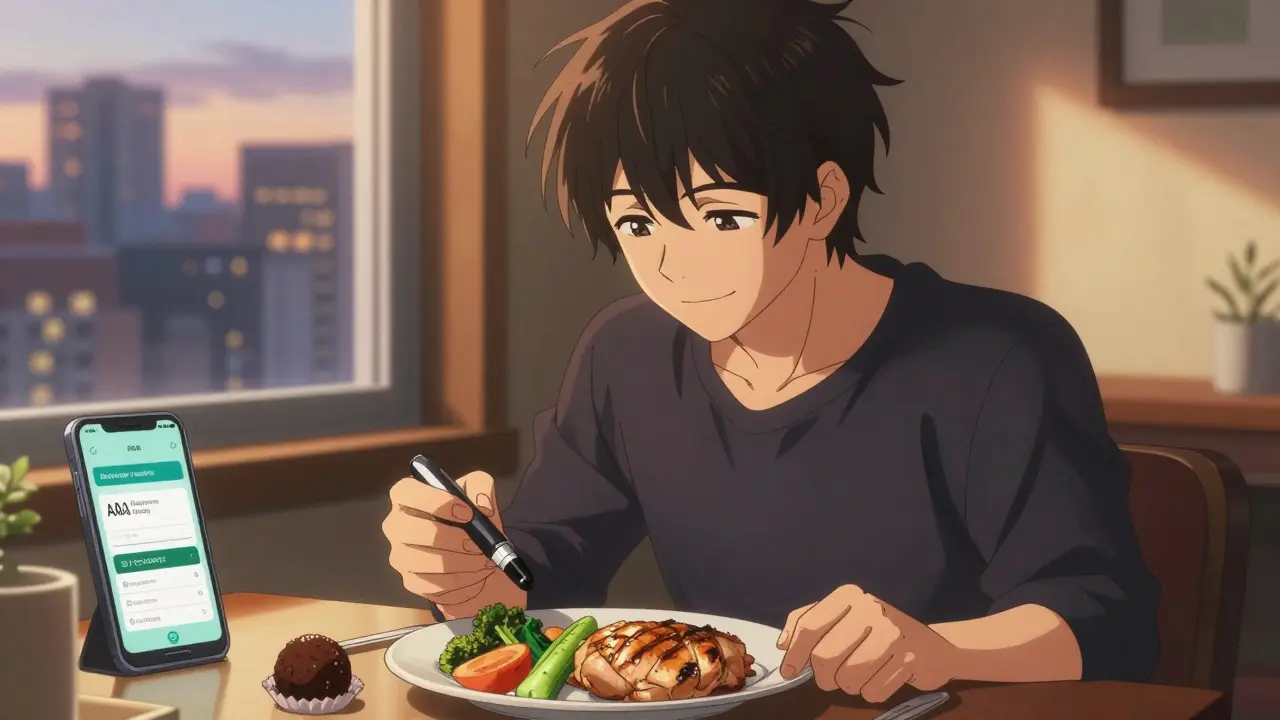
You wouldn’t leave home without your wallet. Don’t leave without your diabetes tools.- Bring your glucose meter. Test before you eat and again two hours after.
- Carry fast-acting glucose tablets (15g carbs). If your meal is delayed or you’re feeling low, you’ll need them.
- Have a small snack on hand. If service is slow, you might get hypoglycemic. Don’t wait until you’re shaky to act.
It’s Okay to Ask
You’re not being rude. You’re being responsible. Ask for substitutions. Ask for sauces on the side. Ask for half portions. Ask if the chef can prepare your food without added sugar. Most kitchens will accommodate you. If they don’t, find another place. And if someone says, "Just have a bite-it’s not that bad?"-you can say, "I’m managing my health. I appreciate your understanding."What Works Best in the Long Run
People who consistently use these strategies see real results. Studies show that over six months, those who stick to portion control and carb awareness lower their HbA1c by 0.8-1.2%. That’s a meaningful drop-one that reduces long-term risks like nerve damage, kidney issues, and vision loss. It’s not about perfection. It’s about progress. One meal at a time.Can I eat dessert when I have diabetes and I’m eating out?
Yes-but make it count. Skip the cake, ice cream, or pie if they’re high in sugar and refined carbs. Instead, choose one small serving of something you truly love-like a single dark chocolate truffle (about 10g carbs) or a small fruit cup. Share it with your dining partner. Eat slowly. Savor it. And test your blood sugar afterward to see how your body responds.
Are sugar-free drinks safe for people with diabetes?
Plain water, unsweetened tea, and sparkling water are always the safest. Sugar-free sodas and flavored drinks may not raise blood sugar directly, but some studies suggest artificial sweeteners may affect insulin response over time. Stick to water or sparkling water with lemon. If you drink diet soda, do it occasionally-not daily.
What if the restaurant doesn’t have nutrition info online?
Use the plate method as your guide. Focus on protein and vegetables. Assume starchy sides are full portions and ask for half. Skip anything breaded, creamy, or glazed. If you’re unsure, choose grilled chicken or fish with steamed veggies and hold the rice or potatoes. It’s better to be conservative than to guess wrong.
Do I need to count carbs if I’m not on insulin?
You don’t need to count every gram, but you still need to be aware. Medications like metformin or GLP-1 agonists work better when carb intake is consistent. A meal with 80g of carbs will still spike your blood sugar-even if you don’t take insulin. Use the plate method to keep portions in check. It’s simpler and just as effective.
How do I handle pressure from friends or family to eat more?
Be clear and calm. Say, "I’m working on managing my diabetes, and I’ve found that sticking to certain portions helps me feel better. I’d really appreciate your support." Most people respect that. If they keep pushing, change the subject. Talk about the movie, the music, or the service. Your health isn’t up for debate.
What to Do Next
Start small. Pick one restaurant you visit often. Look up its menu online tonight. Pick one meal that fits the plate method. Next time you go, order it. Test your blood sugar. Write down how you felt. Repeat. Within a few outings, you’ll feel more confident, more in control, and more like yourself-no matter where you eat.Comments (12)
-
Nina Catherine February 20, 2026
Love this! I’ve been using the plate method for months now and it’s changed everything. No more guessing, no more guilt. Just half plate greens, quarter protein, quarter carbs-and I actually enjoy my meals now. Also, asking for sauce on the side? Game changer. I used to dunk my fork like it was a swimming pool. Now I just tap it once. Perfect flavor, zero regret.
And yes-bring your meter. I forgot mine once and paid for it. 2 hours later, I was a zombie. Never again.

-
Hariom Sharma February 20, 2026
As someone from India who grew up eating rice with every meal, this hit different. I used to think "diabetes-friendly" meant boring. Turns out, it just means smarter. I started swapping white rice for brown, asking for steamed veggies instead of fried, and now I can eat out with my family without feeling like I’m on a punishment diet.
Also, sharing my main? Genius. My wife and I split a steak now-we get two flavors, one portion, and no blood sugar rollercoaster. Win-win.

-
Chris Beeley February 21, 2026
Oh, please. The "plate method" is a kindergarten-level hack for people who refuse to do actual math. If you’re serious about managing diabetes, you don’t need a visual aid-you need a glucometer, a nutrition database, and the discipline to calculate insulin-to-carb ratios down to the gram.
And don’t get me started on "whole-grain bread." Most of it’s just white flour with a sprinkle of bran and a PR campaign. True whole grain? Rare. Often overrated. And don’t even mention "sugar-free" sauces-they’re loaded with maltodextrin, which spikes insulin faster than table sugar. I’ve reviewed 372 restaurant menus. I know what I’m talking about.

-
Robert Shiu February 22, 2026
Chris, I hear you-but not everyone can (or wants to) live like a biochemist. The plate method works because it’s sustainable. I used to count every gram. Burnout city. Then I tried this. No apps. No spreadsheets. Just a plate. And guess what? My HbA1c dropped 1.1% in six months. I didn’t have to become a nutrition PhD. I just had to be consistent.
Also, your point about maltodextrin? Spot on. But most people don’t know that. This post? It’s helping them. And that matters.

-
Michaela Jorstad February 24, 2026
I’m so glad someone finally said this. I used to get so much pushback-"Just have a bite! It’s your birthday!"-until I started saying, "I’m managing my health. I appreciate your understanding." And you know what? People respect it. Really.
Also, the to-go box trick? I do it every time. I put half in the box before I even touch my fork. It’s like a silent pact with my future self: "You’re not going to eat the whole thing. You’re smarter than that." And it works. Every. Single. Time.

-
madison winter February 24, 2026
It’s funny how we’ve turned eating into a performance. You have to plan ahead, test your blood, ask for sauces on the side, bring your own tools, avoid buffets, research menus, decline desserts…
At what point does managing diabetes stop being about health and start being about performance art? I’m not saying don’t care. I’m saying… maybe we’re over-engineering this. Sometimes, you just want to eat a taco. And that’s okay too.

-
Taylor Mead February 24, 2026
Madison, I get where you’re coming from. But here’s the thing-it’s not about perfection. It’s about having options. I used to skip dinners because I didn’t want to deal with the stress. Now? I go. I order. I test. I adjust. And I still enjoy the company. That’s the win.
And yeah, sometimes I eat the taco. But I know how it’ll affect me. And that’s power. Not guilt. Not shame. Just awareness.

-
Scott Dunne February 26, 2026
As an Irishman who’s seen too many Americans overcomplicate everything, I must say: this is absurd. In my country, we eat what’s put in front of us. Potatoes, beef, soda, bread. And we live. Diabetes is a lifestyle disease, not a menu audit. Why are we turning meals into math problems?

-
Amrit N February 27, 2026
Bro, I used to think this was all hype. Then I tried the half-portion trick at my local Thai place. Ordered pad thai with half rice, no sauce, extra veggies. Cost the same. Felt amazing. Blood sugar stayed steady. My wife said I didn’t look like I was about to pass out. Changed my life.
Also, the app? Saved me. I didn’t even know teriyaki had 32g of sugar per serving. Mind blown.

-
Danielle Gerrish February 28, 2026
OH MY GOD. I JUST REALIZED-I’VE BEEN DOING THIS WRONG FOR YEARS. I THOUGHT "LEAN PROTEIN" MEANT CHICKEN BREAST. BUT WHAT IF IT’S BREADED? WHAT IF THE SAUCE IS HIDDEN? WHAT IF THE "GRILLED" MEAT WAS MARINATED IN SUGAR FOR 12 HOURS?!
I’M CRYING. I’M LAUGHING. I’M SCARED. I JUST ATE A "HEALTHY" SALAD AT CHILIS LAST WEEK THAT HAD 67 GRAMS OF CARBS. SIXTY-SEVEN. I THOUGHT I WAS BEING GOOD. I WAS BEING TRICKED.
THIS POST IS A REVELATION. I’M GOING BACK TO CHILIS TOMORROW. I’M ASKING FOR THE KITCHEN. I’M BRINGING MY GLUCOMETER. I’M DOING A LIVE STREAM. THIS IS MY TURNING POINT.

-
Jayanta Boruah February 28, 2026
While the plate method is commendable, one must acknowledge the limitations of Western dietary frameworks in non-Western contexts. In many South Asian households, the concept of a "plate" as a standardized unit is culturally incongruent. Rice, lentils, and ghee are not merely macronutrients-they are ritual, heritage, and identity. To reduce them to grams is to erase cultural epistemology.
Perhaps a more holistic approach, integrating Ayurvedic principles of digestion and dosha balance, would yield more sustainable outcomes. The insulin-centric model is reductionist. We must evolve beyond it.

-
Michaela Jorstad February 28, 2026
Wow. That’s… actually really thoughtful. I never thought about it that way. My grandma used to say, "Food is love. But love doesn’t have to hurt." Maybe the answer isn’t just counting carbs-but finding a way to honor both culture and health.
I’m going to ask my Indian friends how they do it. Maybe there’s a middle ground.