

When your knees ache just to stand up, or your hips scream after walking to the mailbox, it’s not just aging-it’s joint disorder. And too many people think they have to live with it, or jump straight to surgery. But there’s a proven, powerful alternative that doesn’t cost tens of thousands of dollars or require a hospital stay: physical therapy. Not the vague ‘do some stretches’ advice you get from a friend. Real, science-backed physical therapy that rebuilds movement and strength, one controlled motion at a time.
Why Movement Is Medicine, Not a Bonus
For decades, joint pain was treated with pills, injections, and eventually, replacement. But the tide turned in 2021 when the American College of Rheumatology officially declared exercise as disease-modifying therapy for rheumatoid arthritis-not just a way to feel better, but a way to slow damage. That’s huge. It means moving your joints isn’t optional. It’s medical treatment. Studies show people who stick with physical therapy cut their pain by nearly 40% and improve daily function by almost 30%. That’s not a small gain. That’s the difference between needing help to get out of a chair and doing it on your own. And it’s not just for arthritis. Whether it’s your shoulder, knee, hip, or even your sacroiliac joint, targeted movement is the most effective non-surgical tool we have.Range of Motion: It’s Not Just About Flexibility
When a joint gets stiff, it doesn’t just hurt-it stops working. You lose the ability to fully straighten your knee, lift your arm, or turn your neck. That’s not laziness. That’s your body protecting itself. But staying still makes it worse. Physical therapists don’t just ask you to ‘bend and stretch.’ They use precise protocols. For knee osteoarthritis, the standard is 3 sets of 10 to 15 repetitions of terminal knee extension-where you slowly straighten your leg from a bent position-done five days a week. The resistance? Just enough to feel challenge, not pain. And the pain level? Must stay under 3 out of 10. Push past that, and you’re not helping. You’re hurting. The goal isn’t to touch your toes. It’s to restore the exact range your body needs to walk, climb stairs, or sit comfortably. A 2023 review of over 120 studies found that people who followed these specific ROM protocols regained enough movement to reduce their need for painkillers by nearly half within 12 weeks.Strengthening: The Real Game-Changer
Stiffness is one problem. Weakness is the other. When your joints hurt, your muscles shut down. Your quadriceps, glutes, and hip abductors go quiet. That’s your body’s way of saying, ‘I can’t trust this joint.’ But that makes the joint even more unstable. That’s where strengthening comes in. And it’s not about lifting heavy weights. It’s about controlled, consistent tension. For hip osteoarthritis, the 2025 JOSPT guidelines recommend 3 sets of 15 reps with 2.5 to 5.0 kg resistance, three times a week. For rheumatoid arthritis, it’s 40-60% of your one-rep max, twice a week. These aren’t guesses. They’re based on muscle response data from thousands of patients. Here’s what works: isometric holds at the start (like pushing your knee into a pillow without moving it), then moving to dynamic exercises like seated leg presses or standing hip abductions with resistance bands. Progression is slow-adding 0.5 to 1.0 kg every week. Too fast, and you flare up. Too slow, and you don’t build strength. The result? A 2023 study in Arthritis & Rheumatology found that physical therapy gave patients with mild-to-moderate hip OA the same functional improvement as total hip replacement-at 12 months. And they avoided surgery for over two and a half years on average.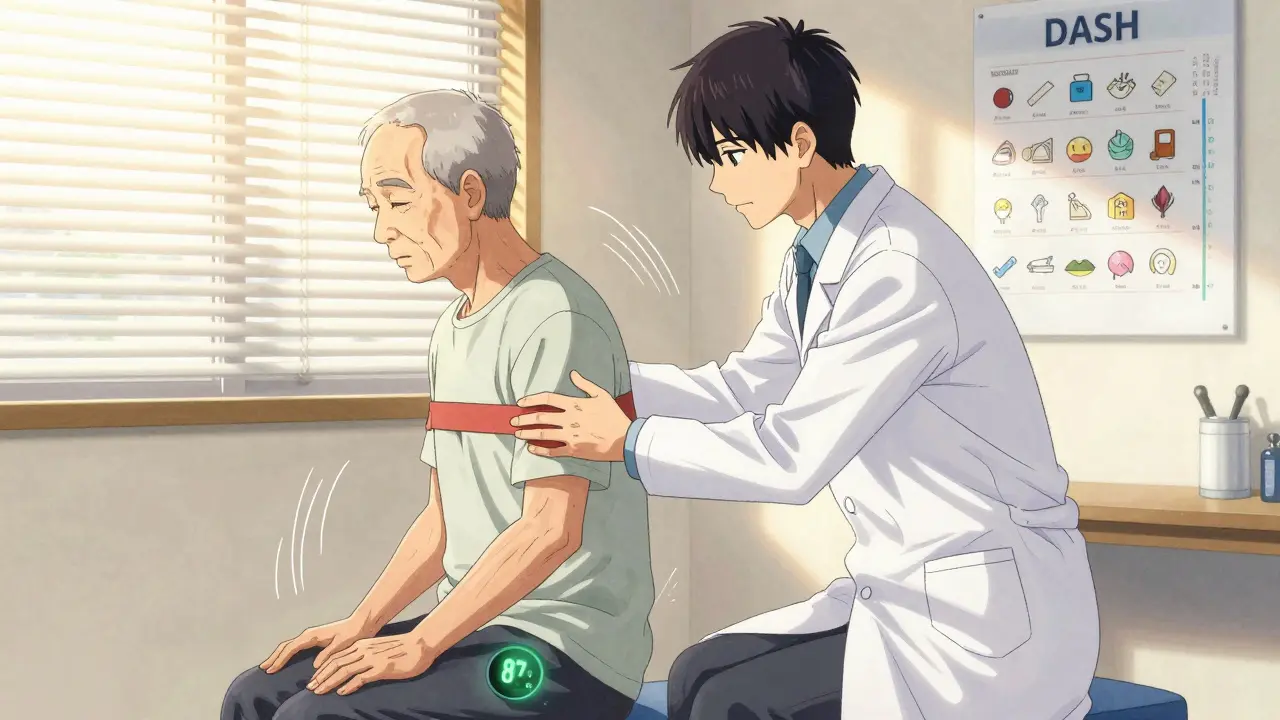
When Physical Therapy Doesn’t Work (And Why)
It’s not magic. And it’s not for everyone. If your X-ray shows more than 50% joint space loss, exercise alone won’t restore the cushioning. That’s structural damage. Physical therapy can still help with pain and mobility, but it won’t reverse the wear. And here’s the catch: generic exercises fail. A 2022 study found that if a therapist just gives you a handout with 5 exercises and says ‘do these,’ only 12-15% of people get real results. But when the program is tailored-based on your pain level, joint alignment, strength gaps, and even your daily routine-the success rate jumps to 65-70%. That’s why a good physical therapist spends the first session doing a full assessment. Not just ‘where does it hurt?’ but ‘how do you get out of bed?’ ‘Can you step up onto a curb?’ ‘Do you feel wobbly when you turn?’ These details matter.The Hidden Barriers: Insurance, Access, and Persistence
You might be ready to start-but the system isn’t always ready for you. Medicare and private insurers often limit sessions. One patient on Reddit said their plan capped them at 10 visits, even though their therapist said they needed 16. That’s common. A 2023 survey found 58% of negative reviews cited insurance limits as the reason they quit. Rural patients are 2.4 times more likely to drop out because of travel. No clinic nearby. No ride. No money for gas. That’s a real barrier. And then there’s the pain spike. The first two weeks are rough. Your muscles are waking up. Your joint is adjusting. That burning sensation? It’s normal. But if it lasts more than two hours after exercise, or spikes above a 5/10, you need to adjust. Not quit. The key? Track it. Write down your pain before and after each session. If you’re consistent, you’ll see the curve drop by week four.What Success Looks Like
Success isn’t running a marathon. It’s simpler:- Getting out of a car without gripping the doorframe
- Climbing stairs without stopping
- Standing in the kitchen to cook without needing a stool
- Playing with your grandkids without needing two days to recover

What’s New in 2025
The field is evolving fast. New guidelines released in January 2025 use machine learning to predict who will respond best to which exercise. Based on your HOOS score, BMI, and X-ray severity, the system recommends the most effective routine before you even start. Telehealth is now covered. You can do your sessions at home with a wearable sensor that tracks your movement accuracy. If you’re not bending your knee enough, the app alerts you. If you’re using your hip instead of your quad, it tells you. Accuracy must be 85% or higher for reimbursement. And in 2026, Medicare will start covering maintenance therapy for chronic joint conditions. No more ‘you’re done after 12 visits.’ If you need ongoing care to stay mobile, you’ll be able to get it.How to Get Started
1. Ask your doctor for a referral. Most orthopedists and rheumatologists now follow the ‘Try Physical Therapy First’ rule. 2. Find a therapist who specializes in orthopedics. Look for one who uses validated tools like HOOS, KOOS, or DASH scores-not just ‘how does it feel?’ 3. Be ready to track your progress. Keep a simple log: date, exercise, pain level before and after, how you felt the next day. 4. Don’t quit during the first two weeks. That’s when your body is learning. The worst pain is often the turning point. 5. Ask about home equipment. Resistance bands, ankle weights, and foam rollers cost less than $50. You don’t need a gym.Final Thought: Movement Is the Only Cure That Never Runs Out
Pills wear off. Injections fade. Surgery has risks. But movement? When done right, it builds resilience. It teaches your body to protect itself. It doesn’t just mask pain-it fixes the root. You don’t need to be young. You don’t need to be fit. You just need to start. And keep going.Can physical therapy really replace surgery for joint disorders?
For mild to moderate osteoarthritis-especially in the hip and knee-yes. A 2023 study in Arthritis & Rheumatology found that physical therapy delivered the same functional outcomes as total joint replacement at 12 months. Many patients delay or avoid surgery entirely, gaining years of mobility without invasive procedures. But if joint damage is severe (over 50% space loss on X-ray), surgery may still be necessary. Physical therapy still helps with pain and recovery, but it won’t rebuild cartilage.
How long does it take to see results from physical therapy?
Most people notice small improvements in pain and movement within 3 to 4 weeks. By week 6 to 8, functional gains-like climbing stairs or rising from a chair-become clear. Medicare data shows 87% of patients reach their goals by session 12, if they follow the protocol. But it’s not about speed. It’s about consistency. Skipping sessions delays progress. Showing up, even when it’s hard, is what changes outcomes.
Is it normal to feel more pain at first?
Yes, but only temporarily. The first 10 to 14 days often involve mild to moderate discomfort as muscles wake up and joints adapt. This isn’t injury-it’s adaptation. Pain should stay below 3/10 during exercise and resolve within two hours after. If pain spikes above 5/10, lasts longer than 24 hours, or causes swelling, you need to adjust the program. Never push through sharp or shooting pain. That’s a warning sign.
Do I need special equipment for home exercises?
No, but it helps. Resistance bands, ankle weights (1-5 kg), and a sturdy chair are enough for most programs. You can do terminal knee extensions, hip abductions, and seated leg lifts without any gear. Therapists often start with bodyweight exercises and add resistance only when you’re ready. A foam roller or tennis ball can help with muscle tightness. You don’t need a gym membership.
What if my insurance won’t cover enough sessions?
Many insurers limit visits to 10-12, even when you need more. Talk to your therapist-they can often adjust the plan to focus on teaching you how to continue safely at home. Ask for a home exercise program with clear instructions and progressions. Some clinics offer maintenance plans at lower rates. Also, check if your plan covers telehealth; remote sessions with wearable sensors are now reimbursable and can extend your care without extra visits.
Can physical therapy help with arthritis in my hands or wrists?
Absolutely. The same principles apply. For hand and wrist osteoarthritis, therapists use gentle range-of-motion drills, grip strengthening with putty or bands, and joint protection techniques. The DASH score (Disabilities of the Arm, Shoulder, and Hand) is used to track progress. A 2024 study showed that patients who did daily wrist flexion/extension and thumb opposition exercises for 8 weeks improved grip strength by 32% and reduced pain by 41%.
How do I know if my physical therapist is qualified?
Ask if they’re board-certified in orthopedics (OCS) or have completed 120+ hours of specialized musculoskeletal training. They should use validated outcome tools like HOOS, KOOS, or DASH-not just ask ‘how does it feel?’ They should track your progress with numbers, not just words. And they should explain why each exercise matters. If they hand you a sheet and say ‘do these three,’ find someone else.
Comments (8)
-
Elaine Douglass December 18, 2025
I started PT last year for my knees and honestly thought I'd be back on the couch in a week
Turns out those little leg lifts and band exercises? They saved my ability to play with my grandkids
Worth every painful minute

-
Takeysha Turnquest December 18, 2025
Movement is the only prayer that doesn’t require a church
The body remembers what the mind forgets
Every rep is a rebellion against decay
You don’t heal with pills you heal with presence

-
Emily P December 19, 2025
Does anyone know if the machine learning tools mentioned in the 2025 guidelines are actually being used in clinics yet or is it still theoretical?
I’m curious if my therapist’s recommendations are based on real data or just experience

-
Dikshita Mehta December 19, 2025
I’ve been a physical therapist in rural India for 14 years
Same principles apply everywhere
Resistance bands cost less than a cup of tea
Patients who track pain daily improve faster than those who don’t
Consistency beats intensity every time
And yes, the first two weeks hurt like hell
But so does losing your independence

-
Mark Able December 20, 2025
Wait so you’re telling me I can just do this at home and avoid surgery?
My cousin spent $40k on a knee replacement and still can’t squat
Why didn’t anyone tell me this before I went under the knife?
Did your therapist give you a checklist or just wing it?
Can I text you my X-rays and you tell me if I’m wasting my time?
Also do you think my insurance will cover this if I do it on my phone?
Can you send me the exact app you use?
Are you sure it’s not just placebo?
My dog’s got arthritis and he does yoga on his own

-
James Stearns December 20, 2025
It is, indeed, an extraordinary assertion that non-invasive, non-pharmaceutical intervention can yield outcomes statistically indistinguishable from total joint arthroplasty. One must, however, interrogate the sample size, the inclusion criteria, and the follow-up duration of the cited 2023 Arthritis & Rheumatology study. Moreover, the notion that resistance bands are equivalent to biomechanical reconstruction is, frankly, an oversimplification bordering on medical malpractice. The human body is not a machine to be calibrated with household items. One must consider the structural integrity of the articular cartilage - a tissue incapable of regeneration without surgical intervention. To suggest otherwise is to endanger public health.

-
Dominic Suyo December 21, 2025
Oh wow another feel-good PT cult article
Let me guess - the author got paid by a resistance band company
They always skip the part where 80% of people quit after two weeks because it hurts and their insurance cuts them off
And don’t get me started on the ‘telehealth sensor’ nonsense - my grandma tried one and it told her she was ‘not bending enough’ while she was literally crying
It’s not medicine it’s a wellness scam with a fancy acronym
And don’t even get me started on the ‘machine learning’ BS - they just fed old data into a chatbot and called it AI
Real medicine doesn’t need apps to tell you how to move your leg

-
Janelle Moore December 23, 2025
Did you know the government is using PT as a cover to track your movement patterns?
Those wearable sensors? They’re syncing with your phone and sending data to the CDC
And the ‘HOOS scores’? They’re coded to flag you as ‘high risk’ so they can deny you future care
My cousin’s neighbor’s sister got her Medicare cut after PT because her knee flexion angle was ‘too inconsistent’
They’re building a database of joint mobility to predict who’ll need surgery next
And they’re using it to raise premiums
It’s not about healing - it’s about control
Don’t let them track your every step
