
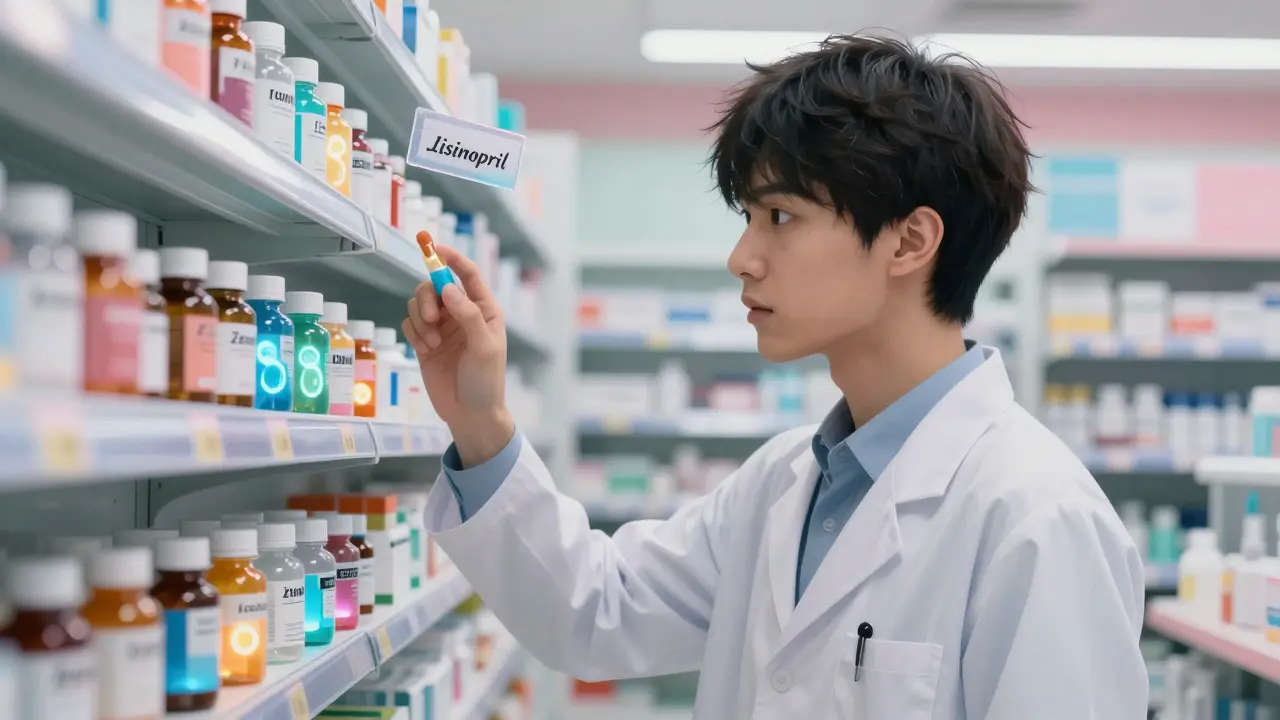
Pharmacy technicians are the backbone of medication safety in every pharmacy - from community stores to hospital wards. But here’s the hard truth: if a tech can’t tell the difference between generic and brand-name drugs, patients are at risk. With 90% of prescriptions in the U.S. filled with generics, this isn’t just about paperwork. It’s about lives.
Why Generic Drug Knowledge Isn’t Optional
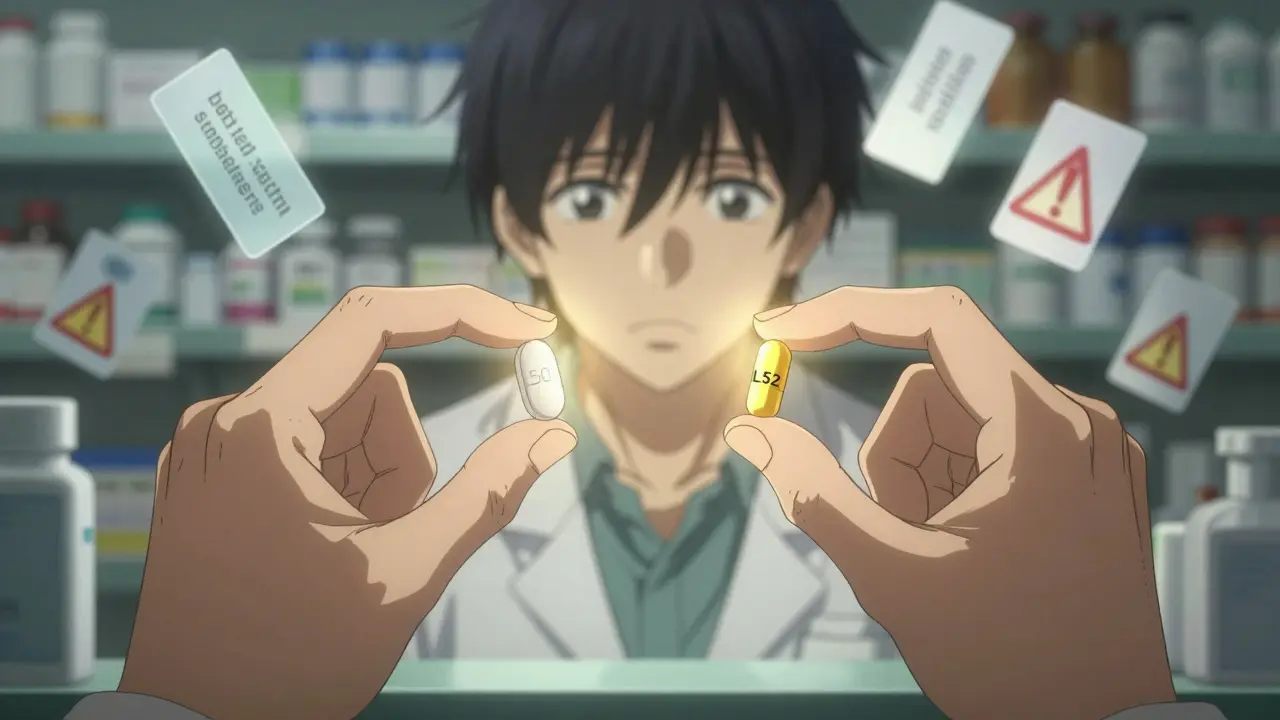
Generic drugs aren’t cheaper because they’re less effective. They’re cheaper because they’re copies - identical in active ingredients, dosage, and effect. But here’s where things get dangerous: they look different. A pill that’s blue and oval one week might be white and round the next. The same drug, different manufacturer. If a technician doesn’t recognize that, they might misfill a prescription. And that’s not hypothetical.
In 2021, the Institute for Safe Medication Practices found that 10-15% of medication errors linked to patient harm came from confusion between brand and generic names. Think glipizide vs. glyburide - two diabetes drugs with similar-sounding names but different dosing. Mix them up, and you could send someone into hypoglycemia. These aren’t rare mistakes. They happen daily.
What the Experts Say: Standards You Can’t Ignore
The Pharmacy Technician Certification Board (PTCB) sets the gold standard. Their 2026 exam now dedicates 18% of its content to generic drug knowledge - up from 14% just two years ago. That’s not a small tweak. That’s a signal: if you don’t know your generics, you don’t pass.
Here’s what you’re expected to know:
- At least 200 of the most commonly prescribed drugs - by both generic and brand name
- Drug classifications (e.g., beta-blockers, SSRIs, statins)
- Therapeutic duplication risks - like taking two different drugs that do the same thing
- Physical appearance: color, shape, imprint codes
- Strengths and dosage forms (tablet, capsule, liquid)
The Department of Veterans Affairs (VA) goes even further. Their HT38 standard requires technicians to identify 100% of Schedule II-V controlled substances by name - no exceptions. Miss one, and you’re not cleared to handle opioids or sedatives.
How States Differ - And Why It Matters
Not every state holds the same bar. California requires knowledge of 180 specific drugs. Texas? Only 120. This isn’t just confusing - it’s a barrier for technicians who move across state lines. One person can be certified in Florida, then hit a wall in New York because they didn’t learn the 30 extra drugs their new state demands.
Some states are trying to fix this. Minnesota added a formal competency on formulary substitution. Utah requires technicians to physically locate drugs by therapeutic class on the shelf. These aren’t just busywork - they’re practical skills that cut down on errors.
And then there’s the VA. Their system is built for consistency. Technicians there get quarterly assessments on 100 randomly selected drugs from a 300-drug list. They must score 90% or higher. Fail twice? You’re off the floor until you retrain.
The Real Cost of Getting It Wrong
A 2023 study from the University of Utah tracked 1,247 pharmacy technicians. Those who scored below 70% on generic drug tests made 3.2 times more dispensing errors. That’s not a correlation - that’s a direct line to patient harm.
And it’s expensive. Dr. Lucinda Maine of AACP told Congress in 2025 that poor generic drug knowledge costs the U.S. healthcare system $2.4 billion annually. That’s not just lab tests and ER visits - it’s lost productivity, extended hospital stays, and legal settlements.
On the flip side, pharmacies where technicians scored above 90% on drug ID tests saw 22% fewer errors. That’s not luck. That’s training.
How to Actually Learn This Stuff (Without Burning Out)
Memorizing 200 drug names sounds impossible. But it’s not. It’s about smart grouping.
Top-performing techs use three proven methods:
- Group by drug class - Learn all beta-blockers together. Know that metoprolol, atenolol, and propranolol belong here. Then learn what they treat: high blood pressure, angina, arrhythmias. Suddenly, you’re not memorizing 200 names - you’re learning 10 patterns.
- Use visual cues - Pills have shapes, colors, and imprints. A red oval with “50” on it? That’s usually lisinopril 50 mg. A white capsule with “L52”? That’s levothyroxine. Techs who use image-based flashcards report 40% better recall than those who just read lists.
- Focus on the top 100 first - The top 100 drugs account for over 70% of all prescriptions. Master those, then expand. RxTechExam’s “Top 100 Drugs” guide is used by 72% of training programs for this exact reason.
One Reddit user, PharmTech2020, said it took them 8 weeks of 1-hour daily flashcard sessions. Their error rate dropped in half. Another, GenericGuru, swears by grouping drugs by color and shape. “I see a yellow oval, I think ‘hydrochlorothiazide.’ No thinking. Just recognition.”
The Hidden Challenge: Drugs That Keep Changing
Here’s the catch: the list never stops moving. Every month, 15-20 new generic drugs hit the market. A drug you learned as “amlodipine 5 mg” from Pfizer might now come from Teva or Mylan - different color, different imprint, same effect.
A 2024 survey found that 57% of technicians had to relearn at least five drugs within 18 months of certification. That’s not failure. That’s the job.
Leading pharmacies now use dynamic digital references updated weekly. The VA updates its drug list quarterly. Independent pharmacies? Many still rely on annual pocket guides. That’s a gap.
What’s Next? Biosimilars, AI, and the Future
The field is evolving. Biosimilars - complex generics for biologic drugs like Humira - are now part of the PTCB curriculum. These aren’t simple copies. They’re nuanced. If you can’t tell the difference between a biosimilar and its reference drug, you risk therapeutic failure.
Walmart rolled out AI-powered training in 2024. New techs went from 6 weeks to 4 weeks of onboarding. Accuracy jumped 22%. That’s not replacing knowledge - it’s reinforcing it.
By 2030, experts predict pharmacogenomics will enter the mix. That means understanding how a patient’s genes affect how they respond to a generic drug. It sounds far off. But in 10 years, your certification might require knowing that.
Final Reality Check
You don’t need to be a pharmacist to save lives. You just need to know what’s in the bottle.
Generic drugs are the rule, not the exception. And if you’re training to be a pharmacy technician, your job isn’t to fill bottles. It’s to make sure the right bottle goes to the right person - every single time.
There’s no shortcut. No magic app. Just consistent, smart, focused learning. Start with the top 100. Group by class. Learn the shapes. Test yourself weekly. And never assume a drug looks the same just because it has the same name.
Because in pharmacy, what looks different might be the same - and what looks the same might be deadly.
What is the minimum number of generic drugs a pharmacy technician must know?
The PTCB requires knowledge of at least 200 commonly prescribed drugs by both generic and brand name. Most training programs focus first on the top 100, which cover over 70% of prescriptions. The VA and some hospital systems require mastery of 300+ drugs, especially for controlled substances. State requirements vary, but no certification allows ignorance of this core competency.
Do all states require the same generic drug knowledge for pharmacy technicians?
No. While 32 states use the PTCB exam as their standard, others have their own lists. California requires knowledge of 180 drugs; Texas requires 120. Some states, like Minnesota and Utah, add specific competencies like formulary substitution or locating drugs by therapeutic class. This creates challenges for technicians who move between states, and many employers now use PTCB certification as a baseline to ensure consistency.
How often do generic drug names or manufacturers change?
Approximately 15-20 new generic drugs enter the market each month. Existing drugs may switch manufacturers multiple times a year, changing their color, shape, or imprint. A 2024 survey found that 57% of pharmacy technicians had to relearn at least five drugs within 18 months of certification. This constant change makes static memorization unreliable - ongoing learning and digital references are essential.
What are the most dangerous look-alike/sound-alike generic drugs?
The Institute for Safe Medication Practices (ISMP) lists 37 high-risk pairs. Common examples include: glipizide (diabetes) and glyburide (also diabetes), hydroxyzine (allergy) and hydralazine (blood pressure), and clonazepam (seizure) and clonidine (blood pressure). These mix-ups have caused serious harm, including overdoses and organ damage. Technicians are trained to double-check these pairs using both name and physical appearance.
Can barcode scanning eliminate generic drug errors?
Barcode scanning reduces generic substitution errors by up to 89%, according to a Johns Hopkins study. But it’s not foolproof. If the barcode is damaged, the drug isn’t scanned, or the system misreads the label, the tech still needs to recognize the drug visually. Technology supports - it doesn’t replace - knowledge. The best systems combine both.
Comments (14)
-
Anil bhardwaj February 25, 2026
Been a tech for 8 years. Used to stress over memorizing every pill shape until I started grouping by class. Now I just see a blue capsule with 'L52' and I know it's levothyroxine. No thinking needed. The top 100 really are 70% of the game.

-
lela izzani February 26, 2026
I train new techs at a VA hospital. We do weekly 10-question drills on random drugs from the 300-list. One girl failed twice, got pulled off the floor, retrained for 3 weeks. Now she’s our best at spotting look-alikes. Knowledge saves lives - no exaggeration.

-
Stephen Archbold February 27, 2026
Love how you mentioned the VA system. We’re doing something similar here in Cork - random 15-drug quizzes every Friday. No penalty, just feedback. Turns out people get competitive. Funny how that works. Also, the color-shape method? Game changer. My guy who used to mix up hydrochlorothiazide and furosemide? Now he sees yellow oval and just says 'thiazide' like it’s a habit.

-
David McKie March 1, 2026
Oh please. You're all acting like this is some noble calling. It’s just another job. People don’t get paid enough to memorize 300 drug shapes. And don’t even get me started on the VA’s obsession with control. Who died and made them the pharmacy police? This isn’t rocket science - it’s rote memorization dressed up as heroism. Real heroes are the ones who actually treat patients, not the ones who can name a blue oval.

-
John Smith March 1, 2026
Wow what a load of nonsense. 200 drugs? 300? Who even counts anymore? Just scan the barcode and move on. Who cares if it’s a white round or a blue oval? The machine knows. You’re all just clinging to this romanticized version of pharmacy like it’s 1995. The future is automation. The past is clutter.

-
Vanessa Drummond March 2, 2026
Barcodes don’t fix dumb mistakes. I had a tech miss a hydralazine/hydroxyzine swap because the barcode was smudged. Patient ended up in the ER. You think techs are just scanners? They’re the last line. And if they don’t know what they’re holding? People die. So yeah, I’m all for the 300-drug list. And the color charts. And the weekly drills. Stop being lazy.

-
Shalini Gautam March 3, 2026
India has 500+ generic manufacturers. We don’t have time for all this. We teach the top 50. If a patient gets the wrong pill? We call the doctor. Simple. Why make it harder? You Americans overthink everything. We get the job done.

-
Southern Indiana Paleontology Institute March 5, 2026
Yall actin like this is some deep science. Its just pills. You got a blue one? Thats a BP med. White one? Thats the diabetes one. You dont need to know the name. Just know what it does. And if you mess up? Call the doc. Simple. Dont overcomplicate. We got work to do.

-
kirti juneja March 5, 2026
My favorite trick? Turn drug shapes into memes. A purple diamond with '50' on it? That's 'Purple Dragon' - my brain just shouts it. I made a whole Slack channel for it. We even vote on the dumbest names. It’s not just memorizing - it’s making it stick. And honestly? It’s kind of fun now.

-
Joanna Reyes March 7, 2026
I’ve been thinking about this a lot - the emotional labor behind this job. We’re not just memorizing pills. We’re holding the line between someone getting well and someone getting hurt. And nobody sees that. The pharmacist gets the credit. The tech gets the blame. And yet we’re the ones who catch the misfills before they leave the counter. The PTCB’s 18% increase isn’t just policy - it’s a recognition that we’re not just assistants. We’re safety anchors. I just wish more people realized that.

-
Nick Hamby March 7, 2026
There’s a philosophical layer here too. We live in an age of automation, yet we ask humans to perform tasks that demand flawless recall in a landscape of constant flux. Is this sustainable? Or are we asking technicians to be perfect in a system designed for imperfection? The answer isn’t more memorization - it’s better systems. AI-assisted recognition, real-time visual databases, dynamic flashcard apps. Knowledge should be augmented, not just accumulated.

-
Dinesh Dawn March 9, 2026
Just wanted to say thanks for the post. I’m from Delhi, and we don’t have much formal training here. I learned everything from YouTube and Reddit. Took me 6 months. Now I’m helping new guys at my clinic. The top 100 method? Saved me. Also, the VA’s 90% rule? That’s the gold standard. Wish we had that here.

-
Nerina Devi March 9, 2026
My mom is a pharmacy tech in rural Tamil Nadu. She used to mix up glipizide and glyburide. After watching your video on visual cues, she started using a notebook with sketches of every pill. Now she’s the one training others. It’s not about the number of drugs - it’s about making the learning human.

-
Haley Gumm March 10, 2026
Let’s be real - the 200-drug standard is just corporate padding. The VA needs 300? Fine. But most community pharmacies? They’re using outdated flashcards. The real problem? Underpaid, overworked techs with no time to study. You can’t fix this with more memorization. You need better pay, better hours, and better support. Otherwise, you’re just blaming the person holding the bottle.
