
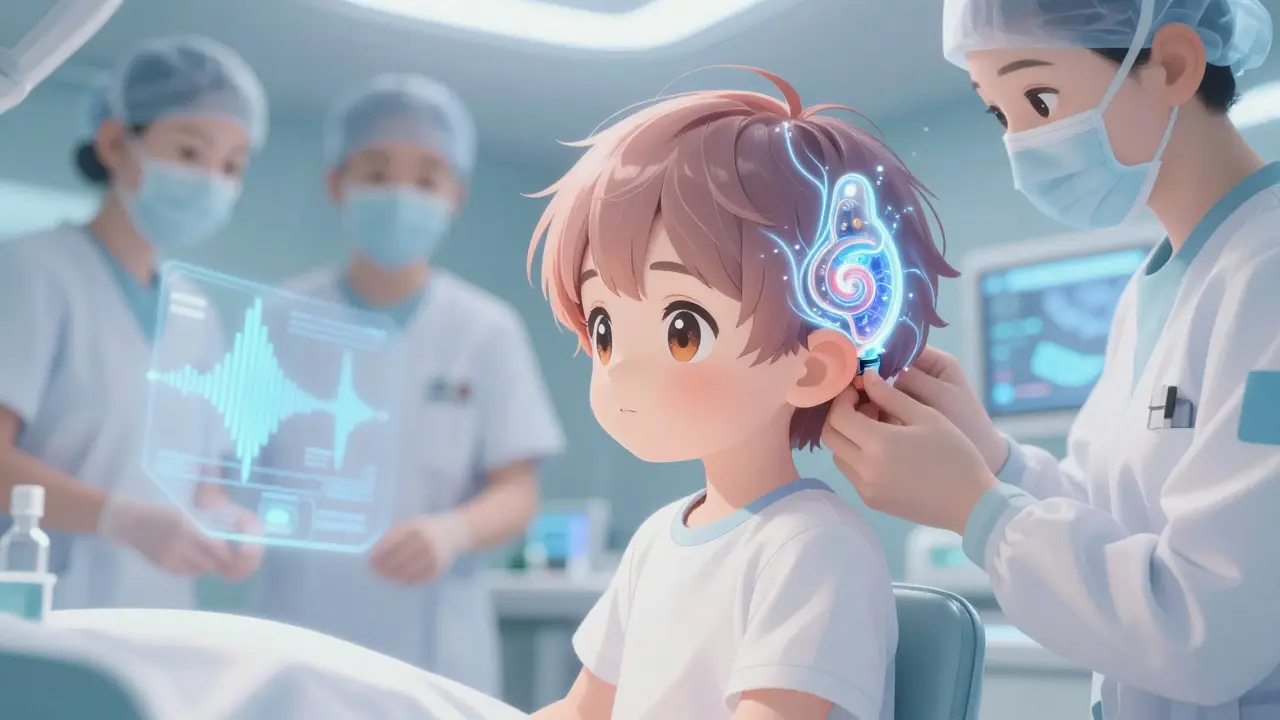
When someone loses their hearing completely-when even the loudest sounds become silent-it’s not just about missing conversations. It’s about losing the laugh of a child, the sound of rain, the hum of a refrigerator, the voice of a loved one. For people with profound sensorineural hearing loss, traditional hearing aids don’t help. The ears are damaged too badly to amplify sound. That’s where cochlear implants come in. They don’t just make sound louder. They bypass the broken parts of the ear and speak directly to the brain.
How Cochlear Implants Work
A cochlear implant isn’t one device. It’s two parts working together: an external piece worn behind the ear, and a tiny internal device surgically placed under the skin. The external part has a microphone that picks up sound, a processor that turns it into digital signals, and a transmitter that sends those signals through the skin to the implant inside the head.
The internal part has a receiver-stimulator, about the size of a quarter, and a thin electrode array threaded into the cochlea-the spiral-shaped part of the inner ear. This array has between 12 and 22 tiny contacts, each spaced less than a millimeter apart. When activated, each contact sends a small electrical pulse to a specific spot along the auditory nerve. Different spots respond to different pitches, mimicking how a healthy ear naturally processes sound.
Unlike hearing aids, which just turn up the volume, cochlear implants create new signals from scratch. They don’t rely on surviving hair cells. That’s why they work for people who get no benefit from hearing aids at all.
Who Is a Candidate?
The FDA approved cochlear implants for adults in 1984 and for children in 1990. Today, the criteria are much broader. Candidates usually have severe-to-profound hearing loss-meaning they can’t hear sounds below 70 decibels, even with the best hearing aids. They also score below 50% on speech recognition tests when wearing their hearing aids.
Children as young as 9 months can get implants. Studies show those implanted before age 2 often develop speech and language skills close to their hearing peers. For adults, the biggest factor isn’t age-it’s how long they’ve been deaf. Someone who lost hearing last year usually adapts faster than someone who’s been deaf for 30 years.
There are exceptions. People with no functioning auditory nerve won’t benefit. Neither will those whose deafness comes from damage to the brain’s hearing centers. But for most with profound sensorineural loss, cochlear implants are the best option available.
The Surgery Process
The surgery takes about two hours. Surgeons make a small incision behind the ear, then drill into the mastoid bone to reach the middle ear. They open the cochlea either through the round window or by making a tiny hole called a cochleostomy. The electrode array is gently threaded into the cochlea’s scala tympani, following its natural curve.
Throughout the procedure, surgeons monitor the facial nerve with electrical tests. If the nerve reacts at 0.05 milliamps, they know they’re too close. Complications are rare-less than 1% risk of facial nerve injury when done by experienced teams.
The receiver-stimulator is placed in a pocket under the skull bone or just under the skin. It’s designed to last decades. Modern implants, like the SYNCHRONY 2 from MED-EL, allow patients to get full 3.0 Tesla MRI scans without needing surgery to remove a magnet inside.

What Happens After Surgery?
Recovery is quick. Most people go home the same day or the next. There’s mild swelling and numbness around the ear, which fades in a few weeks. But the real work starts after healing.
Activation happens 2 to 4 weeks after surgery. That’s when the audiologist turns on the device and starts mapping-adjusting how much electrical current each electrode delivers. The first sounds are strange: robotic, metallic, like a cartoon. That’s normal.
Over the next 3 to 6 months, the brain learns to interpret these new signals. With consistent use and therapy, most adults understand 80% or more of spoken sentences in quiet rooms. Children who start young often reach near-normal speech levels by age 5.
But it’s not magic. Success depends on effort. Audiologists, speech therapists, and family support are crucial. Without rehabilitation, outcomes drop sharply.
Real Benefits, Real Limits
For many, cochlear implants are life-changing. One adult recipient described hearing his granddaughter say “I love you” for the first time in 15 years. Another heard birds chirping outside her window after decades of silence.
But cochlear implants don’t restore normal hearing. Music often sounds flat or distorted. Background noise still overwhelms. In a noisy restaurant, understanding speech can drop to 30-50% accuracy, even after years of use.
Some users report persistent tinnitus or dizziness. About 5-10% need revision surgery due to device failure. And while 90% of adults see major improvements in communication, 15-20% still struggle with music or complex listening environments.

Technology Is Evolving
Today’s implants are smarter than ever. New processors use AI to reduce background noise and focus on voices. Hybrid devices combine electrical stimulation with acoustic amplification for people who still hear low tones naturally.
Researchers are testing electrodes that release drugs to prevent scar tissue buildup, which can block signals over time. Smaller, more powerful processors are on the way. External units may soon connect directly to smartphones, letting users adjust settings with an app.
And the implants themselves? They’re built to last 20 to 30 years. Only the external processor needs upgrading-no new surgery required.
Cost and Access
In the U.S., Medicare, Medicaid, and most private insurers cover cochlear implants if the patient meets medical criteria. The total cost-including surgery, device, and follow-up care-can exceed $100,000, but insurance typically pays the bulk.
Worldwide, about 324,000 people have received implants as of 2022. In the U.S., around 58,000 adults and 38,000 children have them. Access is still limited in many countries due to cost and lack of specialized centers. But awareness is growing, and more children are being screened early.
What to Expect Long-Term
Most recipients keep using their implants for life. The internal device rarely fails. The external processor can be replaced or upgraded as new technology comes out.
Regular check-ups with an audiologist are needed every 6 to 12 months to fine-tune settings. Some users need more frequent adjustments during the first year.
Children need years of speech therapy. Adults benefit from listening practice-watching TV with captions, talking with friends, joining support groups. The brain adapts slowly, but it adapts.
For those with profound deafness, cochlear implants don’t just restore hearing. They restore connection. The silence doesn’t vanish overnight. But with time, patience, and the right support, the world begins to speak again.
Are cochlear implants the same as hearing aids?
No. Hearing aids amplify sound for ears that still have some function. Cochlear implants bypass damaged parts of the ear and send electrical signals directly to the auditory nerve. They’re for people who get little to no benefit from hearing aids.
Can children get cochlear implants?
Yes. Children as young as 9 months can receive implants. Early implantation-before age 2-gives the best chance for developing normal speech and language. Programs now screen newborns for hearing loss so kids can be evaluated quickly.
How long does it take to hear normally after surgery?
You won’t hear normally right away. The first sounds are often mechanical or robotic. Most adults notice big improvements within 3 to 6 months. Children may take 1 to 2 years of therapy to reach age-appropriate speech levels. The brain needs time to learn this new way of hearing.
Can I get an MRI with a cochlear implant?
Yes, but only with certain models. Newer implants like the SYNCHRONY 2 are designed to be safe for full 3.0 Tesla MRI scans without needing surgery to remove the internal magnet. Older models may require removal or have restrictions. Always check with your implant manufacturer and radiologist.
Do cochlear implants restore music appreciation?
Not fully. Most users report music sounds flat, tinny, or unnatural. Some learn to enjoy it over time, especially with training. But even long-term users rarely experience music the way someone with natural hearing does. This remains one of the biggest limitations of current technology.
How long do cochlear implants last?
The internal device is designed to last 20 to 30 years and rarely needs replacement. The external processor is upgraded every 5 to 10 years as new technology comes out-no surgery needed. Most recipients use the same internal implant for life.
What are the risks of cochlear implant surgery?
Serious complications are rare. Less than 1% of patients experience facial nerve damage. Other risks include infection, dizziness, tinnitus, or device failure requiring revision surgery (5-10% over time). Most people recover well with minimal side effects.
Is there a chance the implant won’t work?
It’s uncommon, but possible. Outcomes depend on factors like how long you’ve been deaf, your age at implantation, and whether you commit to rehabilitation. A small percentage of users don’t gain speech understanding, especially if the auditory nerve is underdeveloped or damaged. But for most, the improvement is significant.
Comments (14)
-
jeremy carroll December 15, 2025
just got my kid’s implant activated last week and honestly? she screamed when she heard her mom say ‘cookie’ for the first time. no joke. we cried. this thing isn’t magic but it’s the closest thing we’ve got to a miracle.

-
Alexis Wright December 15, 2025
let’s be real-this whole ‘hearing restoration’ narrative is corporate propaganda. cochlear implants don’t restore hearing, they override it. you’re not hearing the world-you’re being fed a synthetic audio feed by a silicon chip. the brain adapts, sure, but at what cost to your perception of reality? this isn’t medicine, it’s cybernetic assimilation.

-
Sinéad Griffin December 17, 2025
my cousin got one last year and now she’s blasting pop songs on full blast 😍 the first time she heard ‘Bohemian Rhapsody’ she called me sobbing. music still sounds like a robot singing through a tin can but she says it’s ‘better than silence’ 🥹❤️

-
Edward Stevens December 18, 2025
so you’re telling me we spent billions to turn people into cyborgs who still can’t enjoy jazz? 😂 i mean, congrats on not being deaf anymore-but now you’re just a human with a bluetooth speaker glued to your skull.

-
Natalie Koeber December 20, 2025
they say it’s ‘safe’ but have you seen the patents? the magnet in the implant? it’s the same tech they use in military mind-control experiments. they’re not fixing hearing-they’re installing a backdoor into your nervous system. and don’t get me started on the 3.0 tesla mri ‘safety’-that’s just a lie to get you to sign the waiver.

-
Rulich Pretorius December 20, 2025
in south africa, access to these devices is still a luxury. many deaf children grow up without language because there’s no funding, no specialists, no awareness. this tech is brilliant-but if we don’t fix equity first, we’re just building better tools for the privileged. the real innovation isn’t in the electrode array-it’s in making this available to everyone who needs it.

-
Thomas Anderson December 20, 2025
my uncle got one after 40 years of silence. first thing he heard? his dog barking. he just sat there, staring at the window, smiling like a fool. didn’t say a word for ten minutes. sometimes you don’t need words to feel something.

-
Dwayne hiers December 22, 2025
the electrode array’s spatial resolution is limited by the cochlear topography and neural density gradients-max 16-22 channels, whereas the basilar membrane has 3,500+ tonotopic regions. that’s why pitch discrimination is poor, especially for harmonic complexes. current AI beamforming mitigates SNR issues but doesn’t resolve spectral smearing. next-gen multi-electrode phased arrays with localized neurotrophic delivery may resolve this.

-
Jonny Moran December 23, 2025
in my community, deaf culture is strong. some folks don’t want implants. and that’s okay. this tech saves lives, sure-but it shouldn’t erase identity. i know people who use sign language, love their silence, and wouldn’t trade it. the goal isn’t to ‘fix’ deafness-it’s to give people choice.

-
Sarthak Jain December 23, 2025
bro i got one last year and at first everything sounded like a dial-up modem 😅 but after 6 months, i heard my mom cry when she said ‘i’m proud of you’-and i cried too. still can’t tell if a song is in c major or not but… i’d do it again. thanks for the post, man.

-
Tim Bartik December 24, 2025
americans think they invented everything but guess what? the first cochlear implant was tested in france in 1957 by guy djourney. we’re just the ones who turned it into a billion-dollar industry and made it look like a miracle. don’t drink the kool-aid. it’s just tech, not salvation.

-
Daniel Thompson December 25, 2025
while i appreciate the technical breakdown, i’m concerned about the psychological burden on children implanted before they can consent. are we prioritizing auditory assimilation over linguistic and cultural autonomy? the data shows language acquisition improves-but what about identity formation?

-
Daniel Wevik December 26, 2025
the biggest win isn’t the surgery-it’s the rehab. without consistent auditory training, even the best implant fails. i’ve seen adults quit after 3 months because ‘it’s too hard.’ don’t underestimate the work. this isn’t a switch you flip-it’s a muscle you build. stay consistent.

-
Rich Robertson December 27, 2025
in my village in india, a deaf boy got an implant last year. now he laughs at cartoons. his grandma didn’t understand how it worked-but she kissed his head every morning and said, ‘you hear the world now.’ that’s the real tech right there. not the chip. the love.
