
More than 90% of prescriptions filled in the U.S. are for generic drugs. They work just as well as brand-name medicines, cost up to 85% less, and are held to the same strict standards by the FDA. Yet, many patients still hesitate to take them. Why? It’s not about science-it’s about trust. And that’s where healthcare providers come in.
Why Patients Doubt Generics (Even When They Shouldn’t)
Patients aren’t being irrational. Their doubts come from real experiences and messaging they’ve heard over time. A 2024 study in PLOS ONE found that nearly 25% of patients worry generics won’t control their symptoms as well as brand-name drugs. Another 30% fear they’ll have more side effects. Some say they just don’t want to change what’s working. These fears aren’t evenly spread. Research shows patients with lower income, less education, or Medicaid coverage are more likely to distrust generics. Non-white patients report lower confidence levels than white patients-78.3% versus 89.1%. And those with poor health literacy are twice as likely to believe generics are less safe or effective. One major driver? Lack of clear communication. When a pharmacist swaps a brand for a generic without explanation, patients feel left out. Reddit users shared stories like: “My generic Sertraline made me feel dizzy-my old brand never did.” While most cases turn out to be placebo effects or minor variations in inactive ingredients, those experiences stick. And when a pharmacist rushes through the switch, it reinforces the idea that generics are second-rate.The Real Difference Between Brand and Generic
Let’s cut through the noise. A generic drug must meet the FDA’s exact same standards as the brand-name version. The active ingredient? Identical. The dose? The same. The way it’s absorbed into your body? Must be within 80-125% of the brand’s performance. That’s not a guess-it’s a legal requirement backed by lab tests. The only differences? The color, shape, or filler ingredients-things that don’t affect how the medicine works. A generic metformin tablet might be white instead of blue, or contain cornstarch instead of lactose. But if you’re diabetic, it will lower your blood sugar just as effectively. The FDA doesn’t approve generics faster or cheaper because they’re less important. They approve them faster because they don’t need to repeat expensive clinical trials. The original drug already proved safety and effectiveness. The generic just has to prove it behaves the same way in your body. And the numbers don’t lie: 92.7% of Medicare Part D prescriptions in 2022 were generics. Hospitals use them at 95% rates. The system runs on them. They’re not a budget hack-they’re the standard.What Works: Research-Backed Ways to Build Trust
The good news? You can fix this. Multiple studies show that when providers take just two to three minutes to explain generics, patient confidence jumps. Here’s what the data says works:- Start with empathy. Don’t say, “It’s the same thing.” Say, “I know switching can feel uncertain. Let me explain why this generic is just as safe and effective.”
- Use simple analogies. “Think of it like buying store-brand aspirin. The active ingredient is the same-just packaged differently. The FDA checks both to make sure they work the same way.”
- Highlight the FDA’s role. Patients trust regulators. Say: “The FDA requires every generic to meet the same quality, strength, and purity standards as the brand. They inspect the same factories.”
- Ask what they’re worried about. Some fear side effects. Others think generics are “cheap” or “old.” Let them name their concern. Then address it directly.
- Use visual aids. A simple chart showing identical active ingredients side by side helps. The FDA’s website has free downloadable materials for this.
Who Should Do This-and When
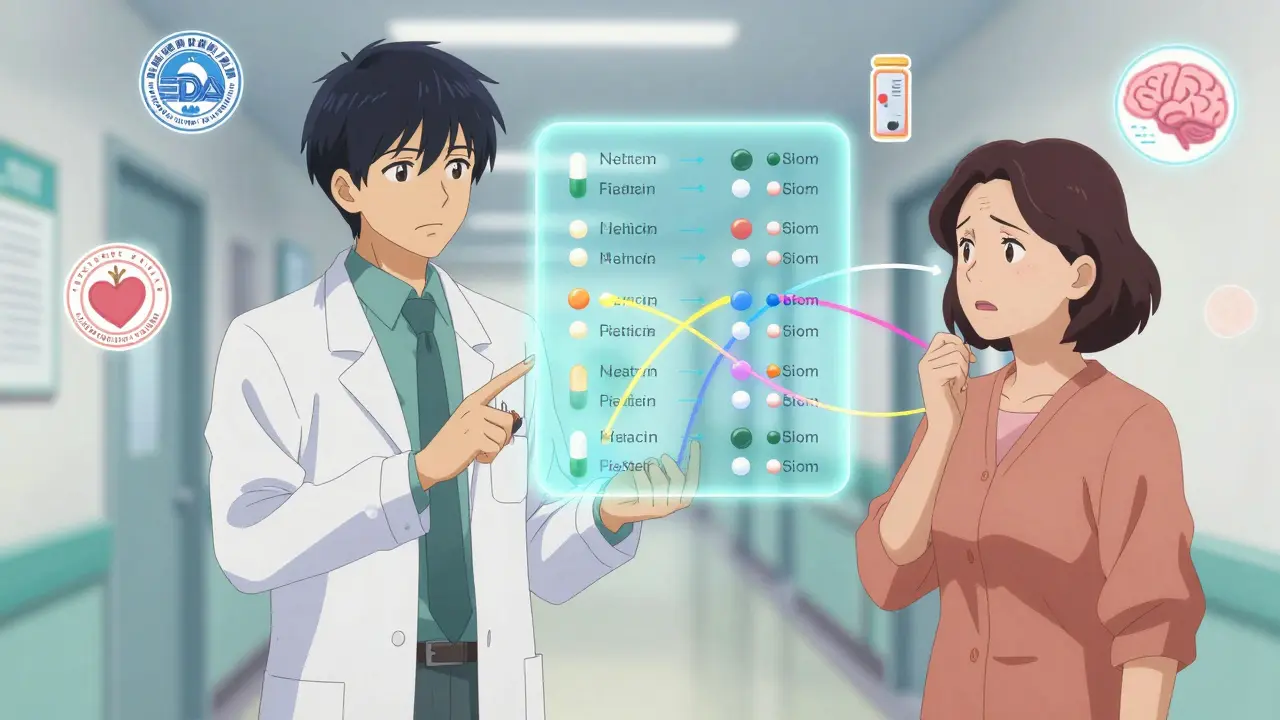
It’s not just the doctor’s job. Pharmacists are in the best position to help. When a patient picks up a prescription and sees a different-looking pill, that’s the moment doubt creeps in. That’s when a pharmacist saying, “This is the generic version of your usual medication. It works the same way, and I can explain how,” makes all the difference. But doctors need to be on board too. If a physician says, “I only prescribe the brand,” patients believe it. If they say, “I’m switching you to this generic because it’s proven and saves you money,” patients feel respected. The most effective approach? A team effort. The prescriber sets the tone. The pharmacist reinforces it. Both use the same language.What Doesn’t Work
Don’t rely on pamphlets alone. A 2023 study found only 62% of patients thought pharmacy handouts were “somewhat helpful.” Don’t assume patients know what “bioequivalence” means. Even if you say it correctly, most won’t understand it. Don’t skip the conversation because “they’re just getting a refill.” People forget. They might have switched pharmacies. They might have heard a rumor. Don’t assume they’re on board. And never dismiss their concerns as “irrational.” Even if the science says they’re wrong, their fear is real. Address it with facts, not frustration.
Special Cases: Complex Medications and Delivery Systems
Some drugs are trickier. Inhalers, injectables, or patches with complex delivery systems can make patients nervous. One patient told the FDA, “I was scared I wouldn’t use the generic inhaler right.” For these, extra care matters. Show them how to use it. Let them practice. Compare it side by side with the brand. Confirm they understand the steps. The FDA has specific guidance for complex generics. Providers should be aware of these and be ready to explain why, even with differences in delivery, the medicine still works the same.The Bigger Picture: Why This Matters
Generic drugs saved the U.S. healthcare system $370 billion in 2022. Over the next decade, that number could hit $1.7 trillion. But those savings mean nothing if patients refuse to take the medicine. Every time someone skips their generic blood pressure pill because they’re afraid it won’t work, it leads to hospital visits, emergency care, and higher costs. Every time a patient stops their antidepressant because they think the generic is “weaker,” it risks relapse. Improving confidence isn’t just about saving money. It’s about ensuring people get the treatment they need.Next Steps: What You Can Do Today
If you’re a provider:- Start the next conversation about generics with: “I know you might have questions about this. What are you thinking?”
- Use one simple analogy to explain bioequivalence.
- Point to the FDA’s website or hand out their free patient fact sheet.
- Ask the pharmacist to follow up if the patient seems unsure.
- Ask: “Is this generic the same as my old pill? How do you know?”
- Don’t assume a change in appearance means a change in effect.
- Check the FDA’s website for approved generics of your medication.
Are generic drugs really as effective as brand-name drugs?
Yes. The FDA requires generic drugs to have the same active ingredient, strength, dosage form, and route of administration as the brand-name version. They must also prove they’re absorbed into the body at the same rate and to the same extent-within a strict 80-125% range. This is called bioequivalence. Thousands of studies and decades of real-world use confirm they work the same.
Why do some people feel different on a generic medication?
Most of the time, it’s not the drug-it’s the mind. People expect to feel different when switching, and that expectation can cause real symptoms. But sometimes, inactive ingredients (like fillers or dyes) differ between brands and generics. For most people, this doesn’t matter. But if someone has a rare allergy or sensitivity to one of those, they might notice a change. That’s why it’s important to talk to your provider if you feel anything unusual after switching.
Can pharmacists switch my brand-name drug to a generic without telling me?
In most states, yes-unless the doctor specifically writes “dispense as written” or “no substitution.” But even when substitution is allowed by law, best practice is to inform the patient. Studies show patients feel more in control and more confident when they’re told about the switch before it happens. A good pharmacist will always explain it.
Are generics made in the same factories as brand-name drugs?
Yes, often. The FDA inspects both brand and generic manufacturing sites using the same standards. In fact, many brand-name companies make their own generic versions. Even if the factory is different, the FDA checks every facility for quality, cleanliness, and compliance. There’s no “cheap” factory loophole.
How can I check if a generic drug is approved by the FDA?
Go to the FDA’s Drugs@FDA database (https://www.accessdata.fda.gov/scripts/cder/daf/). Search by the brand name or generic name. If it’s listed with an “AP” or “AB” rating, it’s approved and considered equivalent. You can also ask your pharmacist-they have access to this information too.
Why do generics cost so much less if they’re the same?
Brand-name companies spend billions developing a drug and running clinical trials. Once the patent expires, other companies can make the same drug without repeating those expensive steps. They only need to prove it works the same way. That saves them money-and that savings gets passed on to you. It’s not about lower quality. It’s about not paying for research twice.
Comments (12)
-
Christopher King December 24, 2025
Let me tell you something the FDA doesn't want you to know. Generics are made in the same factories as the brand names? LOL. Ever heard of China? The FDA inspects like once every 5 years and they get a heads-up. The real active ingredient? Sometimes it's 70% of what's on the label. I know a guy who switched to generic Adderall and ended up in the ER. They call it 'bioequivalence' but it's just corporate greed dressed up as science. You think your blood pressure pill is safe? It's not. It's a lottery. And they wonder why people don't trust them.

-
Bailey Adkison December 25, 2025
There's no such thing as 'bioequivalence' in the way they define it. The 80-125% range is a legal fiction. If your drug is 80% as effective as the brand, it's not equivalent. It's inferior. And calling it 'the same' is dishonest. The FDA doesn't require identical inactive ingredients. That's not semantics-that's pharmacology. If you're allergic to cornstarch and your generic uses it instead of lactose, you're not getting the same drug. You're getting a different one. Stop pretending otherwise.

-
Harbans Singh December 25, 2025
Interesting read. In India, generics are the norm-we don’t even have brand names in most villages. My uncle takes generic metformin for 20 years and his sugar’s better than mine with the 'brand.' But I get why folks in the US are nervous. We grow up with ads screaming 'This is the one doctors trust!' It’s not about science, it’s about branding. Maybe we need to rebrand generics as 'trusted by millions' instead of 'cheap alternative.'

-
Justin James December 26, 2025
You think it’s just about trust? No. It’s about control. The pharmaceutical industry doesn’t want you to know that they own the generic manufacturers too. The same CEOs who profit off the $200 brand-name pill also profit off the $5 generic. They created the myth that generics are 'just as good' so they could keep raking in cash while you think you’re saving money. And when you have side effects? They blame your 'placebo response.' But I’ve seen people go from stable to suicidal on generic sertraline-same dosage, same manufacturer, different pill. The fillers change. The coating changes. The absorption profile shifts. And the FDA doesn’t test for that in real time. They test in labs with 12 healthy volunteers. That’s not medicine. That’s math. And math doesn’t feel panic attacks.

-
Zabihullah Saleh December 28, 2025
There’s a cultural layer here too. In the U.S., we equate price with value. If it’s cheap, it’s trash. But in other places, like India or Thailand, generics are the default and people don’t question them. Why? Because they’ve seen them work for decades. Maybe we need to stop treating medicine like a luxury good and start treating it like a public utility. The real issue isn’t science-it’s capitalism.

-
Rick Kimberly December 30, 2025
While the data presented is largely accurate and well-supported by empirical evidence, it is imperative to acknowledge the limitations of bioequivalence standards. The 80-125% confidence interval permits a significant degree of variability, particularly in drugs with narrow therapeutic indices. In clinical practice, even minor pharmacokinetic deviations can result in suboptimal outcomes. Therefore, while generics are generally safe and effective, blanket assurances may inadvertently undermine patient autonomy and informed consent.

-
Katherine Blumhardt December 31, 2025
I switched to generic levothyroxine last year and my hair started falling out 😔 I told my doctor and they said 'it's probably stress' but I KNOW it was the pill. Now I pay extra for the brand because my thyroid is too important to gamble with. Also my pharmacist didn't even tell me they switched it. That's just wrong.

-
sagar patel January 1, 2026
Generics are fine if you're poor. But if you can afford the brand, why risk it? I've seen too many people suffer because some pharmacist thought they were saving them money. The FDA doesn't care about your quality of life. They care about compliance rates. You think your blood pressure is fine on a generic? Wait till you have a stroke. Then you'll wish you paid the extra $10.

-
Michael Dillon January 2, 2026
Oh please. You're all acting like generics are some kind of conspiracy. I’ve taken generic statins for 8 years. My cholesterol is perfect. My liver’s fine. My bank account is happier. If you’re having side effects, maybe it’s not the pill. Maybe it’s your anxiety. Or maybe you just like the brand name because it makes you feel like you're doing something right. Newsflash: the pill doesn’t care what color it is.

-
Gary Hartung January 3, 2026
Let’s be honest-this entire article is a corporate PR stunt. The FDA? A puppet of Big Pharma. The 'same standards'? What standards? The ones written by lobbyists who used to work for Pfizer. And don’t get me started on the 'free FDA fact sheets'-they’re printed on recycled paper with ink that probably contains glyphosate. This isn’t healthcare. It’s a performance. And we’re all just extras in a pharmaceutical soap opera.

-
Ben Harris January 4, 2026
My mom took generic warfarin and ended up in the hospital with internal bleeding. They said it was 'a rare case of variability' but I know what happened. The generic was made in a factory with no air conditioning. The pill got too hot. The active ingredient degraded. No one tested that. No one cares. They just want you to shut up and take the cheap pill. And now they’re telling us to trust them more? No thanks. I’ll take my brand-name and my $15 copay. My life isn’t a cost-benefit analysis.

-
Sophie Stallkind January 4, 2026
Thank you for highlighting the critical role of provider communication. The data on patient confidence increasing by 21 percentage points with a simple explanation is compelling. This underscores the importance of training clinicians not only in pharmacology, but in health communication. Trust is not a byproduct of science-it is a clinical intervention. Every interaction is an opportunity to reinforce safety, equity, and understanding. We must institutionalize this practice across all care settings.
