
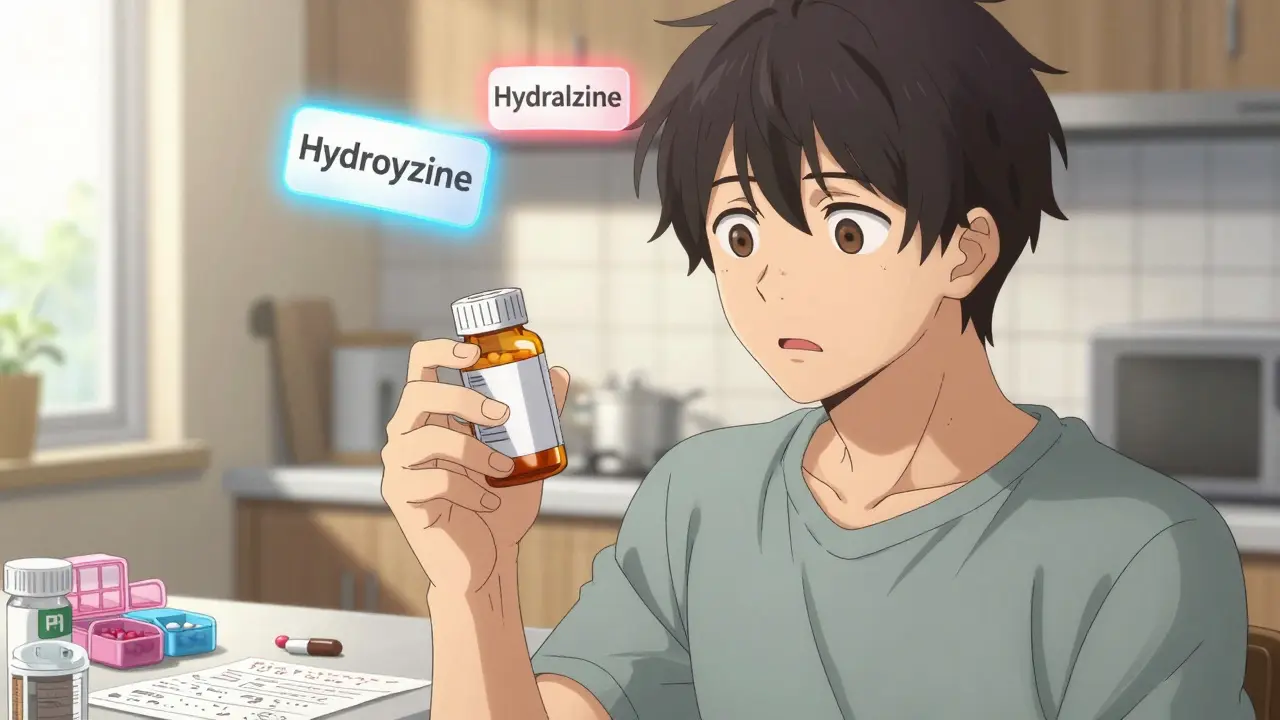
Every year, over 1.3 million people in the U.S. end up in the emergency room because of medication errors. Many of these aren’t accidents caused by carelessness-they’re preventable mistakes that happen because basic safety rules aren’t followed. Whether you’re taking one pill a day or managing five different medications, getting it right isn’t optional. It’s life or death.
Rule 1: Know Exactly What You’re Taking
Don’t assume the pill looks the same as last time. Medications can change manufacturers, colors, shapes, or even names. A common error? Mixing up hydroxyzine and hydralazine-two drugs that sound alike but do completely different things. One treats anxiety; the other lowers blood pressure. One wrong pill can send you to the hospital. Always check the label. Look for the generic name (like metformin) and the brand name (like Glucophage). Compare it to your prescription. If the pill looks different, ask your pharmacist. Don’t rely on memory. Keep a written list of every medication you take, including dosage and why you’re taking it. Update it every time something changes.Rule 2: Take the Right Dose at the Right Time
Dosing isn’t one-size-fits-all. A 70-year-old with kidney issues needs a lower dose of certain drugs than a 30-year-old. For medications like insulin, warfarin, or opioids, even a small mistake can be dangerous. The CDC says 15% of dosing errors happen in children, but adults aren’t immune. Timing matters too. Some meds need to be taken on an empty stomach. Others must be spaced exactly 12 hours apart. If you’re supposed to take a pill at 8 a.m. and 8 p.m., don’t skip one because you’re tired. Missing a dose of an antibiotic can let bacteria survive and become resistant. Taking a blood thinner too close together can cause internal bleeding. Use a pill organizer with alarms. Apps like Medisafe or MyTherapy can send reminders. If you’re on a complex schedule, ask your pharmacist to help you set it up. Don’t guess. If you’re unsure, call your doctor or pharmacy before you take it.Rule 3: Use the Right Route
A pill isn’t meant to be crushed, dissolved, or injected. And an injection isn’t meant to be swallowed. The route matters because your body absorbs medicine differently depending on how it gets in. Oral tablets are designed to dissolve in your stomach. Crush them, and you can overdose. Injectables like insulin are meant for under the skin-not into a vein. Putting a topical cream into your eye can cause serious damage. One nurse in Sydney told me about a patient who accidentally gave a child a liquid antibiotic meant for injection by mouth. The child ended up in intensive care. Always read the instructions. If it says “for external use only,” don’t put it inside your body. If it says “swallow whole,” don’t chew it. If you have trouble swallowing pills, ask your doctor if there’s a liquid or patch form available. Never change the route without professional advice.
Rule 4: Confirm It’s Really You
This rule isn’t just for hospitals. It applies at home too. If you share meds with a partner, parent, or child-even if they have similar symptoms-you’re risking harm. What works for one person might kill another. In clinics, staff check your name and date of birth before giving you any medication. At home, you need to do the same. Before you take a pill, ask yourself: Is this prescription mine? Does it match my condition? Did my doctor prescribe this for me specifically? Don’t take someone else’s leftover antibiotics. Don’t use your spouse’s blood pressure pill if yours ran out. Even if the names sound familiar, the dose or formulation might be different. One study found that 22% of medication errors in older adults happened because they grabbed the wrong bottle from a shared medicine cabinet. Label every container clearly. Use tape or stickers if the original label is faded. Keep your meds separate-don’t mix them in one big jar.Rule 5: Watch for Reactions and Tell Someone
Medications don’t just work-they can also cause side effects. Some are mild. Others are signs of something serious. If you feel dizzy after starting a new drug, don’t brush it off. If your skin turns yellow, you’re bleeding oddly, or your breathing gets tight, stop taking it and call your doctor immediately. Keep a journal. Write down what you took, when, and how you felt. Did you get a rash? Nausea? Confusion? These details help your doctor spot interactions. For example, mixing blood thinners with certain herbal supplements like ginkgo or garlic can cause dangerous bleeding. Many people don’t realize supplements count as medication. Also, tell your pharmacist about everything you take-including vitamins, OTC painkillers, and cannabis products. They’re trained to catch conflicts your doctor might miss. If you’re on five or more medications, ask for a “brown bag review.” Bring all your bottles to your pharmacist once a year. They’ll sort through them and tell you what’s still needed and what’s just cluttering your cabinet.What Happens When You Skip These Rules?
Let’s say you’re taking warfarin for a blood clot. You forget your pill one day, so you take two the next. Now your blood won’t clot properly. You trip and hit your head. You start bleeding inside your skull. That’s not a guess. That’s a real case from a Sydney hospital last year. Or you’re on metformin for diabetes. You take it with a big glass of grapefruit juice because you like the taste. Grapefruit changes how your body processes the drug. Your blood sugar crashes. You pass out at the grocery store. These aren’t rare stories. They happen every day. The World Health Organization says medication errors cost the global healthcare system $42 billion a year. Most of that is preventable.
Tools That Actually Help
You don’t have to rely on memory alone. Here’s what works:- Pill organizers with days of the week and morning/evening slots-used by 68% of seniors with success.
- Smartphone apps that send alarms and track doses-popular with adults under 50.
- Barcode scanners at pharmacies that verify your prescription against your profile-standard in Australia since 2022.
- Medication reconciliation at every doctor visit-where your full list is reviewed and updated.
Final Thought: Safety Is a Habit, Not a One-Time Check
Taking medication safely isn’t about being perfect. It’s about being consistent. It’s about asking questions. It’s about not being embarrassed to say, “I’m not sure what this is for.” The five rules aren’t just for hospitals. They’re for your kitchen table, your bathroom counter, your purse, your car. Every time you pick up a pill, pause. Ask yourself: Is this the right one? Is it the right dose? Is it for me? Am I taking it the right way? Am I watching for trouble? Do that every time-and you’re doing more than following rules. You’re protecting your life.What should I do if I miss a dose of my medication?
Don’t double up unless your doctor says to. Check the medication guide or call your pharmacist. For some drugs like antibiotics, missing a dose can reduce effectiveness. For others like blood thinners or insulin, doubling up can be dangerous. Always get specific advice for your medication.
Can I crush my pills if I have trouble swallowing them?
Only if the label or your pharmacist says it’s safe. Many pills are designed to release slowly. Crushing them can cause a dangerous overdose. Extended-release tablets, capsules, and coated pills should never be crushed. Ask your doctor for a liquid form or alternative delivery method instead.
Are over-the-counter drugs and supplements safe to take with prescription meds?
Not always. Common OTC painkillers like ibuprofen can increase bleeding risk if you’re on blood thinners. St. John’s Wort can make birth control or antidepressants stop working. Even vitamin C and calcium can interfere with some antibiotics. Always tell your pharmacist about everything you take-prescription, OTC, and supplements.
How do I know if a medication has expired?
Check the expiration date on the label. That’s the last day the manufacturer guarantees full strength and safety. Don’t rely on how it looks. Pills can look fine but lose potency. Liquid antibiotics and insulin are especially risky after expiration. When in doubt, dispose of it safely and get a new prescription.
Why do I need to keep a list of all my medications?
Doctors and pharmacists need to see everything you’re taking to spot dangerous interactions. Many people forget about vitamins, herbal teas, or old prescriptions. A complete list helps prevent errors during hospital visits, emergencies, or when a new doctor prescribes something. Keep it updated and bring it to every appointment.
Next Steps: What to Do Today
1. Find all your medications-prescription, OTC, and supplements-and lay them out. 2. Write down the name, dose, reason, and schedule for each. 3. Compare your list to your last prescription. Do they match? 4. Call your pharmacist and ask: “Are any of these interacting?” 5. Set up one reminder on your phone for your next dose. Small steps. Big results. Your body depends on it.Comments (14)
-
Windie Wilson January 12, 2026Oh great, another article telling me I’m a dumbass for not reading the tiny print on my pill bottle. Like I haven’t been taking my meds for 12 years and somehow still alive. 🙄

-
Amanda Eichstaedt January 14, 2026This is the kind of stuff that should be taught in middle school. Not just for pills-life, relationships, decisions. We treat medicine like it’s a vending machine and we’re entitled to whatever comes out. But bodies aren’t robots. They’re messy, weird, and they remember every mistake.

-
Abner San Diego January 16, 2026America’s healthcare system is a joke and now they want us to be pharmacists too? I pay $200 for a pill and then get a 10-page essay on how not to die from it? Someone’s getting paid to write this, and it ain’t me.

-
Eileen Reilly January 18, 2026ok so i just took my blood pressure med with coffee bc why not and now i feel like a ghost but also kinda awake?? whoops. also why is everyone so scared of grapefruit?? it’s just a fruit???

-
Monica Puglia January 19, 2026I started using a pill organizer last year after my grandma had a bad mix-up. 🙏 It changed everything. Also, I keep a little notebook in my purse now. No more guessing. I’m not perfect, but I’m trying. 💪

-
Cecelia Alta January 20, 2026Let’s be real-90% of people don’t even know what their meds are for. I’ve seen my aunt take her husband’s antidepressants because she was ‘feeling down.’ Then she wonders why she’s dizzy and crying at the grocery store. This isn’t education-it’s damage control. And it’s too late. We’ve been letting people wing it for decades. Now the system’s trying to clean up the mess while still charging $800 for a blood test.

-
steve ker January 21, 2026Why are we even talking about this. In Nigeria we just take what works. If you feel better you keep taking it. If you die well you lived

-
George Bridges January 22, 2026I appreciate this. My mom has 7 different meds and I help her manage them. It’s not glamorous, but it’s necessary. The hardest part isn’t the pills-it’s getting her to ask questions. She’s scared to sound stupid. We need to normalize asking.

-
Rebekah Cobbson January 24, 2026You don’t have to be perfect. Just consistent. I used to skip my thyroid med when I traveled. Now I set a reminder and pack my pills in a clear bag. Small habits save lives. You got this.

-
Audu ikhlas January 25, 2026This is what happens when you let western medicine become religion. In my village we use herbs and prayer. No labels no apps no fear. You think your pills are safe? They are poison wrapped in paper and sold for profit

-
TiM Vince January 26, 2026I’ve been on warfarin for 5 years. I used to forget. Now I have a calendar on my fridge with red X’s. I don’t think about it anymore. It’s just part of my routine. No drama. Just discipline.

-
gary ysturiz January 28, 2026You don’t need to be a genius to take your meds right. Just slow down. Read the label. Ask one question. That’s it. One small step. One less trip to the ER. You’re worth it.

-
laura manning January 28, 2026It is imperative to underscore that the aforementioned guidelines are not merely recommendations, but rather, non-negotiable protocols grounded in empirical pharmacological evidence, clinical trial outcomes, and FDA-mandated labeling requirements. Failure to adhere to these parameters constitutes a statistically significant risk factor for iatrogenic morbidity and mortality, with an incidence rate exceeding 1.3 million annually in the United States alone. Furthermore, the concomitant ingestion of grapefruit juice with statins, calcium channel blockers, and certain benzodiazepines has been demonstrated in peer-reviewed literature to inhibit CYP3A4 enzymatic activity, thereby elevating serum drug concentrations to potentially toxic levels. Therefore, it is incumbent upon the patient to engage in active, ongoing medication reconciliation with both prescriber and pharmacist.

-
Cecelia Alta January 30, 2026I’m not saying this to be dramatic, but I’ve seen someone die because they thought ‘it’s just a vitamin.’ And no, ginkgo isn’t ‘just herbal tea.’ It’s a blood thinner. Like warfarin. But without the monitoring. People don’t realize supplements aren’t regulated. They think ‘natural’ means ‘safe.’ It doesn’t.