
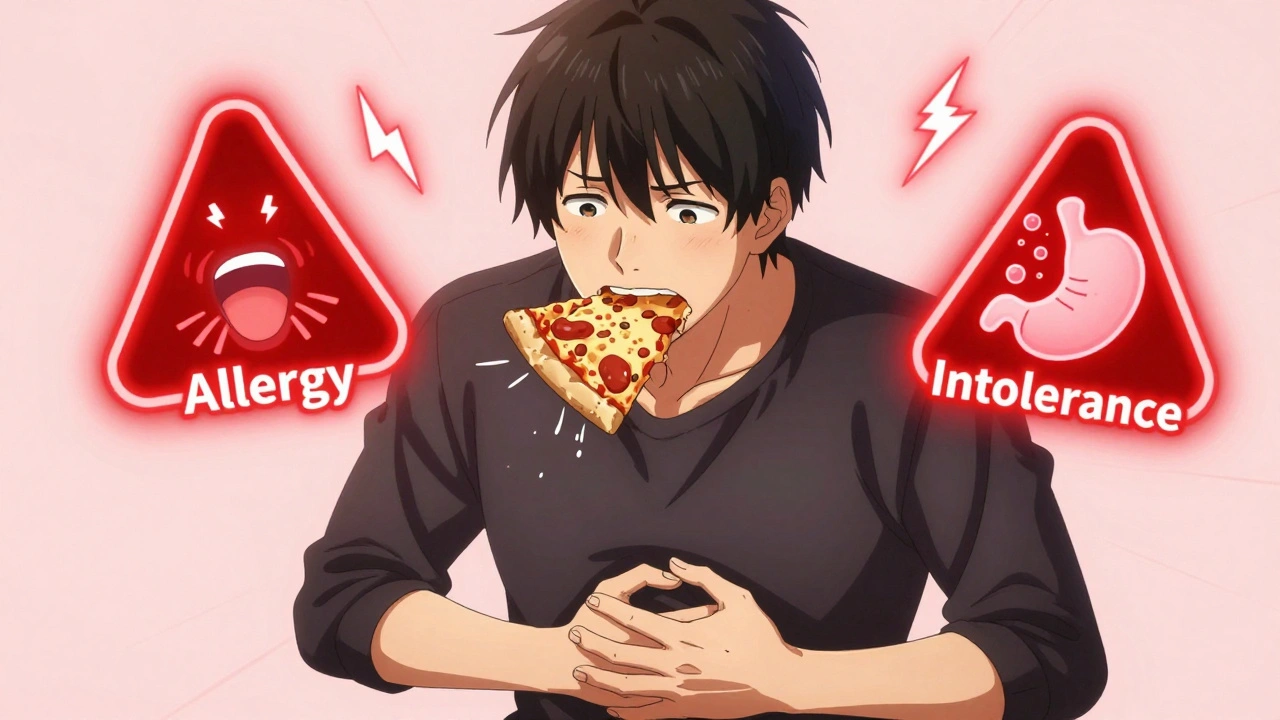
When your stomach churns after eating dairy, or you get bloated after a slice of pizza, it’s easy to assume it’s a food allergy. But here’s the truth: food intolerance and food allergy are not the same. One can send you to the ER. The other just makes you feel miserable for a few hours. Mixing them up can lead to unnecessary fear, wrong diets, or even dangerous delays in treatment.
What Happens in Your Body?
A food allergy is your immune system going into overdrive. It sees a harmless food protein-like peanut or egg-as an invader. It fires off IgE antibodies, which trigger mast cells to dump histamine and other chemicals into your bloodstream. That’s why symptoms hit fast: within minutes, sometimes seconds. You might get hives, swelling in the throat, trouble breathing, or a sudden drop in blood pressure. In severe cases, it’s anaphylaxis-a medical emergency that needs epinephrine right away. Food intolerance? That’s your digestive system struggling. No immune system involved. It’s usually about missing enzymes. For example, lactose intolerance means your body doesn’t make enough lactase to break down milk sugar. That undigested sugar heads to your colon, where gut bacteria ferment it. The result? Bloating, gas, cramps, diarrhea. Symptoms take longer to show up-usually 30 minutes to a few hours after eating.GI Symptoms: How to Tell Them Apart
Both can cause stomach pain and diarrhea. But the pattern tells the story.- Food allergy GI symptoms: Sudden vomiting, severe abdominal cramping, explosive diarrhea-often within two hours. These rarely happen alone. You’ll likely also have itchy skin, swelling, wheezing, or dizziness. Even a tiny crumb can trigger this.
- Food intolerance GI symptoms: Gradual bloating, excessive gas, mild cramping, loose stools. These build slowly. You might feel fine after a splash of milk in coffee but crash after a whole glass. There’s no swelling, no breathing trouble, no anaphylaxis.
Lactose intolerance affects about 65% of people worldwide. That’s not rare-it’s normal. But it’s not an allergy. People with lactose intolerance can often handle small amounts. The NIH says most can tolerate up to 12 grams of lactose daily-roughly one cup of milk-without major issues.
The Big Eight: Common Allergens
In the U.S., 90% of serious food allergies come from just eight foods: peanuts, tree nuts, milk, eggs, wheat, soy, fish, and shellfish. The FDA requires these to be clearly labeled on packaged foods since 2021. If you’re allergic to peanuts, even trace amounts from shared equipment can cause a reaction. That’s why people with allergies read every label, carry epinephrine, and avoid restaurants with cross-contamination risks.
Testing: What Actually Works
Not all tests are created equal. Some are science-backed. Others are scams.For Food Allergies:
- Skin prick test: A tiny drop of allergen is placed on your skin, then lightly pricked. A raised bump (wheal) larger than 3mm suggests allergy. It’s quick, cheap, and widely used.
- Specific IgE blood test: Measures allergy antibodies in your blood. Results are in kU/L. Anything above 0.35 kU/L is considered positive, but it’s not perfect-false positives happen.
- Oral food challenge: The gold standard. Done under medical supervision. You eat tiny, increasing amounts of the food while being watched. If you react, you’re diagnosed. If not, you’re cleared. This is the only way to be 100% sure.
- Component-resolved diagnostics: Newer tests that look at specific proteins in foods. For example, Ara h 2 in peanuts is a strong predictor of severe allergy. If levels are above 0.23 kU/L, you have a 95% chance of a true peanut allergy.
The American Academy of Allergy, Asthma & Immunology warns against IgG blood tests marketed as “food sensitivity” panels. These tests claim to find delayed reactions, but they’re not validated. Studies show they’re wrong more than half the time. They can lead people to cut out healthy foods unnecessarily.
For Food Intolerances:
- Hydrogen breath test: Used for lactose and fructose intolerance. You drink a sugar solution, then breathe into a tube every 15-30 minutes. If hydrogen levels rise more than 20 ppm above baseline, you’re malabsorbing the sugar.
- Celiac disease testing: Requires a blood test for tissue transglutaminase antibodies (tTG-IgA). If levels are above 10 U/mL, you need an endoscopy to confirm intestinal damage (Marsh 3 classification). Don’t go gluten-free before testing-it can hide the results.
- Elimination and challenge diet: The go-to method for non-celiac gluten sensitivity or reactions to FODMAPs, sulfites, or histamine. You remove suspected foods for 2-6 weeks. Then, reintroduce them one at a time, watching for symptoms. It’s slow, but it’s accurate.
What Doesn’t Work
There’s a booming industry selling “food sensitivity” tests via at-home kits. They measure IgG antibodies and claim to show which foods you’re “sensitive” to. But here’s the problem: IgG antibodies are normal. They show you’ve eaten the food before-not that it’s harming you. A 2023 study found these tests had sensitivity under 30% and specificity under 45%. In plain terms: they’re wrong more often than they’re right.The American Gastroenterological Association says: don’t start an elimination diet until you’ve ruled out real diseases like IBS, IBD, or celiac. Many people think they have a food intolerance when they actually have an underlying gut condition.

Management: What to Do After Diagnosis
If you have a food allergy:
- Avoid the food completely.
- Always carry two epinephrine auto-injectors (like EpiPen 0.3mg or 0.15mg).
- Wear a medical alert bracelet.
- Teach family, coworkers, and school staff how to use the injector.
- Check food labels every time-even if you’ve eaten it before. Ingredients change.
Epinephrine isn’t optional. It’s life-saving. Without it, anaphylaxis can kill in minutes. A twin-pack of EpiPens costs $550-$750 without insurance in 2024. Some pharmacies offer generics for less.
If you have a food intolerance:
- You don’t need to cut it out entirely.
- Find your personal threshold. Many lactose-intolerant people can handle yogurt or hard cheeses (lower in lactose).
- Use enzyme supplements like lactase pills before meals.
- For gluten sensitivity, avoid wheat, barley, rye-but oats are usually safe if labeled gluten-free.
- For sulfite sensitivity, avoid wine, dried fruit, and processed potatoes.
Dr. Rima Himelstein from UChicago Medicine puts it simply: “With food intolerances, the most common cause is an enzyme deficiency. With allergies, the immune system thinks the protein is harmful.” That’s the core difference.
When to See a Doctor
See a specialist if:- You have symptoms after eating the same food more than once.
- Symptoms are severe-vomiting, fainting, swelling, breathing trouble.
- You’ve been on a restrictive diet for months with no improvement.
- You suspect celiac disease or IBD (weight loss, blood in stool, persistent diarrhea).
Don’t self-diagnose. A 2023 study in Clinical Gastroenterology and Hepatology found that 80% of people who thought they had a food intolerance were wrong. Many had IBS, IBD, or acid reflux. Treating the wrong thing wastes time and money.
What’s New in 2025
Research is moving fast. A 2024 study in Nature Communications found specific blood metabolites that can distinguish non-celiac gluten sensitivity from IBS with 89% accuracy. That could mean a simple blood test instead of a long elimination diet.FARE (Food Allergy Research & Education) is funding 17 clinical trials right now, including new tests that measure basophil activation in blood-another way to predict real allergic reactions more accurately.
For now, the best advice remains: get tested properly. Don’t guess. Don’t trust online kits. Work with a board-certified allergist or gastroenterologist. Your gut-and your safety-depend on it.
Can you outgrow a food allergy?
Yes, some children outgrow allergies to milk, eggs, wheat, and soy-up to 80% in some cases. But allergies to peanuts, tree nuts, fish, and shellfish are usually lifelong. Regular testing and oral food challenges under medical supervision can determine if tolerance has developed.
Can food intolerance turn into an allergy?
No. Food intolerance and food allergy are completely different biological processes. One is digestive, the other is immune. You can’t “develop” an allergy from eating too much of a food you’re intolerant to. But having one doesn’t protect you from developing the other separately.
Why do some people react to gluten but not have celiac?
Non-celiac gluten sensitivity (NCGS) is real but poorly understood. It’s not an allergy or autoimmune disease like celiac. People with NCGS may react to gluten or other wheat components like FODMAPs. Diagnosis requires ruling out celiac and wheat allergy first, then using an elimination and challenge diet. Blood tests for NCGS don’t exist yet.
Is a negative skin test enough to rule out a food allergy?
Not always. Skin tests can give false negatives, especially if you’ve taken antihistamines recently. They can also give false positives-especially in people with eczema. The only way to confirm a food allergy is through an oral food challenge under medical supervision.
Can stress make food intolerance worse?
Yes. Stress affects gut motility and increases intestinal permeability, which can amplify symptoms of IBS, lactose intolerance, and other functional gut disorders. Managing stress through sleep, exercise, or mindfulness can help reduce flare-ups-even if the underlying intolerance remains.
Comments (8)
-
olive ashley December 5, 2025
So let me get this straight-you’re telling me that if I eat a cookie with trace nuts and my stomach hurts, it’s not an allergy? Nah. That’s what they want you to think. Big Pharma and the FDA are hiding the real truth: IgG tests work just fine. They’ve been suppressing the data since 2018. I’ve been using a $49 kit from a guy on Reddit and my migraines vanished. They don’t want you to know this because you’d stop buying EpiPens. And those $700 pens? Pure greed.

-
Priya Ranjan December 5, 2025
You people are so naive. Lactose intolerance isn’t about enzymes-it’s about karma. You eat dairy because you’re weak. You crave comfort food. Your body is screaming at you to stop being emotionally dependent on milk. I stopped dairy after my third divorce. Lost 30 pounds. My skin cleared. No supplements. No tests. Just discipline. The science? It’s written in the Vedas. You just don’t read them.

-
Gwyneth Agnes December 7, 2025
Don’t trust IgG tests. They’re useless.

-
Max Manoles December 8, 2025
Thank you for this incredibly thorough breakdown. I’ve spent the last three years navigating this exact confusion after my daughter’s anaphylactic reaction to almonds. The misinformation out there is staggering. I’ve seen parents eliminate entire food groups based on $200 online kits that measure IgG-completely invalid. The oral food challenge was terrifying, but it saved her life. We now carry two EpiPens everywhere. One in her backpack, one in mine. And yes, we read every label. Even the ‘may contain’ ones. Because when your child’s throat swells, you don’t gamble. This post? It’s the clarity we needed.

-
Katie O'Connell December 10, 2025
One must, with the utmost intellectual rigor, acknowledge the epistemological limitations inherent in the current diagnostic paradigms surrounding food hypersensitivities. The conflation of physiological intolerance with immunological reactivity constitutes a profound epistemic error, perpetuated by the commodification of health anxiety through the marketing of unvalidated biomarkers. One is thus compelled to interrogate the hegemony of the biomedical model, which reduces complex gut-brain interactions to reductive binary classifications. The rise of the ‘elimination diet’ as a diagnostic tool, while methodologically sound, remains insufficiently contextualized within the broader phenomenology of somatic experience. One must, therefore, advocate for a hermeneutic approach to dietary symptomatology-one that privileges patient narrative alongside laboratory data.

-
Clare Fox December 11, 2025
im kinda wondering if stress is the real culprit here. like, maybe we’re all just… anxious. and our guts are reflecting that. i had bloating for months, thought it was gluten, cut it out, still felt awful. then i started meditating and sleeping more. boom. better. not gone, but better. maybe we’re not allergic to food… maybe we’re allergic to modern life. just a thought. also, i spelled ‘allergy’ wrong in my notes last week. oops.

-
Akash Takyar December 13, 2025
Dear friends, I am truly moved by the depth of this discussion. It is vital that we approach food sensitivities with patience, compassion, and scientific integrity. For those struggling, I encourage you to consult a board-certified specialist-not a YouTube influencer. Your health is not a trend. The elimination diet is slow, yes-but it is the most honest path to truth. And remember: healing is not a race. It is a journey. You are not alone. I believe in you.

-
Inna Borovik December 14, 2025
Oh please. You think IgE is the gold standard? That’s what they taught you in med school. But what about basophil activation? Or mast cell tryptase spikes that don’t show up on skin tests? I had a negative prick test for shellfish-then I ate shrimp at a wedding and turned purple. Took three epinephrine shots. Turns out, my IgE was low because I was on antihistamines for my eczema. The test was wrong. The doctor was wrong. I’m not the problem. The system is.
And don’t even get me started on ‘non-celiac gluten sensitivity.’ That’s just a dumpster fire of bad science. They don’t know what it is, so they made a label for it. Same with FODMAPs. It’s all just ‘we don’t know, so guess.’
Meanwhile, Big Food keeps adding hidden sugars and emulsifiers to everything. That’s the real trigger. Not your enzymes. Not your immune system. Your food is poisoned. And they’re laughing all the way to the bank.
