
Birth Control Supplement Checker
Check Supplement Interactions
Enter a supplement name to see if it may affect your birth control effectiveness.
Many women take herbal supplements to support energy, sleep, or hormone balance-without realizing they might be making their birth control less effective. It’s not a myth. Some common supplements can interfere with how your body processes the hormones in birth control pills, patches, or rings. The result? Unexpected pregnancy. This isn’t about rare edge cases. It’s about real, documented interactions that doctors see in clinics every day.
St. John’s Wort Is the Biggest Red Flag
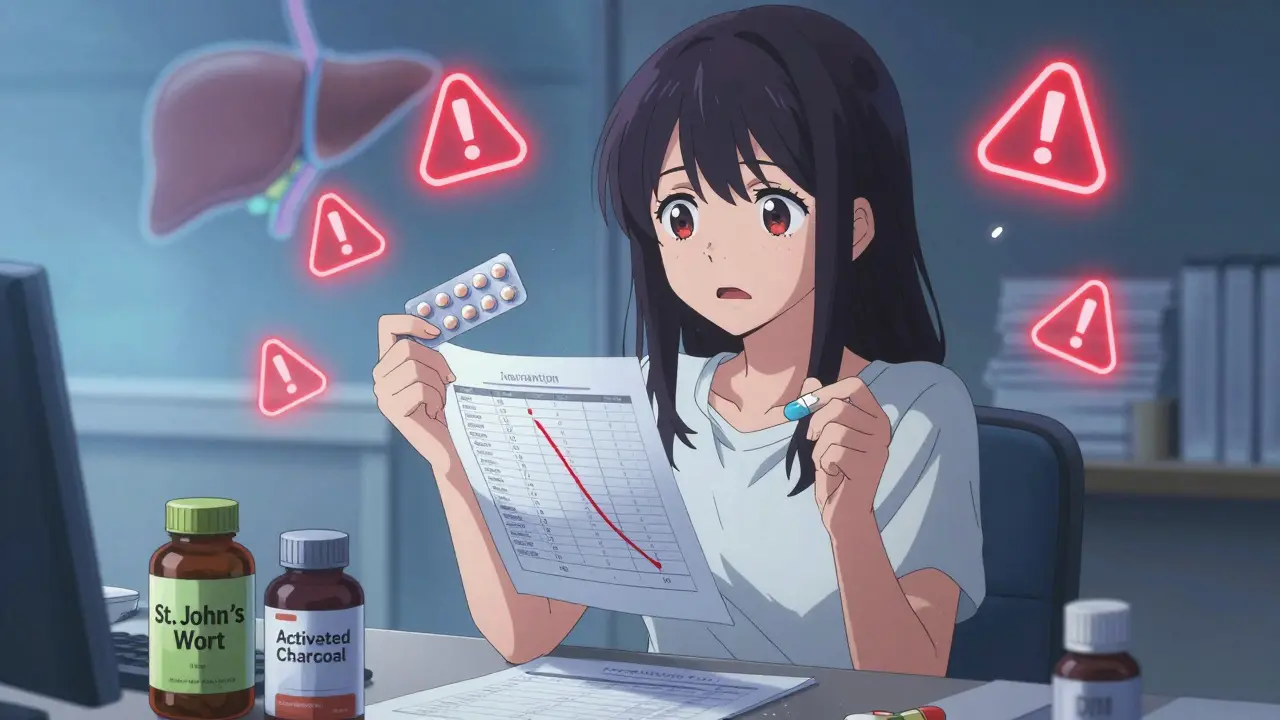
If you’re taking St. John’s wort for mild depression, anxiety, or mood support, you need to hear this: it can seriously reduce the effectiveness of hormonal birth control. This herb doesn’t just slightly lower hormone levels-it triggers a chain reaction in your liver. The active compound, hyperforin, activates something called the pregnane X receptor (PXR). That tells your liver to speed up production of enzymes (CYP3A4) and transporters (P-glycoprotein) that break down and flush out the estrogen and progestin in your birth control.
A study published in medical journals showed women taking 900 mg of St. John’s wort daily along with a standard birth control pill (30 mcg ethinyl estradiol, 150 mcg levonorgestrel) had hormone levels drop by up to 25%. That’s enough to make the pill ineffective. Clinically, this shows up as breakthrough bleeding-23% of women on St. John’s wort experienced it, compared to just 5% in the control group. That’s not a coincidence. It’s a warning sign your body isn’t getting enough hormones to prevent ovulation.
The American College of Obstetricians and Gynecologists (ACOG) says: if you’re using St. John’s wort, use another form of birth control while you’re on it-and for at least a month after you stop. That’s not a suggestion. It’s medical advice backed by data.
Soy, DIM, and Other Estrogen-Related Supplements
Not all interactions work the same way. Soy isoflavones, found in soy protein, tofu, and some supplements, don’t speed up hormone breakdown. Instead, they compete for estrogen receptor sites. Think of it like two keys trying to fit into the same lock. If soy isoflavones are hanging out in those spots, your body’s own estrogen (or the synthetic estrogen in your pill) can’t bind as well. This might not cause pregnancy on its own, but it could alter hormone signaling enough to affect cycle regularity or increase side effects like nausea or breast tenderness.
Same goes for DIM (diindolylmethane), a compound from cruciferous vegetables like broccoli and cauliflower. It’s popular for estrogen balance. But at high doses-600 mg or more-DIM may shift estrogen metabolism in a way that lowers overall estrogen activity. At lower doses (50-100 mg), there’s no strong evidence it affects birth control. Still, if you’re taking more than 100 mg daily, talk to your doctor. You don’t need to stop, but you do need to be aware.
Grapefruit, Activated Charcoal, and Other Surprises
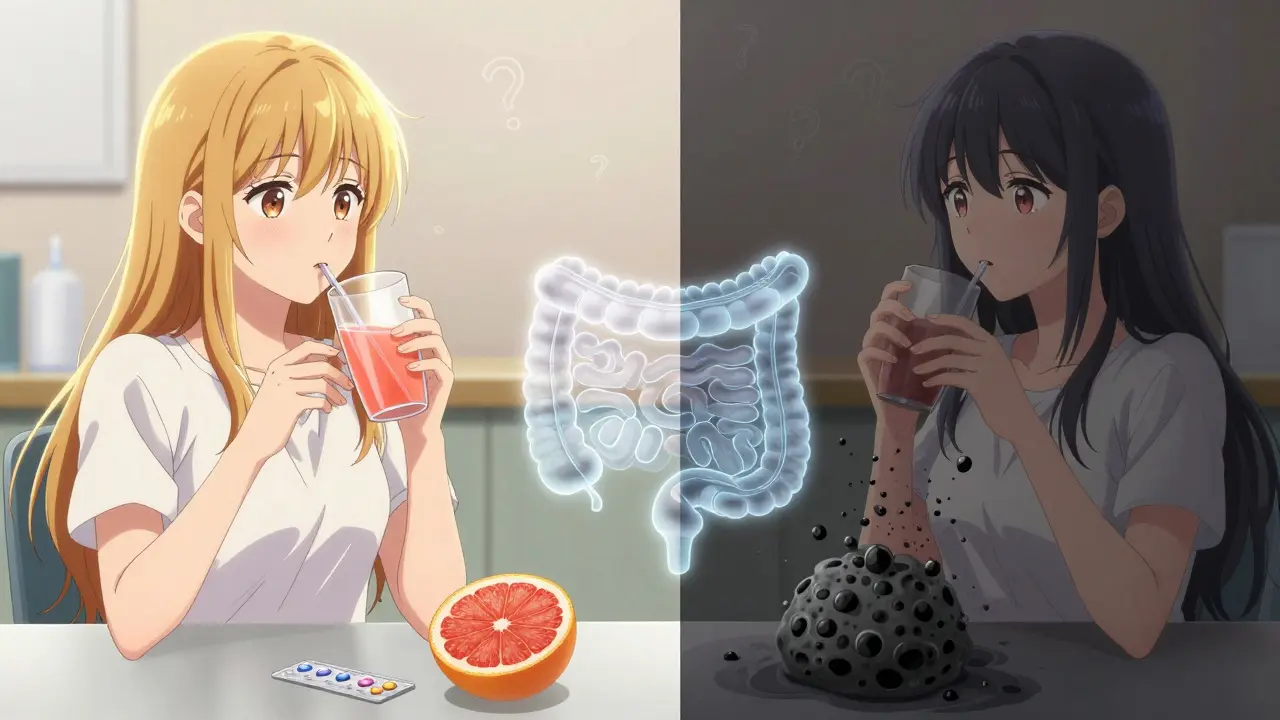
Grapefruit juice has been linked to changes in how some medications are absorbed. While its effect on birth control isn’t as clear-cut as St. John’s wort, research from EBSCO suggests it might interfere with hormone metabolism. Some studies show it can increase hormone levels, others show it might reduce absorption. Either way, it’s unpredictable. If you drink grapefruit juice regularly, don’t assume it’s harmless.
Activated charcoal is another sneaky one. It’s used for bloating or detox claims. But if you take it within four hours of your birth control pill, it can literally adsorb the hormones-like a sponge soaking up the medicine before it even gets into your bloodstream. One study showed significant drops in hormone absorption. If you’re using activated charcoal for digestive issues, take it at least four hours before or after your pill.
Supplements That Are Probably Safe
Not all herbs are risky. Ashwagandha, for example, has been studied for its effect on birth control. A 2015 study found no evidence that it affects the liver enzymes responsible for breaking down estrogen or progestin. That means it likely doesn’t interfere with pill effectiveness. Probiotics? No interaction found. Melatonin? It doesn’t reduce contraceptive hormones, though some women report more side effects like drowsiness when combined with birth control. Vitamin D, calcium, magnesium, and most B vitamins? Safe.
Even Vitex (chasteberry), which influences prolactin and menstrual cycles, doesn’t appear to reduce birth control effectiveness. In fact, some clinicians say it might help balance hormones in women using birth control-especially during perimenopause. That said, if you’re using it to regulate cycles, you’re already working against the pill’s purpose. Talk to your provider before combining them.
Why This Isn’t Just About St. John’s Wort
The bigger problem? Most herbal supplements aren’t tested for drug interactions. Unlike prescription drugs, which go through years of safety and interaction studies, supplements are sold as “natural” and “safe”-with no requirement for standardized dosing, quality control, or interaction testing. One batch of St. John’s wort might have 0.3% hyperforin; another might have 1.2%. That’s a fourfold difference in potency.
And it’s not just about what’s on the label. Many supplements contain contaminants, fillers, or unlisted ingredients. A 2012 survey found that 23.2% of U.S. adults used herbal supplements-and most didn’t tell their doctors. That’s a huge blind spot. Your OB-GYN or pharmacist can’t help you avoid interactions if they don’t know you’re taking them.
What You Should Do
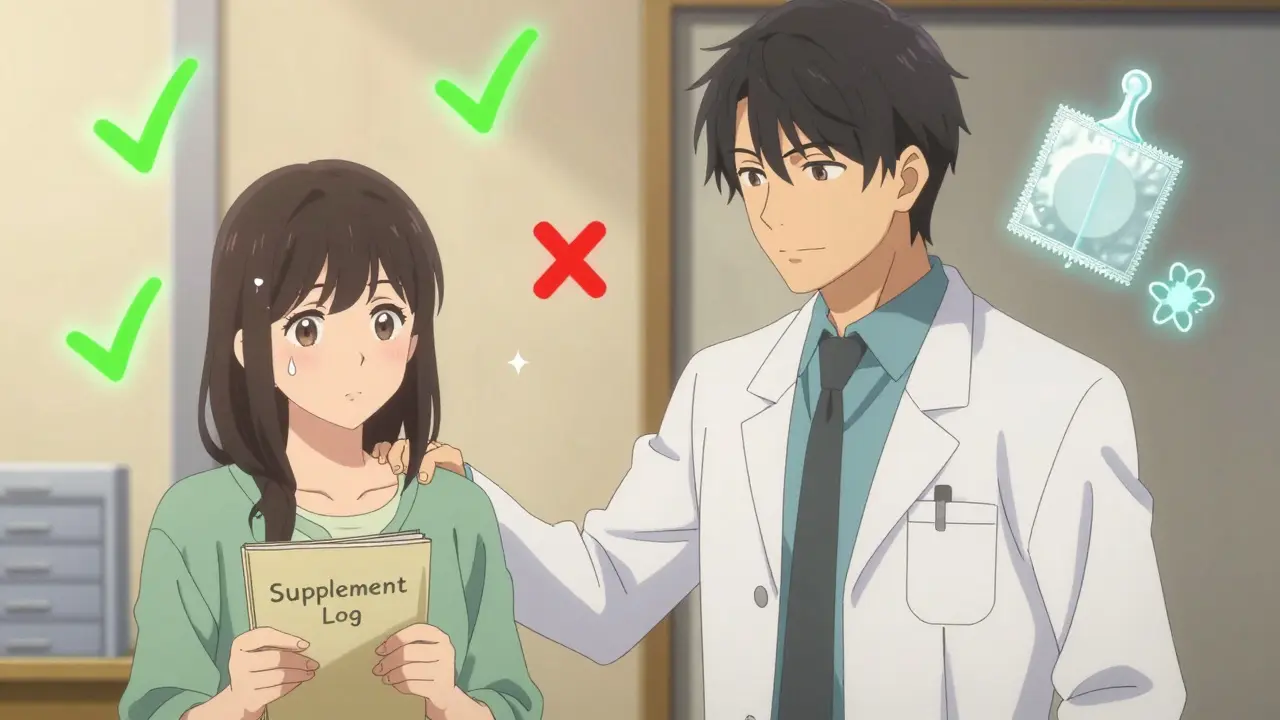
- Always tell your doctor or pharmacist about every supplement you take-even if you think it’s harmless.
- Don’t assume “natural” means safe. Just because something comes from a plant doesn’t mean it won’t interfere with your medication.
- Use backup contraception if you’re taking St. John’s wort, activated charcoal, or grapefruit juice regularly. A condom, IUD, or implant are reliable options.
- Read labels carefully. Look for standardized extracts. Avoid products that don’t list active ingredient amounts.
- When in doubt, pause. If you’re starting a new supplement, wait a few weeks before trusting your birth control alone. Watch for breakthrough bleeding or changes in your cycle.
There’s no need to stop all supplements. But you do need to be intentional. Birth control is one of the most effective forms of contraception when used correctly. Don’t let an untested herb undo that.
What About Other Supplements?
Here’s a quick guide based on current evidence:
| Supplement | Interaction Risk | Recommendation |
|---|---|---|
| St. John’s Wort | High | Avoid. Use backup contraception during and for one month after use. |
| Activated Charcoal | High | Take at least 4 hours before or after birth control. |
| Grapefruit Juice | Moderate | Limit intake. Monitor for changes in bleeding or side effects. |
| DIM (Diindolylmethane) | Low to Moderate | Safe under 100 mg/day. Consult provider if taking 500+ mg. |
| Soy Isoflavones | Low | Generally safe. May alter hormone signaling slightly. |
| Ashwagandha | Very Low | Safe. No evidence of interaction. |
| Probiotics | None | Safe. No known interaction. |
| Melatonin | None | Safe. May increase drowsiness. |
| Vitex (Chasteberry) | Low | Safe. May affect cycle regularity. |
Can herbal supplements cause pregnancy even if I take my birth control pill every day?
Yes. Certain herbs like St. John’s wort and activated charcoal can reduce the amount of hormones your body absorbs. Even if you take your pill at the same time every day, these supplements can interfere with how your body processes them. That’s why breakthrough bleeding is a red flag-it means your hormone levels are dropping below the level needed to prevent ovulation.
Is it safe to take vitamin D or calcium with birth control?
Yes. Vitamin D, calcium, magnesium, and most B vitamins don’t interfere with hormonal birth control. These are essential nutrients and can be taken safely alongside your pill. There’s no need to space them out or avoid them.
What should I do if I’ve been taking St. John’s wort and my period is irregular?
Stop taking St. John’s wort immediately. Use backup contraception (like condoms) for at least one month after stopping. Then, see your doctor. Irregular bleeding could mean your hormone levels have dropped enough to risk ovulation. A pregnancy test is recommended if your period is late or unusual.
Are there any supplements that can make birth control more effective?
No. There are no supplements proven to increase the effectiveness of birth control. Some people believe certain herbs boost hormone levels, but there’s no clinical evidence for this. In fact, some herbs (like St. John’s wort) do the opposite-they reduce effectiveness. Don’t rely on supplements to improve your contraception.
Should I stop taking supplements if I’m on birth control?
Not necessarily. Most supplements are safe. But you need to know which ones carry risk. St. John’s wort, activated charcoal, and high-dose DIM are the main concerns. For everything else, check with your doctor or pharmacist. They can review your full list and tell you what’s safe based on your health history and medication.
Comments (14)
-
Oliver Calvert February 16, 2026
St. John’s Wort is a silent killer when it comes to birth control-seriously, if you’re taking it and not using backup, you’re playing roulette with your fertility.
Doctors don’t talk about this enough because supplements aren’t regulated, but the data is clear: 25% drop in hormone levels isn’t a glitch, it’s a system failure.
I’ve seen three patients in the last year with breakthrough bleeding who swore they ‘took the pill perfectly.’ Turns out, one was on St. John’s Wort for ‘anxiety.’
It’s not about being paranoid. It’s about being informed. If you’re taking anything herbal, assume it’s interacting until proven otherwise.

-
Kancharla Pavan February 17, 2026
How can people be so irresponsible? You take a pill prescribed by a doctor to prevent pregnancy, then you go and dump some random herb from a Walmart shelf into your body like it’s a tea party? This isn’t ‘natural wellness’-this is medical negligence dressed up as self-care.
St. John’s Wort isn’t ‘herbal medicine,’ it’s a biochemical saboteur. And if you’re using it because you ‘don’t trust Big Pharma,’ then you deserve the consequences.
There are no exceptions. No ‘but I only take it once a week.’ If you’re on hormonal birth control, you don’t get to play chemistry with your body. Period.

-
PRITAM BIJAPUR February 18, 2026
There’s a beautiful irony here: we live in a world where we can sequence our DNA in 24 hours, yet we still treat herbal supplements like ancient wisdom rather than pharmacologically active compounds.
Hyperforin doesn’t care if you call it ‘natural’-it activates PXR like a switch, and your liver obeys.
Our bodies evolved with plants, yes-but not with 900mg concentrated extracts of St. John’s Wort in a gelcap.
Maybe the real question isn’t ‘what interacts?’ but ‘why do we think unregulated botanicals are safer than regulated pharmaceuticals?’
It’s not about fear. It’s about coherence. We can’t have both: reverence for nature and trust in science.
And if you’re using melatonin + birth control? You’re not ‘boosting sleep’-you’re asking your liver to multitask. It’s okay. It’s just not magic.

-
Dennis Santarinala February 20, 2026
I just want to say-thank you for writing this.
So many people are scared to talk about this stuff, and it’s so important.
I took St. John’s Wort for a few months after my mom passed, and I had breakthrough bleeding-I thought it was stress, not realizing it was the supplement.
Now I use condoms as backup, and I tell every friend who asks about ‘natural mood support’-please, just talk to your doctor first.
You’re not weird for taking supplements. You’re smart for asking questions.
And if you’re reading this and you’re on birth control? Please, just check with your pharmacist. They’re not judging you.
They just want you to be safe.
❤️

-
Haley DeWitt February 20, 2026
OMG YES THANK YOU FOR THIS!!
I was on DIM for PCOS and didn’t realize it could mess with my pill until I started spotting every week.
My OB said, ‘You’re not crazy, it’s the supplement.’
Now I take 50mg max and I’m fine.
Also-activated charcoal? I used it for bloating after a big meal and got my period 3 days early.
Y’all need to stop treating supplements like harmless snacks.
They’re medicine. Just because they’re plant-based doesn’t mean they’re gentle.
Also-tell your doctor. They’ve seen it all. No judgment. Promise.

-
John Haberstroh February 21, 2026
St. John’s Wort is the Darth Vader of herbal supplements-quiet, sneaky, and it turns your birth control into a useless lightsaber.
And grapefruit juice? More like the Joker-sometimes it boosts hormones, sometimes it nukes them. No one knows why. Just don’t drink it with your pill.
Activated charcoal? That’s the Thanos snap. One swipe, and your hormones are dust.
Meanwhile, ashwagandha? Chill guy. Just vibing. Doesn’t care about your birth control. Let it be.
Bottom line: not all herbs are created equal. Some are angels. Some are assassins.
Know which is which.

-
Logan Hawker February 22, 2026
Oh wow, another ‘natural medicine’ panic piece. How quaint.
Let me guess-you’re terrified of plants because you’ve been conditioned to distrust anything that isn’t patented and priced at $120 a bottle.
St. John’s Wort has been used for centuries. The ‘25% drop’? That’s from a single study with a tiny sample size.
Meanwhile, birth control pills themselves have a 9% failure rate even without supplements.
So why not just… use condoms? Or an IUD? Or stop pretending that hormonal contraception is a magic bullet?
This feels less like science and more like pharmaceutical marketing dressed in lab coats.
Also, ‘breakthrough bleeding’ is normal for 30% of pill users. You’re pathologizing biology.
Just sayin’.

-
James Lloyd February 23, 2026
While the author’s tone may be alarmist, the data is solid. The CYP3A4 induction by hyperforin is well-documented in pharmacokinetic studies dating back to 2001.
ACOG’s guidance isn’t arbitrary-it’s based on multiple RCTs and case series.
That said, the table is overly simplistic. DIM’s effect is dose-dependent and biphasic; at low doses, it may even enhance estrogen detoxification without compromising contraceptive efficacy.
Also, the distinction between ‘no interaction’ and ‘safe’ is critical: melatonin doesn’t alter hormone levels, but it may potentiate sedation-a clinically relevant synergy.
Recommendation: Always disclose supplement use to your provider. Not because they’re suspicious, but because they’re trained to connect dots you didn’t know existed.

-
Liam Earney February 25, 2026
I just want to say… I really appreciate how thorough this is.
But I also want to say… I’m scared.
I’ve been taking ashwagandha for two years, and I just found out my mom took it while on the pill and got pregnant.
She never told anyone.
I didn’t know any of this.
And now I’m sitting here wondering if I’ve been risking something I didn’t even realize I cared about.
Thank you for writing this.
It’s not fearmongering.
It’s a lifeline.
And I’m so grateful.

-
Linda Franchock February 26, 2026
Lmao at people who think ‘natural’ = safe.
Have you seen what’s in that ‘organic’ turmeric supplement? Lead. Arsenic. Unlabeled steroids.
St. John’s Wort? Yeah, it’s a plant. So’s poison ivy.
And if you think your ‘wellness routine’ is more important than your reproductive autonomy, then congrats-you’re the reason birth control failure rates are rising.
Also, I used to take Vitex to ‘balance my cycle’ while on the pill.
My cycle? Balanced like a Jenga tower.
One pill. One supplement. One surprise pregnancy.
Lesson learned: if it’s not FDA-regulated, it’s not your friend.

-
Prateek Nalwaya February 26, 2026
So here’s the thing-I love herbal stuff. I drink chamomile tea, take magnesium, use lavender oil.
But I also know my body isn’t a science experiment.
St. John’s Wort? I stopped cold. No regrets.
Activated charcoal? I only use it for food poisoning emergencies, and I time it 4 hours away from my pill.
And yeah, I told my OB.
She didn’t blink.
She just said, ‘Good. Now let’s talk about your vitamin D levels.’
That’s the vibe.
It’s not about giving up supplements.
It’s about being smart with them.

-
Sam Pearlman February 28, 2026
Wait-so you’re telling me grapefruit juice might INCREASE hormone levels? That’s literally the opposite of what the article says.
So which is it? Does it make birth control work better or worse?
And why does this article feel like it’s written by someone who’s never met a real person who takes supplements?
I’ve been taking ashwagandha and birth control for 5 years.
No issues.
So maybe the real problem isn’t the herbs…
It’s the fear-mongering?

-
Steph Carr February 28, 2026
As a woman of color who grew up on herbal teas and Ayurvedic remedies, I’m tired of Western medicine acting like ‘natural’ = dangerous.
But I’m also tired of people pretending they’re immune to drug interactions because they ‘have good genes.’
Here’s the truth: we need both.
Respect for ancestral knowledge. Respect for pharmacology.
St. John’s Wort isn’t evil. It’s potent.
And potency doesn’t care about your intentions.
So maybe the answer isn’t ‘stop everything’…
But ‘know what you’re taking, and talk to someone who can help you decode it.’
Not a Reddit post.
A pharmacist.
Or a doctor who’s seen this before.

-
Brenda K. Wolfgram Moore March 1, 2026
I’m 34, on the pill for 12 years, and I’ve never had a problem.
Then I started taking DIM for acne.
Two months later-pregnant.
Turns out, I was taking 600mg a day.
My doctor said it likely interfered with my estrogen levels.
Not because I’m stupid.
But because no one told me.
So if you’re reading this and you’re on birth control and taking ANY supplement?
Stop.
Go to your pharmacy.
Ask them to check for interactions.
It takes 5 minutes.
And it could save your future.
