
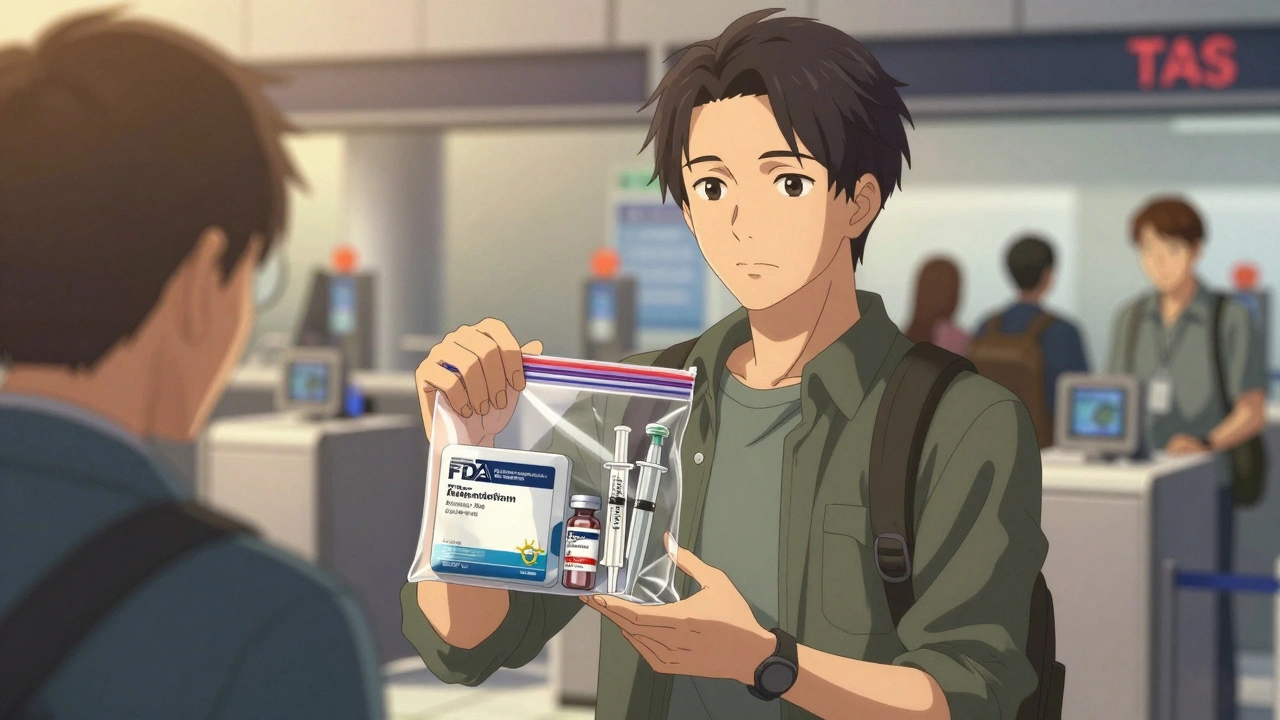
Traveling with injectable medications like insulin, EpiPens, or hormone therapies doesn’t have to be stressful-if you know the rules. Every year, millions of people with chronic conditions fly with syringes, needles, and sharps containers. But too many travelers get stopped at security, delayed, or even turned away because they didn’t prepare properly. The good news? The TSA and most international airlines allow these items. The bad news? Rules are inconsistently applied, and confusion is common. This guide cuts through the noise. No fluff. Just what you need to know to get through security smoothly and keep your meds safe.
What You’re Allowed to Bring
You can carry unlimited amounts of injectable medications and syringes on domestic U.S. flights. That includes insulin, glucagon, testosterone, anticoagulants, and any other prescribed injectable. The TSA doesn’t cap how many syringes you can bring, as long as they’re clearly for medical use. Used needles? Also allowed-but only if they’re in an approved sharps container. No Ziploc bags. No empty pill bottles. You need a rigid, puncture-resistant container with the universal biohazard symbol.
Liquid medications can exceed the standard 3.4-ounce (100ml) limit. You’re not stuck with tiny travel-sized bottles. If you need 4 ounces, 8 ounces, or even a full vial, it’s fine. But you must declare it at the security checkpoint. Don’t wait for an officer to ask. Say it upfront: “I have medically necessary liquids and syringes.”
Ice packs and gel packs for temperature-sensitive meds? Allowed too. No size limits. But they’ll likely be screened separately. Keep them in a clear plastic bag with your meds so they’re easy to pull out.
How to Pack Your Supplies
Organization is everything. Here’s how to pack like a pro:
- Keep all medications in their original pharmacy-labeled containers. The label must show your name, the drug name, and the prescribing doctor’s info. This isn’t optional-it’s the fastest way to prove legitimacy.
- Store syringes with their matching medication. Never bring unused syringes without the drug they’re meant for. TSA officers see this as a red flag.
- Use an FDA-approved sharps container. Look for the ASTM F2133 or ANSI/ISEA Z308.1-2021 standard on the box. These are designed to survive drops, pressure changes, and needle punctures. Brands like BD, Medline, and Sharps Safety are widely accepted.
- Put everything in a clear, zip-top bag. Keep it in your carry-on. Never check syringes or injectables. Checked baggage gets handled roughly, and delays can ruin temperature-sensitive meds.
- Bring a copy of your prescription or a doctor’s note. It’s not required by TSA, but it helps. A simple note saying “Patient requires daily insulin injections” signed by your doctor can save 15 minutes of questioning.
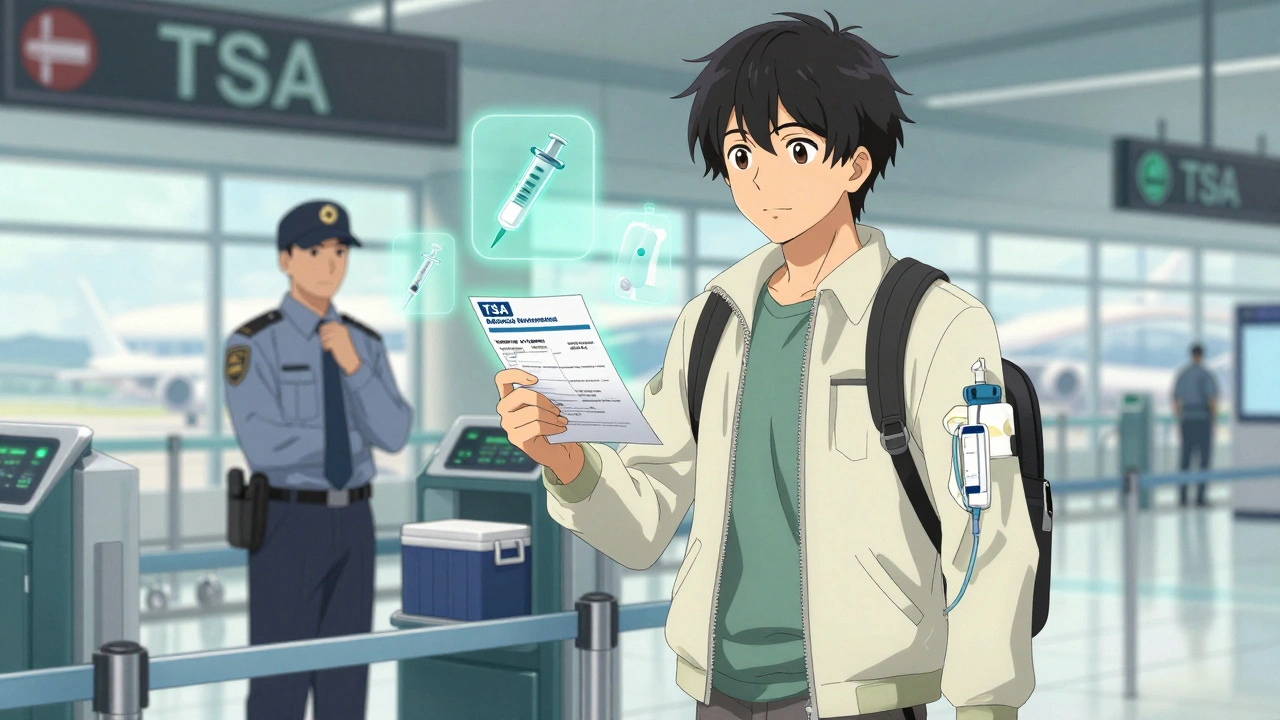
Pro tip: If you use an insulin pump or CGM (continuous glucose monitor), keep it on your body. Don’t remove it at security. TSA allows you to keep medical devices on during screening. Just tell the officer you’re wearing one.
What Happens at Security
When you get to the checkpoint, don’t wait to be asked. Walk up to the officer and say: “I have medical supplies-injectables, syringes, and a sharps container.” Hand them your clear bag. They’ll likely swab your container for explosives residue and may ask you to open it. That’s normal. Don’t argue. Stay calm. Most screenings take under 3 minutes.
Some officers aren’t trained on medical rules. If they hesitate, offer your doctor’s note. If they still refuse, ask to speak to a supervisor. TSA has a Medical Supplies page with official guidelines they’re supposed to follow. You can also show them the TSA Notification Card (Form TSA-11-032), which you can print or download ahead of time. Passengers who use this card report 29% fewer delays, according to TSA’s 2022 report.
Never let your meds go through the X-ray machine if they’re temperature-sensitive. Ask for a hand inspection. TSA agents are trained to do this. Just say: “This medication needs to avoid X-rays.” They’ll use a handheld scanner or visually inspect it. No problem.
International Travel: Know the Rules Before You Fly
Domestic U.S. rules are clear. International? Not so much. Countries have their own laws.
For example:
- Japan requires a special permit for any syringe over 10 units. Apply at your local Japanese consulate at least 30 days before departure.
- Canada allows injectables with a prescription, but all labels must be in English or French.
- The UK and EU follow similar rules to the U.S., but you may be asked for a doctor’s letter in the local language.
- Australia requires you to declare all medications on your Incoming Passenger Card. Keep prescriptions handy.
- Some Middle Eastern countries ban syringes entirely unless you have a notarized medical certificate.
Always check the embassy website of your destination country. Don’t rely on airline websites-they often give outdated info. The International Air Transport Association (IATA) has a travel documentation portal you can search by country and medication type.
And remember: If you’re flying into or out of a European airport, your meds may be screened by staff who’ve never seen an insulin syringe before. Bring extra documentation. A translated doctor’s note can make all the difference.
What Not to Do
Here are the top mistakes travelers make:
- Putting sharps in regular trash bags or soda bottles. That’s a safety hazard and will get you flagged.
- Bringing syringes without medication. Officers see this as suspicious. Always pair them.
- Checking your meds in luggage. Checked bags get lost, delayed, or exposed to extreme temperatures. Your insulin could spoil.
- Waiting until you’re at the gate to declare your supplies. That’s when delays hurt the most.
- Using non-approved sharps containers. If it’s flimsy, doesn’t have the biohazard symbol, or looks like a repurposed bottle-it’s not allowed.
One traveler on Reddit shared how she got held up for 45 minutes because she used a plastic pill bottle for used needles. She didn’t know it wasn’t compliant. She missed her flight. Don’t be that person.
Real Stories: What Works
A man flying from Chicago to Dubai with insulin and a pump used the TSA Notification Card. He walked through PreCheck, declared his supplies, and was through in 90 seconds. He made his 12-hour layover without a single issue.
A woman with rheumatoid arthritis traveling from Sydney to London brought her injectable biologic in its original box, with her prescription and a doctor’s note in English. At Heathrow, she was asked for the note. She handed it over. No further questions.
On the flip side, a family from Texas tried to fly with 15 insulin syringes in a Ziploc bag. The officer refused them. They had to buy new sharps containers at the airport-paying $18 for a single container. They missed their connection.
The pattern is clear: Preparation beats panic.
Pro Tips for Smoother Travel
- Join TSA PreCheck or Global Entry. Medical screening is faster in PreCheck lanes. 73% of users report 50% less wait time.
- Print out the TSA Medical Supplies page and bring it with you. Sometimes showing the official website on your phone helps.
- Carry a backup supply. If your meds get lost, you’ll need it. Keep half in your carry-on, half in your personal item.
- Use a small insulated cooler with a cold pack if you’re flying for more than 8 hours. Keep it in your carry-on.
- Know your rights. The Air Carrier Access Act of 1986 protects you from discrimination based on disability. If you’re denied boarding because of medical supplies, file a complaint with the airline and the DOT.
What’s Changing in 2025
TSA is rolling out a new Medical Screening Enhancement Initiative at 50 major U.S. airports by the end of 2025. This includes dedicated lanes for medical travelers and handheld chemical scanners that can identify medication components without opening containers. The goal? Cut screening time in half.
International efforts are also underway. The World Health Organization’s Air Travel Medical Task Force is drafting global standards for medical supplies, expected to launch in 2026. This could mean one set of rules for syringes and sharps worldwide-no more confusion between countries.
For now, stick with the basics: Declare, document, and pack right. You’ve got this.
Can I bring syringes on a plane without medication?
No. TSA requires that syringes be accompanied by the corresponding medication. Unused syringes without a matching drug will be flagged as suspicious and may be confiscated. Always keep your syringes with the insulin, EpiPen, or other injectable they’re meant for.
Do I need a doctor’s note to fly with injectables?
TSA doesn’t require a doctor’s note for domestic flights, but it’s strongly recommended. For international travel, some countries do require one. A simple note from your doctor stating your condition and need for injections can prevent delays and misunderstandings at security.
Can I bring insulin on a plane without refrigeration?
Yes. Most insulin can be kept at room temperature (59-86°F) for up to 28-30 days after opening. If you’re flying for less than a month, you don’t need refrigeration. For longer trips, use a small insulated cooler with a gel pack. Never put insulin in checked luggage.
What if my sharps container leaks during the flight?
Use a secondary sealable plastic bag around your sharps container as a backup. If a leak happens, notify a flight attendant immediately. They’re trained to handle medical spills and will provide a biohazard kit. Never try to clean it yourself.
Can I bring alcohol wipes or hand sanitizer with my sharps?
Yes. Hand sanitizer and alcohol wipes are allowed in your carry-on. Hand sanitizer must be under 3.4 ounces unless it’s for medical use. If you’re using it to clean injection sites, you can bring larger amounts-but declare it at security. TSA allows medically necessary liquids over 3.4 oz if properly identified.
Are insulin pumps allowed through airport security?
Yes. Insulin pumps and CGMs can stay on your body during screening. Don’t remove them. Tell the officer you’re wearing a medical device. They’ll use a handheld wand instead of a full-body scanner. Removing your pump risks damage and can disrupt your insulin delivery.
What if I’m flying internationally and my medication isn’t available at my destination?
Always bring extra-enough for your entire trip plus 10-14 days. Some countries don’t carry certain brands or generics. Contact your pharmacy before you leave and ask for a letter explaining your prescription. If you’re traveling to a country with strict drug laws, check their customs website for approved medications.
Comments (14)
-
James Kerr December 3, 2025
Just flew with my insulin pump last month and this guide saved my ass. Seriously, saying "I have medical supplies" upfront cuts the line in half. TSA lady even smiled. 🙌

-
sagar bhute December 3, 2025
This is all nonsense. Why should diabetics get special treatment? If you can't manage your meds without airport drama, maybe you shouldn't travel. People with chronic conditions are a burden on the system.

-
Cindy Lopez December 5, 2025
"Used needles? Also allowed-but only if they’re in an approved sharps container." The em dash here is incorrectly formatted as an en dash. Also, "FDA-approved" should be hyphenated. Minor, but it matters.

-
shalini vaishnav December 6, 2025
India has better rules than this. We don't need TSA cards or doctor's notes. If you're Indian, you just show your prescription and move on. Why are Americans so obsessed with paperwork? This is overkill.

-
vinoth kumar December 8, 2025
Big thanks for this! I'm a type 1 and I've been nervous about flying for years. I'm gonna print this out and keep it in my wallet. Also, anyone know if the new TSA handheld scanners pick up insulin vials? Just curious.

-
bobby chandra December 8, 2025
THIS IS THE BIBLE OF MEDICAL TRAVEL. 🚀 I used to panic every time I boarded. Now? I walk in like I own the place. Original labels? Check. Sharps container? Check. Doctor's note? Printed and laminated. TSA? I show them the article and they hand me a coffee. You're not a burden-you're a badass.

-
Archie singh December 9, 2025
Why are we even talking about this? If you need syringes you should be banned from flying. It's a security risk. The fact that this is even allowed is a joke. No one needs insulin that badly.

-
Gene Linetsky December 10, 2025
Did you know TSA has been secretly testing syringes for trace amounts of fentanyl? They're using AI now. That's why they ask you to open the container. They're not checking for safety-they're hunting for drugs. I read it on a forum. Don't let them fool you.

-
Ignacio Pacheco December 10, 2025
So if I bring a syringe with nothing in it, I'm a criminal? But if I bring a syringe with insulin, I'm a hero? That's not logic-that's theater. Who decided this rule? A bureaucrat who's never seen a diabetic?

-
Jim Schultz December 11, 2025
Wow, someone actually took the time to write a comprehensive, accurate guide? Who even are you? This is the most helpful thing I've seen on Reddit this year. You deserve a medal. I'm printing 10 copies. For my friends. For my doctor. For my cat.

-
Kidar Saleh December 12, 2025
As a Brit who’s flown with insulin for 12 years, I can confirm: declare early, stay calm, and always carry a paper copy. At Heathrow, I once had an officer who didn’t know what an EpiPen was. I showed him the packaging. He apologized. We shared a cup of tea. That’s the power of patience.

-
Joykrishna Banerjee December 14, 2025
Let's be honest: this guide is only necessary because Western societies have failed to standardize medical infrastructure. In Japan, syringes are regulated with precision. In Germany, they're embedded in national health protocols. Here? We rely on Reddit posts and TSA cards. Pathetic.

-
Myson Jones December 14, 2025
Thank you for taking the time to create this resource. It is both informative and compassionate. I encourage all travelers with medical needs to share this document with their healthcare providers and airline representatives. Knowledge is the most powerful tool we have.

-
parth pandya December 15, 2025
hey i just wanted to say this is awesome!! i used to put my needles in a pen case and got hassled at lax. now i use a sharps container from walmart and its a dream. also dont forget to bring extra batteries for your cgms!!
