
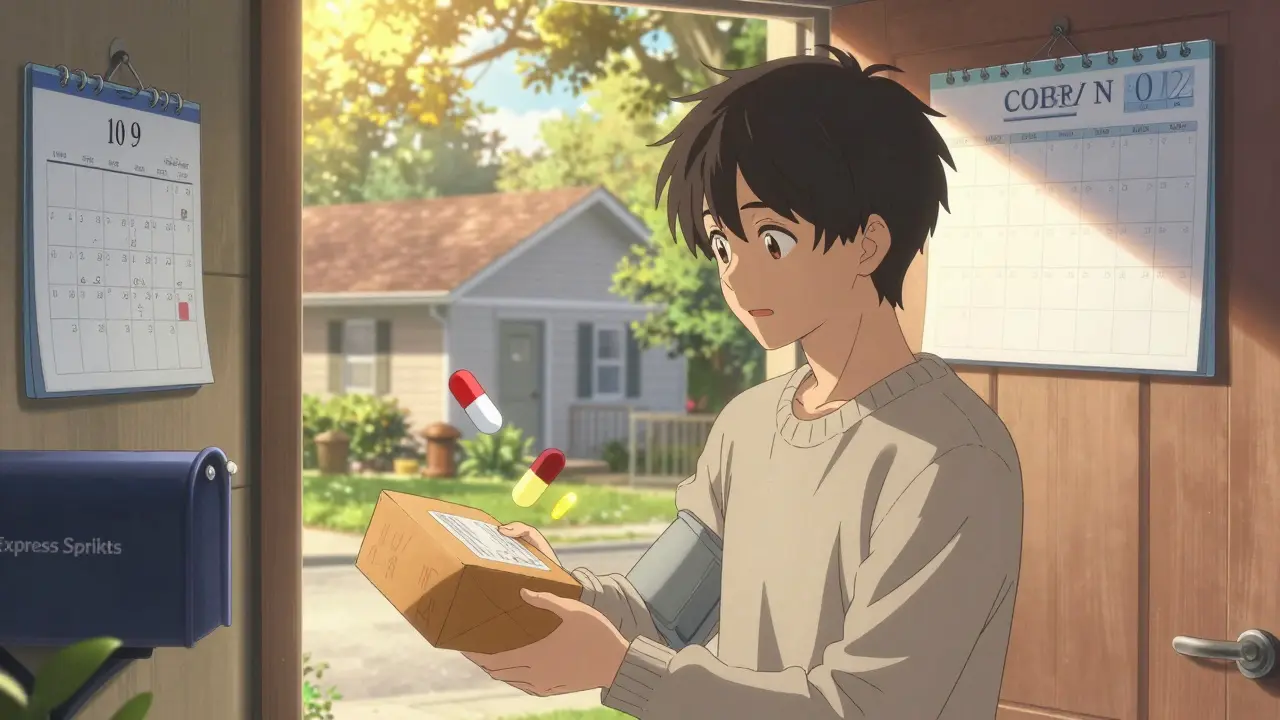
Buying your monthly pills through the mail might sound old-fashioned, but it’s one of the smartest ways to cut drug costs if you take long-term medications. For people on blood pressure pills, diabetes meds, or cholesterol drugs, mail-order pharmacies can save hundreds a year - without you ever stepping into a store. But it’s not perfect. Sometimes your pills get lost. Sometimes you need them now, and waiting five days isn’t an option. So is it worth it? Let’s break down what actually happens when you switch from your local pharmacy to a mail-order service.
How Mail-Order Pharmacies Save You Money
Here’s the simple math: if a 30-day supply of your medication costs $15 at your local pharmacy, a 90-day supply through mail-order usually costs around $30 - not $45. That’s two months’ worth for the price of one. For someone taking three maintenance meds, that’s easily $100-$200 saved every year. Some plans even let you get a 100-day supply for the cost of 60 days, making the savings even bigger.
This isn’t magic. Mail-order pharmacies are run by big pharmacy benefit managers (PBMs) like Express Scripts, CVS Caremark, and OptumRx. They fill thousands of prescriptions a day using automated systems, which cuts labor costs. They also buy drugs in bulk and negotiate lower prices with manufacturers. Because they’re not paying for storefronts, staff, or walk-in traffic, they pass those savings along.
Most health plans - including Blue Cross NC, Sutter Health, and many employer plans - include mail-order as a standard benefit. You don’t pay extra to use it. You just need to choose it as your default for maintenance meds. Many plans even push you toward it by charging more for 30-day retail fills. If your plan doesn’t offer it, ask. Over 89% of Fortune 500 companies already do.
Why People Love It (Besides the Savings)
Convenience is the biggest win. No more driving across town, waiting in line, or rushing to refill before you run out. If you’re elderly, have mobility issues, or live in a rural area with no nearby pharmacy, mail-order is a lifeline. You get your meds delivered to your door, often with all your prescriptions synchronized so they arrive on the same day.
There’s also less room for error. Mail-order pharmacies have automated dispensing systems with error rates of just 0.016%, compared to 0.04% at retail pharmacies. That’s a 60% drop in mistakes. They also run automated checks across all your prescriptions - even ones filled elsewhere - to catch dangerous drug interactions. And yes, pharmacists are available 24/7 by phone if you have questions.
Studies show people who use mail-order are 5-15% more likely to stick with their meds. That’s huge. Skipping pills for high blood pressure or diabetes leads to hospital visits, which cost way more than the meds themselves. Better adherence doesn’t just feel good - it saves the whole system money.
The Downsides: When Mail-Order Doesn’t Work
Mail-order is great for chronic conditions. It’s terrible for anything urgent. Need an antibiotic for a sudden infection? A new painkiller after surgery? A refill for a medication you just started? Forget it. Mail-order takes 5-7 business days to ship. If you’re in pain or sick, you can’t wait. Some people end up paying full price at a retail pharmacy for an emergency refill - wiping out their savings.
Then there’s the delivery risk. About 0.5% of shipments get lost, damaged, or delayed. That’s low, but when it happens to you, it’s a nightmare. One Reddit user reported their blood pressure meds vanished in transit and had to pay $80 out-of-pocket for a same-day refill. Insurance won’t cover that unless you file a claim and wait days for reimbursement.
Not all meds are available. Some biologics, injectables, or specialty drugs still require in-person handling. Cold-chain meds that need refrigeration are slowly being added, but not everywhere yet. And if you’re new to the system, transferring your prescriptions can be messy. Thirty-two percent of new users say they had trouble getting their old prescriptions moved over from their local pharmacy.
Who Benefits the Most?
Mail-order isn’t for everyone. But it’s perfect for people who:
- Take 2 or more maintenance medications every month
- Have stable, long-term conditions like hypertension, diabetes, or thyroid disease
- Live far from a pharmacy or have trouble driving
- Prefer routine and dislike running out of meds
- Want to avoid multiple pharmacy trips each month
If you’re on a tight budget and your meds are expensive, mail-order is one of the easiest ways to cut costs without switching drugs or insurance. It’s also ideal for people on Medicare Part D - federal rules require these plans to offer mail-order options for maintenance drugs.
But if you’re young, healthy, and only need occasional meds - like an antibiotic once a year or a painkiller after an injury - stick with your local pharmacy. The hassle isn’t worth it.
How to Get Started (Without the Headache)
Setting up mail-order is easier than you think. Here’s how:
- Check your health plan’s website or member portal. Look for "mail-order pharmacy," "home delivery," or "PBM."
- Find your PBM (Express Scripts, CVS Caremark, OptumRx). Log in or call their customer service line.
- Have your prescription info ready - drug name, dosage, prescriber, and pharmacy number.
- Choose whether to transfer your current prescription or start fresh.
- Set up automatic refills so you never run out.
Most people finish the setup in under 15 minutes. Your first order will take a week to arrive, so plan ahead. Don’t wait until your last pill is gone. Keep a 5-day buffer.
Use the tracking tools. Express Scripts now offers real-time GPS tracking for every shipment. You’ll know exactly when your box is out for delivery. If it’s delayed, you can call and get it expedited.
What’s Changing in 2025 and Beyond
The mail-order industry is growing fast. Right now, only 12% of maintenance prescriptions are filled this way. But experts predict that number could hit 30-35% by 2030. Why? Because savings add up. UnitedHealth Group estimates if 70% of maintenance meds moved to mail-order, it could save Americans $23.5 billion over the next decade.
New features are rolling out. CVS Caremark announced in March 2025 that they’ll offer same-week delivery to 85% of U.S. addresses. That’s a game-changer for people who need meds faster but still want the savings. Cold-chain delivery for insulin and other temperature-sensitive drugs is also expanding.
But there’s a threat: proposed legislation like the 2023 Lower Drug Costs Now Act could limit how much mail-order pharmacies can charge less than retail. If passed, it could slash patient savings by up to 40%. That’s why the industry is pushing hard to keep the current cost-sharing model intact.
Final Verdict: Should You Switch?
If you take regular meds for a chronic condition - yes, absolutely switch. The savings are real, the safety is better, and the convenience is unmatched. Just make sure you plan ahead. Don’t wait until you’re out. Keep a backup supply. Know your plan’s rules. Use the tracking tools. And never use mail-order for acute or new prescriptions.
If you’re only taking meds once in a while - or you need them right now - stick with your local pharmacy. There’s no shame in that. Mail-order isn’t meant for everyone. But for millions of Americans on long-term meds, it’s the quiet hero of the healthcare system - saving money, preventing hospital stays, and making life just a little easier.
Comments (14)
-
Gray Dedoiko December 24, 2025
I switched to mail-order for my blood pressure meds last year and honestly? Life changed. No more driving 20 minutes in the rain just to get a 30-day supply. Plus, I got a 90-day supply for the price of 60. Saved me like $180 a year. Best decision I made for my health budget.
Only thing? Once my box went missing. Took three days to get it sorted. Annoying, but worth it.

-
Aurora Daisy December 25, 2025
Oh wow, so now we’re glorifying corporate pharmacy giants because they save you $20 a month? Brilliant. Next you’ll tell me Amazon is a healthcare hero because it delivers your insulin faster than your local pharmacist who actually knows your name.
Let’s not pretend this isn’t just another way to cut corners on human care. My grandma’s pharmacist used to call her when her BP was off. Mail-order? They send a tracking link and a robot voice saying ‘your meds are on the way.’

-
bharath vinay December 26, 2025
They’re not saving you money-they’re controlling you. These PBM giants? Express Scripts, OptumRx-they’re all owned by the same insurance conglomerates that also own the drug manufacturers. The ‘savings’? A shell game. They lower your copay so you keep taking the pills, then jack up the drug price behind the scenes.
And don’t get me started on the data they collect. Every pill you take, every refill, every delay-they’re building a profile on your health for sellable analytics. This isn’t convenience. It’s surveillance with a free shipping label.

-
Wilton Holliday December 28, 2025
Hey everyone-big fan of this breakdown. Seriously, if you’re on long-term meds, DO THIS.
My mom’s on 4 prescriptions. She used to forget refills, run out, panic. Now? Automatic refills, synced delivery every 2 weeks, and she gets a little thank-you note from the pharmacy every holiday. It’s sweet.
And yes, the error rate is lower. I checked. They catch interactions I didn’t even know could happen. My dad’s on statins and diabetes meds-turns out one of his OTC supplements was risky. They flagged it. Saved him a hospital trip.
Just set it up early. Don’t wait until you’re out. And use the tracking. It’s wild seeing your meds move across the country in real time.
Also-emoticon for the win: 🙌

-
Raja P December 29, 2025
For me, it’s about peace of mind. I live in a small town with one pharmacy that’s closed on Sundays. If I run out on a weekend? No good. Mail-order means I always have a buffer.
Also, the pharmacist on the line once spent 20 minutes explaining my new med’s side effects. Not a robot. Not a script. A real person who cared.
Not perfect, but way better than the alternative.

-
Austin LeBlanc December 30, 2025
You people are so naive. You think mail-order is ‘convenient’? You’re just letting Big Pharma automate your dependence. You don’t even know who’s filling your pills. Could be some kid in Ohio with zero training. The ‘0.016% error rate’? That’s still 16 mistakes per 100,000 scripts. That’s 16 people getting the wrong dose.
And you’re celebrating this? Get a real pharmacist. One who looks you in the eye. Not some algorithm that says ‘your meds are out for delivery.’

-
Christine Détraz December 30, 2025
I used to hate mail-order until my arthritis made it impossible to drive. Now I get all my meds delivered, and they even send me a monthly wellness checklist. It’s not just about cost-it’s about dignity.
Also, I’ve had two deliveries delayed. Both times, they called me first, offered a free 3-day supply from a local partner, and sent the next one by overnight. That’s customer service.
Don’t let fear of the occasional hiccup stop you from a system that’s clearly better for most people.

-
John Pearce CP December 31, 2025
While the economic efficiencies of mail-order pharmacy distribution are demonstrably superior to retail models, one must not overlook the systemic erosion of interpersonal medical stewardship. The commodification of pharmaceutical care, while fiscally prudent, constitutes a tacit abdication of the Hippocratic principle of personal accountability in patient management.
Furthermore, the reliance upon algorithmic error detection, though statistically favorable, introduces a latent vulnerability wherein contextual clinical nuance-such as patient-specific metabolic variations or psychosocial adherence barriers-is systematically excised from the decision matrix.
Thus, while the savings are quantifiable, the qualitative degradation of therapeutic continuity remains an unaccounted cost.

-
Ajay Sangani January 2, 2026
i think we forget that meds arent just chemicals-theyre part of a routine, a ritual. my grandad used to walk to the pharmacy every month, chat with the pharmacist, ask about the weather. now he gets a box. no one asks how hes doing. just a barcode scan and a delivery notification.
maybe its efficient but… is it human?

-
Pankaj Chaudhary IPS January 2, 2026
In India, we still struggle to get basic medicines reliably in rural areas. So when I see Americans debating whether mail-order is ‘too impersonal,’ I’m reminded how lucky we are to even have the option.
Yes, the human touch matters. But so does access. For millions, mail-order isn’t a luxury-it’s the only way they get their life-saving drugs.
Let’s not romanticize the old system when it failed so many. Progress isn’t perfect. But it’s better than nothing.

-
Payson Mattes January 3, 2026
Wait-so you’re telling me the government doesn’t know every single pill you take through mail-order? Lol. They track your delivery address, your refill patterns, your doctor’s prescribing habits. That data gets sold to insurers, advertisers, even employers.
And you think this is ‘safe’? My cousin got flagged for ‘medication non-compliance’ because he missed a refill during a family emergency. His insurance raised his rates. No one called. No one asked why.
This isn’t convenience. It’s a trap wrapped in a shipping label.

-
Isaac Bonillo Alcaina January 4, 2026
Let’s be clear: mail-order pharmacies are not healthcare providers. They are logistics companies with pharmacists on payroll. Their KPIs are filled scripts, not patient outcomes. The ‘automated interaction checks’? They’re triggered by rigid algorithms that ignore drug-food interactions, renal function, or polypharmacy in elderly patients.
And yet, you treat them like saints because they save you $50 a month? That’s not wisdom. That’s financial Stockholm syndrome.

-
siddharth tiwari January 5, 2026
my sister got her insulin delivered and it was warm when it arrived. she had to throw it out. insurance said ‘sorry, not covered unless you file a claim’ - took 3 weeks to get reimbursed. meanwhile she was injecting expired stuff because she couldn’t afford a new vial.
mail-order is great… until it fails. and when it fails, you’re on your own.

-
suhani mathur January 6, 2026
Wow, you all are acting like mail-order is the end of civilization. I’ve been using it for 5 years. Got my thyroid med, my antidepressant, my blood thinner-all delivered. Never missed a dose. Saved $2,000 a year.
And yes, once my package was late. I called. They overnighted a new one. Free. The pharmacist even sent a voice note saying ‘hope you’re feeling better.’
Stop making it sound like a dystopia. It’s just… a better way to get pills.
