
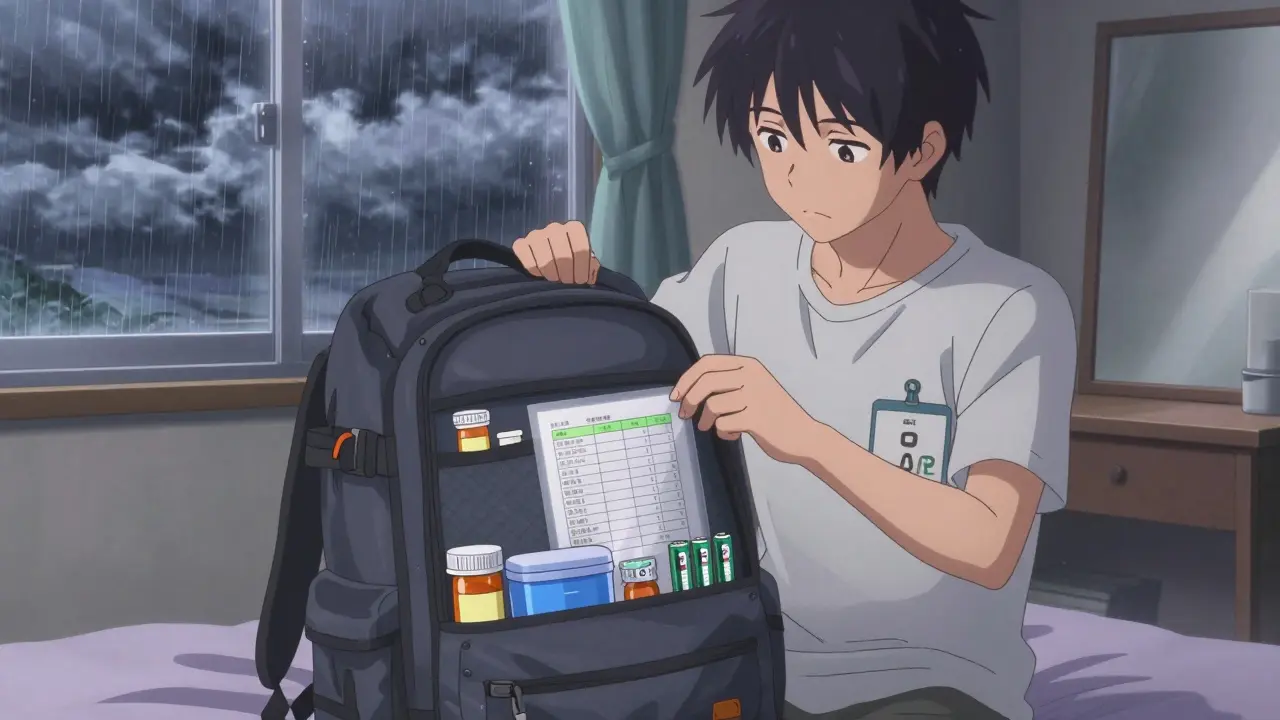
When a storm hits, a fire spreads, or an earthquake shakes your neighborhood, you won’t have time to search for your pills. Your blood pressure medication, insulin, or asthma inhaler could be sitting in a cabinet you can’t reach-or worse, left behind in a flooded house. Medication safety in emergencies isn’t just a good idea; it’s a lifeline. And the simplest way to protect yourself is by building a go-bag that actually works.
Why Your Go-Bag Needs More Than Band-Aids
Most people think of emergency kits as water, flashlights, and canned food. That’s fine-but if you take daily medication, skipping your meds for even a day can land you in the ER. During Hurricane Ida, 23% of evacuees ran out of medicine. Nearly one in three of those cases involved heart or diabetes drugs. That’s not bad luck-it’s preventable. The CDC says 89% of Americans over 65 take at least one prescription. But only 22% of households have a go-bag with enough meds to last through a disaster. That gap isn’t just a gap-it’s a danger zone.What to Put in Your Go-Bag (The Real List)
Forget generic checklists. Here’s what actually matters, based on FEMA, the Red Cross, and real-world emergency reports:- At least 14 days of all prescription meds-not 7. California wildfire survivors and Hurricane Ian evacuees reported running out by day 10. Two weeks is the new minimum.
- Over-the-counter essentials: Pain relievers (like acetaminophen or ibuprofen), antihistamines, antacids, and laxatives. These aren’t optional-they’re your backup when pharmacies are closed.
- Specialty items: Insulin, epinephrine pens, inhalers, seizure meds, or blood thinners. These aren’t just medications-they’re survival tools.
- Temperature control for sensitive drugs: If you use insulin, biologics, or certain antibiotics, heat or freezing can ruin them. Use a Frio Wallet or similar cooling case. The MedAngel ONE sensor (FDA-cleared in 2023) sends phone alerts if your meds get too hot.
- Original prescription bottles: Don’t dump pills into random containers. Labels with names, dosages, and prescribing doctors are critical if you need help in an emergency.
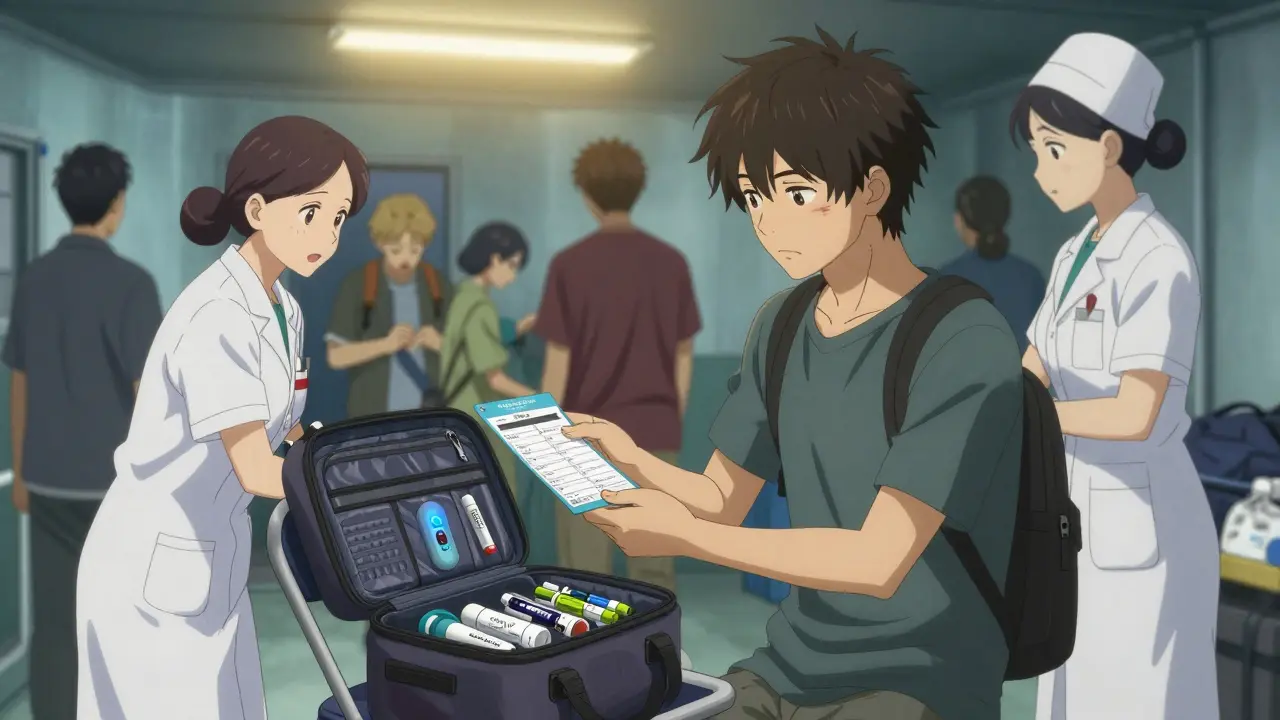
- A printed medication list: Include the drug name, dose, frequency, reason for taking it, and your doctor’s contact. Add allergies and any advance directives. Emergency responders don’t have time to guess.
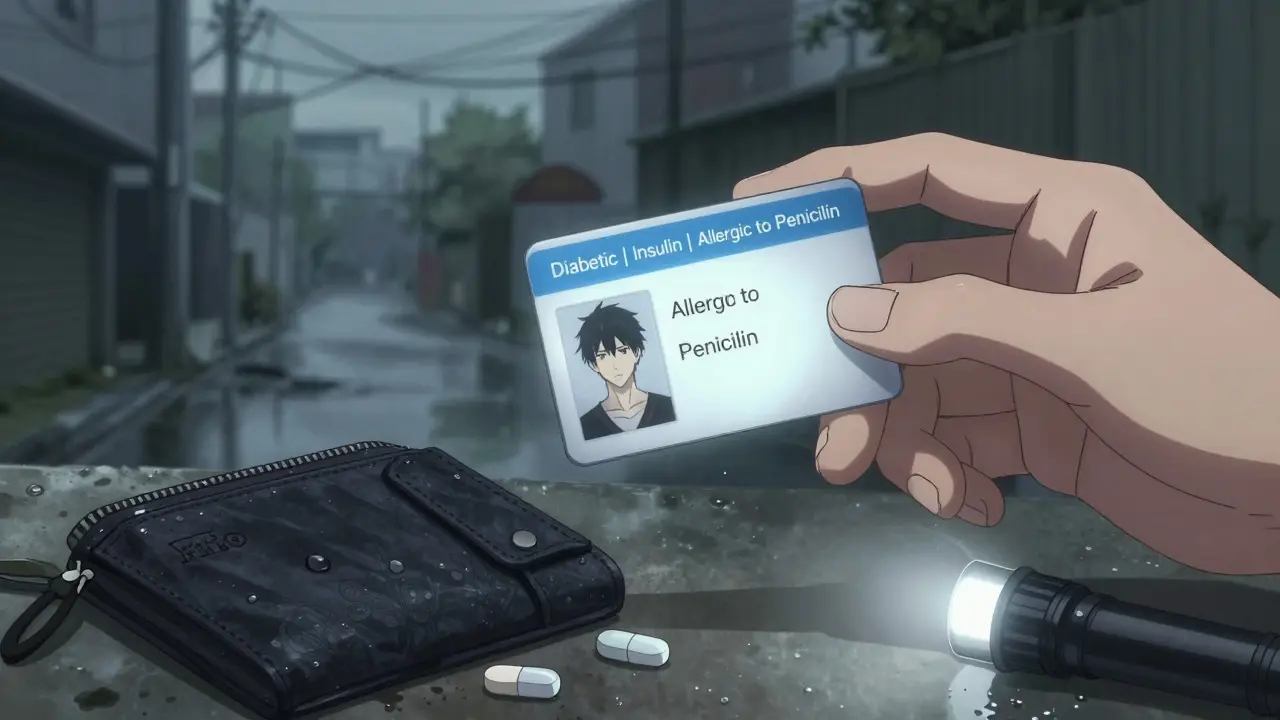
- Medical ID card: A small plastic card in your wallet or attached to your bag with your conditions, meds, and emergency contacts. Keep it waterproof.
- Extra batteries: For nebulizers, insulin pumps, or CPAP machines. Don’t assume you’ll find replacements.
How to Keep Your Meds Safe and Effective
Storing meds wrong can make them useless-or dangerous. Here’s how to do it right:- Store in a dry, cool spot: A bedroom closet shelf, not the bathroom. Humidity kills pills. FEMA recommends keeping your go-bag away from kids but easy to grab.
- Check expiration dates twice a year: Set a reminder for April and October. Expired epinephrine can fail to work. Expired antibiotics might not fight infection.
- Rotate your supply: When you refill your prescriptions, add the new bottles to your go-bag and use the old ones. Never let meds sit for years.
- Ask your pharmacist for 90-day fills: Most insurance allows it. That means you’re not stuck with 30-day supplies that won’t last through a disaster.
- Don’t rely on emergency refills: Yes, 42 states let pharmacists give emergency meds without a new script-but only if the pharmacy is open and has stock. Don’t gamble on that.
Document Everything (Yes, Even Your Allergies)
In the chaos of an evacuation, no one will know your medical history unless you tell them. A 2023 Red Cross testimonial told the story of a woman who avoided a deadly drug interaction because her go-bag had a clear list of meds and allergies. Your list should include:- Full name and date of birth
- Allergies (medications, food, latex)
- Chronic conditions (diabetes, heart disease, epilepsy)
- Current meds and dosages
- Primary care doctor and pharmacy contact info
- Advance directives (if you have them)
Special Cases: Kids, Seniors, and Complex Regimens
If you’re caring for someone with special needs, your go-bag needs extra attention:- For children: Include liquid medications in sealed containers, syringes, and a feeding schedule. Kids can’t tell you they’re out of meds.
- For seniors: Use pill organizers labeled by day and time. Add hearing aid batteries, glasses, and mobility aids if needed.
- For complex regimens: If you take 10+ meds a day, consider a digital app like Medisafe that syncs with your pharmacy. Print a summary and keep it in your bag.
What Not to Do
These mistakes happen more than you think:- Don’t wait until a storm is coming. Geoffrey C. Wall, Pharm.D., says: ‘It’s too late when you’re packing in a rush.’
- Don’t use ziplock bags for insulin. Heat from a car trunk can destroy it in hours.
- Don’t assume your doctor will know you’re out of meds. Hospitals don’t have access to your home pharmacy records.
- Don’t forget cash. ATMs and credit card machines fail during disasters. Keep $100 in small bills in your go-bag.
How Often to Update Your Go-Bag
Treat it like a car inspection. Every six months:- Check expiration dates on every pill, liquid, and device.
- Replace anything expired or damaged.
- Update your medication list if you’ve started or stopped anything.
- Test your cooling case (if you have one) to make sure it still works.
- Recharge any batteries.
- Make sure your bag is still easy to carry. A heavy bag won’t get grabbed in a panic.
What Happens If You Forget Your Go-Bag?
If you’re caught without it, don’t panic-but act fast:- Go to the nearest emergency room. They’re legally required to give you meds to stabilize you.
- Call your pharmacy. Some can provide emergency refills if you’re displaced.
- Reach out to local disaster relief centers. The Red Cross and FEMA often have medication distribution points.
- Use your printed list to explain your needs. It’s your best tool.
But remember-this is damage control. Your go-bag is your first line of defense.
Can I just keep my meds in my car instead of a go-bag?
No. Cars get too hot or too cold. Insulin, epinephrine, and many other drugs break down in extreme temperatures. A go-bag should be kept in a stable environment like a closet or under your bed-not in the trunk.
Do I need to carry all my meds if I’m only evacuating for a day?
Yes. Disasters don’t follow schedules. What starts as a one-day evacuation can turn into a week without power, water, or access to pharmacies. Always plan for the worst-case scenario.
What if I can’t afford a 14-day supply?
Talk to your pharmacist. Many offer free or low-cost samples. Some charities and community health centers help people with chronic conditions stock emergency meds. Ask about patient assistance programs. Even a 7-day supply is better than nothing-build up to 14 days over time.
Should I include vitamins and supplements?
Only if they’re part of your medical treatment. For example, if you take high-dose vitamin D for a diagnosed deficiency, include it. But don’t waste space on daily multivitamins unless your doctor says they’re essential.
Can I use a regular backpack as a go-bag?
Yes-but make sure it’s water-resistant and durable. A cheap backpack can tear or get soaked. Look for one with padded straps and compartments. Some brands make emergency kits specifically designed for meds-check for water-resistant zippers and internal pockets.
What if I live in an apartment and can’t carry a heavy bag?
Keep a lightweight go-bag by your door with your most critical meds: insulin, heart meds, inhalers, epinephrine. Keep a second, smaller bag in your work bag or car with the same essentials. Redundancy saves lives.
Medication safety in emergencies isn’t about being paranoid. It’s about being prepared. You wouldn’t drive without a spare tire. Don’t live without a spare set of meds. Start today. Check your cabinet. Fill your bag. Update your list. And when the next emergency comes-you’ll be ready.
Comments (8)
-
Melissa Cogswell January 30, 2026
I’ve been using a Frio Wallet for my insulin since Hurricane Harvey. It’s a game-changer-keeps it cool even in a sweltering car during evacuations. I also keep a printed list laminated in a ziplock inside my go-bag. No one ever asked for it… until the power went out for 11 days after Ian. Then it saved my life. Don’t wait until it’s too late. Just do it.
Also, if you’re on blood thinners, don’t forget to pack a small bottle of saline. In case you need to flush a port or IV line, and hospitals are overwhelmed. It’s small, but it matters.

-
Diana Dougan January 30, 2026
OMG this post is sooo 2019. Like, who still uses paper lists?? Just put everything in Apple Health or Google Fit. And why 14 days? That’s so extra. I keep my meds in my purse and if the world ends, I’m already dead anyway. 🤷♀️
Also, Frio Wallet? Sounds like a Netflix show. Next you’ll tell me to charge my CPAP with a solar panel. LMAO.

-
Bobbi Van Riet January 31, 2026
My grandma is 82 and on 12 meds, including warfarin and an inhaler. She used to keep them all in a shoebox under her bed-until I sat down with her and made a real go-bag. We used a waterproof duffel, labeled everything in big print, and even added a little notepad for her to write down how she’s feeling each day. She cried when she saw it. Not because it was fancy-but because she finally felt safe.
And yeah, I know some of this seems overkill. But when you’ve watched someone go into cardiac arrest because their beta-blocker ran out during a blackout, you don’t take chances. The Red Cross has free templates for the med list-I’ll DM you the link if you want it. This isn’t about being paranoid. It’s about being a good daughter, a good friend, a good human.
Also, don’t forget to check the expiration on your antihistamines. They lose potency faster than you think, and if you’re allergic to bees? That’s not the day you want to find out.

-
Holly Robin January 31, 2026
THIS IS A GOVERNMENT TRAP. Why do you think they want you to stockpile meds? So they can ration them later. The CDC? They’re in bed with Big Pharma. And who says your meds won’t be stolen from your go-bag during a riot? I saw a video-some guy got mugged for his insulin in Texas. They’re using ‘emergency prep’ as a cover to control us.
Also, why 14 days? Why not 30? Why not 90? Why not just let the feds handle it? They’ve got drones, satellites, and FEMA trucks… but no one’s telling you the real truth: your meds are being tracked. Your pharmacy is sharing your data. You’re being prepped for mandatory dosing.
And don’t even get me started on the MedAngel ONE. That’s a spy device. It sends your vitals to the cloud. Who’s watching? Who’s logging? I’m burning my list and throwing my Frio Wallet in the ocean. #FreeMedications #EndThePharmaControl

-
Shubham Dixit February 1, 2026
What a waste of time. In India, we don’t need 14-day supplies. We have pharmacies on every corner. Even during floods, someone sells you your medicine. Why are Americans so weak? You have so much, yet you panic over pills. In my village, if your father runs out of blood pressure medicine, he walks 5 km to the clinic and gets it for free. No Frio Wallet. No laminated lists. Just faith and family.
You think your go-bag saves you? In a real disaster, the first thing people grab is food, water, and their children-not their insulin. You are overcomplicating survival. Your problem is not lack of meds. Your problem is lack of resilience.
Also, why are you writing in English? You live in America. Learn to be tough. Stop buying gadgets. Start living.

-
KATHRYN JOHNSON February 1, 2026
There is no legitimate reason to store medications in a go-bag. The FDA has explicitly stated that unregulated storage conditions may render pharmaceuticals unsafe. This post encourages non-compliant behavior. Furthermore, the suggestion to use waterproof paper contradicts CDC guidelines on document preservation during extended disasters. You are promoting a false sense of security.
Additionally, the notion that emergency responders rely on printed lists is dangerously misleading. Hospitals use national electronic health record systems. If you are unable to access your records, that is a systemic failure-not a personal one.
Stop spreading misinformation. This is not preparedness. This is fearmongering dressed as advice.

-
Sidhanth SY February 3, 2026
Big respect to the author. I’m from India, but I live in Chicago now. I used to think this was overkill… until my neighbor had a stroke during the power outage last winter. He had his meds in a bag by the door, and the paramedics didn’t have to guess. I got my own go-bag together after that.
Also, I keep a small power bank with a USB charger for my Medisafe app. It’s not just about the pills-it’s about the memory. When you’re stressed, you forget your own name. A printed list + a phone backup? That’s peace of mind.
And yeah, I keep $50 in my bag too. ATMs were down for three days. Cash saved my grocery run. Don’t sleep on the little stuff.

-
Yanaton Whittaker February 3, 2026
bro i just keep my insulin in my jacket pocket and pray 😭🙏
also why is everyone so extra?? i live in a hurricane zone and my go-bag is a duffel with chips, water, and my inhaler. that’s it. if i die, i die. life’s short. 🤷♂️
